



Women Reservation Bill Fails in Lok Sabha
|
General Studies Paper II: Indian Constitution and Statutory Bodies, Parliament, Equality & Development |
Why in News?
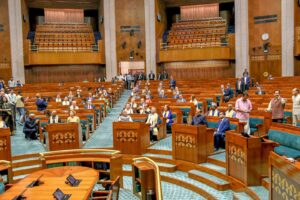
Recently, the Women’s Reservation Bill failed in Lok Sabha as the Constitution (131st Amendment) Bill, 2026 could not secure the required two-thirds majority, despite aiming to operationalise the already enacted Constitution (106th Amendment) Act, 2023 on women’s quota.
Women’s Reservation Bill: Provisions and Amendment Linkage
-
- Provisions: Popularly known as the Nari Shakti Vandan Adhiniyam ((Constitution (106th Amendment) Act, 2023)), this Act mandates 33% (one-third) reservation for women in the Lok Sabha, State Legislative Assemblies, and the Delhi Legislative Assembly.
- It specifically inserts Articles 330A and 332A to provide horizontal reservation, ensuring that one-third of seats already reserved for Scheduled Castes (SCs) and Scheduled Tribes (STs) are allocated to women.
- The Act also includes a 15-year “sunset clause”, after which the reservation expires unless extended by Parliament.
- Provisions: Popularly known as the Nari Shakti Vandan Adhiniyam ((Constitution (106th Amendment) Act, 2023)), this Act mandates 33% (one-third) reservation for women in the Lok Sabha, State Legislative Assemblies, and the Delhi Legislative Assembly.
- Implementation Condition: The most defining condition of the 2023 Act is Article 334A, which stipulates that the reservation will only take effect after an exercise of delimitation is conducted.
- This exercise can only be undertaken after the relevant figures of the first census conducted after the Act’s commencement are published.
-
-
- Since India’s last Census was conducted in 2011, and the 2021 Census has been delayed, the law remains non-operational as of now.
- This creates a constitutional deferment, despite enactment, no immediate reservation is available in upcoming elections.
- As the next census is scheduled to be conducted between 2026 and 2027, actual implementation was projected to be delayed until the 2034 General Elections.
-
- Amendment Linkage: The Constitution (131st Amendment) Bill, 2026 was introduced to operationalise or modify conditions tied to the 106th Amendment.
- This Bill sought to bridge the implementation gap by removing the requirement to wait for a post-2023 census.
-
- It proposed enabling delimitation using the 2011 Census data to operationalise women’s reservation before the 2029 General Elections.
- It proposed raising the maximum strength of the Lok Sabha from 550 to 850, with 815 seats for states and 35 for Union Territories.
- It sought to amend Article 82 to allow Parliament to determine which census is used for delimitation, rather than relying on the first census after 2026.
Constitution (131st Amendment) Bill Failed Lok Sabha Test
- Legal Requirements: As a constitutional amendment under Article 368, the Bill required a Special Majority in the Lok Sabha.
- This mandates a majority of the total House membership and at least two-thirds of the members present and voting.
- With 528 members present, the required threshold for passage was 352 votes.
- Because the bill significantly altered the federal structure—specifically state representation—it would have required ratification by at least 50% of State Legislatures
- Voting Outcomes: During the final vote, the Bill secured 298 votes in favour and 230 against.
- While it achieved a simple majority, it fell 54 votes short of the mandatory two-thirds benchmark.
- Consequently, the Speaker declared the motion lost, leading the government to immediately withdraw the companion Delimitation Bill, 2026 and the Union Territories Laws (Amendment) Bill.
- Reasons: The primary driver of the failure was the intense debate over delimitation.
- Opposition parties, particularly from Southern, Eastern, and North-eastern states, argued that using 2011 Census data to expand the Lok Sabha to 850 seats would “punish” states that successfully implemented population control.
- Projections indicated that states like Kerala and Tamil Nadu would see their relative political influence diminish compared to Northern heartland states like Uttar Pradesh and Bihar.
- Parties like the Samajwadi Party and AIMIM opposed the bill because it did not include specific reservations for OBC and Muslim women.
- The bill was criticized for providing the Union government excessive power to decide the timing of delimitation and which census to use through simple law, weakening the role of the Rajya Sabha.
|
Note: The 131st Amendment’s failure prevents decoupling the women’s quota from census data. Consequently, implementation remains stalled under Article 334A, awaiting the next census and delimitation exercise. |
Possible Next Steps by Govt on Women’s Reservation
- Reverting to 2023 Law: Since the Constitution (106th Amendment) Act, 2023 failed, the government can proceed under the original 2023 Act, which stipulates that reservation will take effect after a new Census (projected for 2027) followed by a delimitation exercise.
- Addressing Opposition Demands: Opposition leaders, including Rahul Gandhi, demand the 33% quota be implemented immediately within the existing 543 Lok Sabha seats. They insist on decoupling reservation from delimitation and seat expansion (which proposed increasing seats to 850).
- Sending a Revised Bill to a Joint Select Committee: To break the legislative deadlock, the government could reintroduce a revised version of the bill and refer it to a Joint Select Committee for detailed scrutiny.
- This process would allow for cross-party negotiations on contentious issues like regional representation for southern states and the timing of the next Census.
|
Also Read: Women’s Reservation Act 2023 Came Into Force |