




Harivansh Re-elected Rajya Sabha Deputy Chairman
|
General Studies Paper II: Parliament, Indian Constitution |
Why in News?
Recently, Harivansh Narayan Singh was re-elected unopposed as Rajya Sabha Deputy Chairman for a historic third consecutive term, becoming the first nominated member to hold the post.
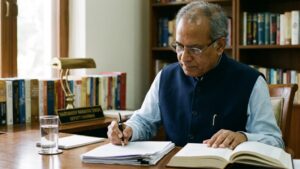
Who is Harivansh Narayan Singh?
- About: Harivansh Narayan Singh (born 30 June 1956) is a distinguished Indian journalist-turned-politician currently serving as the 13th Deputy Chairman of the Rajya Sabha.
- Early Life: Harivansh was born in the Sitab Diara village of Ballia district, Uttar Pradesh—the same birthplace as the legendary socialist leader Jayaprakash Narayan.
- His early education took place under a neem tree in his village, fostering a deep connection to ground realities.
- He later moved to Varanasi to attend Banaras Hindu University (BHU), where he earned a Master’s in Economics and a Diploma in Journalism. During his college years, he was deeply influenced by the socialist movements of the 1970s.
- Media Career: Before entering politics, Harivansh spent over four decades in journalism.
- He began as a sub-editor at the weekly magazine Dharmyug (1977–1981) and later worked with Ravivar.
- His most significant contribution was as the Editor-in-Chief of Prabhat Khabar starting in 1989.
- He transformed it into one of the top Hindi dailies in India, expanding its circulation from a few hundred to nearly 8 lakh copies across Bihar, Jharkhand, and West Bengal.
- Political Ascent: His political journey began with an appointment as the Additional Media Advisor to former Prime Minister Chandra Shekhar in 1990.
- In 2014, he was first elected to the Rajya Sabha as a representative of the Janata Dal (United) from Bihar.
- First elected as Deputy Chairman in August 2018, he won a contested election with 125 votes.
- He was re-elected in September 2020, known for his balanced and dignified presiding style.
- His tenure is marked by a commitment to parliamentary values and the belief that healthy debate is the cornerstone of democracy.
- In April 2026, after his elected term ended, he was nominated to the Upper House by President Droupadi Murmu under the “Journalism” category, filling the vacancy left by former Chief Justice Ranjan Gogoi.
- On 17 April 2026 he was re-elected unopposed for a historic third consecutive term, becoming the first person since 2004 to achieve this feat and first nominated member to hold the post.
About Deputy Chairman of Rajya Sabha
-
- Constitutional Basis: The position is established under Article 89, which mandates that the Council of States shall choose one of its members to be the Deputy Chairman.
- Unlike the Chairman, who is not a member of the House, the Deputy Chairman is internally elected by the Rajya Sabha MPs.
- Position: The Deputy Chairman of the Rajya Sabha is a crucial constitutional authority in the Indian Parliamentary system, serving as the second-highest presiding officer of the Upper House.
- He is not subordinate to the Chairman and is directly responsible to the Rajya Sabha.
- Election Procedure: The Deputy Chairman is elected by members of the Rajya Sabha from among themselves through a simple majority vote.
- The election is conducted by the Secretary-General of Rajya Sabha, and candidates are usually nominated by political parties.
- Often, there is an attempt to build consensus across parties, though elections can be contested.
- Powers and Responsibilities: The Deputy Chairman presides over the House when the Chairman’s office is vacant or when the Vice President is acting as the President of India.
- While presiding, they exercise all powers of the Chairman, including interpreting rules, maintaining discipline, and regulating debates.
- They can adjourn proceedings, suspend members, and ensure adherence to parliamentary rules.
- The Deputy Chairman often chairs key Parliamentary Committees, such as the Committee on Privileges.
- They also play a vital role in international forums, representing the Indian Parliament in delegations and the Inter-Parliamentary Union (IPU).
- Panel of Vice-Chairpersons: The Deputy Chairman works alongside the Panel of Vice-Chairpersons, nominated by the Chairman.
- In the absence of both Chairman and Deputy Chairman, these panel members preside. However, the Deputy Chairman remains the primary substitute authority.
- Voting Rights: When not presiding, the Deputy Chairman acts as an ordinary member and can participate in debates and vote initially on any issue.
- However, while in the Chair, they cannot vote in the first instance and only exercise a casting vote to break a tie, ensuring the neutrality of the presiding officer.
- Constitutional Basis: The position is established under Article 89, which mandates that the Council of States shall choose one of its members to be the Deputy Chairman.
- Salary and Allowances: The salary and allowances of the Deputy Chairman are determined by Parliament under the Salaries and Allowances of Officers of Parliament Act, 1953.
-
-
- Their salary and allowances are charged to the Consolidated Fund of India.
-
- They receive pay, housing, staff, and other benefits comparable to senior constitutional authorities
- Tenure and Removal: The tenure is typically six years, co-terminus with their Rajya Sabha membership.
-
- The Deputy Chairman holds office until he ceases to be a member of the Rajya Sabha, resigns, or is removed by the House.
- A Deputy Chairman can be removed by a resolution passed by an effective majority (majority of the then members), provided at least 14 days’ notice is given for the resolution.
- Based on Articles 96, the Deputy Chairman of Rajya Sabha cannot preside over the House while a resolution for their removal is under consideration.
- List of Notable Past Holders: The inaugural holder was S. V. Krishnamoorthy Rao (1952). Other prominent figures include Najma Heptulla, the longest-serving Deputy Chair, and Pratibha Patil, who later became the President of India.
|
Also Read: Rajya Sabha Election Process |