



India Approves SAARC Swap for Maldives
|
General Studies Paper II: India and its Neighbourhood Relations |
Why in News?
Recently, India approved a ₹30 billion currency swap withdrawal for Maldives under the SAARC Currency Swap Framework, boosting financial stability and supporting foreign exchange reserves.
What is SAARC Currency Swap Framework?
- About: The SAARC Currency Swap Framework is a financial arrangement operated by the Reserve Bank of India (RBI) that allows central banks of SAARC countries to exchange currencies under pre-agreed terms.
- It acts as a short-term liquidity support mechanism to address foreign exchange shortages and stabilize economies.
- Background: The framework was launched on 15 November 2012 as part of regional financial cooperation.
- It has been periodically revised, with the latest framework covering 2024–2027, reflecting evolving economic needs.
- Objective: Its primary objective is to provide a “backstop line of funding” for short-term foreign exchange liquidity and to help countries manage Balance of Payments (BoP) crises until long-term solutions are arranged.
- Mechanism: The RBI signs bilateral swap agreements with SAARC central banks.
- Countries can draw funds in Indian Rupee (INR), US Dollar (USD), or Euro (EUR).
- The framework includes a ₹25,000 crore INR swap window and a $2 billion USD/Euro corpus, ensuring flexibility and liquidity access.
- Coverage: The facility is available to all SAARC member countries—including India, Maldives, Sri Lanka, Bangladesh, Nepal, Bhutan, Pakistan, and Afghanistan—subject to signing agreements with RBI.
- Risk Mitigation: Transactions carry no exchange rate risk. Terms are fixed in advance, protecting smaller economies from market volatility during financial stress.
- Tenor: Drawals are typically for a three-month tenor. The framework allows for a maximum of two rollovers, providing flexible interim support to central banks.
SAARC Currency Swap with Maldives
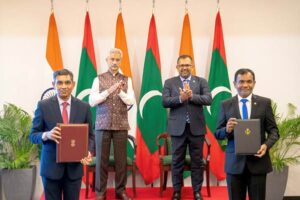
- 2024-2027 Agreement: On October 7, 2024, the RBI and the Maldives Monetary Authority (MMA) signed a new agreement under the revised SAARC Currency Swap Framework.
- This deal, finalized during President Mohamed Muizzu’s state visit to New Delhi, remains valid until June 18, 2027.
- The agreement provides two distinct funding channels for the Maldives. It includes a USD/Euro Window allowing access to $400 million and a dedicated INR Window providing up to ₹30 billion (approximately $357 million).
- In April 2026, India approved the first withdrawal of ₹30 billion under the INR Swap Window. This funding was released to reinforce macroeconomic stability amid evolving global uncertainties.
- Historical Aggregate Support: Since the framework’s inception in 2012, the RBI has provided a cumulative total of $1.1 billion in swap support to the Maldives.
- This makes the island nation one of the most consistent beneficiaries of India’s regional safety net.
- Coinciding with the new rupee drawdown, the Maldives successfully settled a previous $400 million swap facility on April 24, 2026.
- Local Currency Promotion: Beyond standard swaps, both central banks signed a Memorandum of Understanding in late 2024 to promote the use of Indian Rupee (INR) and Maldivian Rufiyaa (MVR) in cross-border trade.
- In addition to currency swaps, India has provided other forms of relief, such as rolling over $100 million in Treasury Bills for the Maldives in 2023.
- These combined measures help manage the nation’s debt-to-GDP pressures while ensuring essential imports.
Significance of Maldives for india
- Strategic Location in the Indian Ocean: The Maldives lies along major Sea Lines of Communication (SLOCs) in the Indian Ocean Region (IOR), through which nearly 80% of India’s crude oil imports pass.
- Its proximity—about 700 km from Lakshadweep—makes it critical for monitoring maritime traffic and ensuring energy and trade security.
- Maritime Security and Defence Cooperation: Maldives is central to India’s maritime security architecture. India assists through coastal radar systems, joint EEZ surveillance, and defence training.
- The archipelago’s location helps India counter piracy, terrorism, and illegal trafficking, strengthening net security provider status in the IOR.
- Collaborative efforts include the trilateral Exercise Dosti, coastal radar networks, and the UTF Naval Harbor project to enhance maritime domain awareness.
- Geopolitical and Strategic Competition: Maldives holds significance amid growing China’s presence in the Indian Ocean.
- India’s engagement—through infrastructure, defence, and financial aid—aims to balance external influence and maintain strategic dominance in its immediate neighbourhood under the Neighbourhood First Policy.
- Economic and Trade Relations: India is a key trading partner, with bilateral trade crossing $500 million annually.
- India exports essential commodities like food, medicines, and construction materials.
- It also provides lines of credit and currency swaps, ensuring Maldives’ economic stability.
- Developmental and Humanitarian Assistance: India is one of the largest development partners of Maldives, supporting projects like Greater Malé Connectivity Project (GMCP) worth $500 million.
- Other key projects include the Hanimadhoo International Airport redevelopment and over 4,000 social housing units handed over in 2025.
- India also provides disaster relief, medical support, and capacity building, reinforcing strong developmental ties.
- People-to-People Links: There are deep historical, cultural, and educational ties, with many Maldivians seeking education and healthcare in India.
- Tourism and diaspora connections enhance soft power influence, making Maldives vital for India’s regional diplomacy and outreach.
- India was the top source market for Maldivian tourism from 2020 to 2023, contributing 11.2% of total arrivals in 2023.
|
South Asian Association for Regional Cooperation (SAARC):
|
|
Also Read: Maldives President’s Visit to India |