Agni-VI Ballistic Missile Project
|
General Studies Paper III: Defence Technology, Achievements of Indians in Science & Technology |
Why in News?
Recently, DRDO confirmed that the organization is technically prepared to proceed with the full-scale development of the Agni-VI, awaiting formal approval from the Government to move to the next phase.
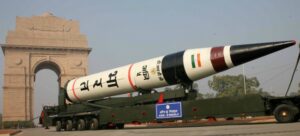
What is Agni-VI Ballistic Missile?
- About: The Agni-VI is a next-generation Intercontinental Ballistic Missile (ICBM) currently being developed by India’s DRDO.
- Classification: The Agni-VI is classified as an Advanced ICBM, designed to serve as the most potent land-based pillar of India’s Nuclear Triad.
- Its primary goal is to provide a robust second-strike capability under India’s “No First Use” policy.
- Operational Strike Range: This missile is engineered for a strike range of 10,000 km to 12,000 km.
- MIRV Technology: A defining feature is the Multiple Independently Targetable Re-entry Vehicle (MIRV) capability.
- It is expected to carry 10 to 12 nuclear warheads, each capable of striking different targets simultaneously.
- Payload Capacity: The Agni-VI is designed to carry a massive 3-tonne payload, nearly double that of the Agni-V.
- This heavy throw-weight supports multiple warheads or massive bunker-buster munitions.
- Propulsion System: It utilizes a four-stage solid-fuel rocket engine. This solid propellant ensures high reliability, lower maintenance, and a rapid response time.
- Launch Platforms: The system is designed for extreme versatility, capable of being launched from road-mobile launchers, rail-mobile platforms, or submarines (SLBM variant).
- Maneuverable Re-entry Vehicles: To evade advanced missile defense systems like THAAD or S-500, it incorporates Maneuverable Re-entry Vehicles (MaRV).
- These warheads can change trajectory during the terminal phase to confuse interceptors.
- Physical Dimensions: It is estimated to be 20 to 40 metres in length with a diameter of 2 metres.
- The use of lightweight composite materials is intended to keep the total mass between 55,000 and 70,000 kg.
- Speed and Re-entry: During its terminal phase, the missile is expected to reach speeds up to Mach 24 (approx. 29,400 km/h).
- Development Status: The missile design was finished in 2025, full-scale production and testing are awaiting the formal Cabinet Committee on Security (CCS) nod as of late April 2026.
Strategic Significance
- Shift to Global Power Projection: Unlike the Agni-V, which primarily addressed the regional threat from China, the Agni-VI’s 10,000 km to 12,000 km range elevates India to a global strike power.
- This range allows India to hold targets in Europe, Africa, and North America at risk, moving beyond a “China-centric” deterrent to one that influences global strategic stability.
- Neutralizing Advanced Missile Defenses: By utilizing Maneuverable Re-entry Vehicles (MaRV) and radar-absorbent coatings, it is engineered to evade modern interceptors like China’s HQ-19 or the US THAAD.
- This ensures a credible deterrent even against adversaries with top-tier defensive shields.
- MIRV-Led Deterrence Calculus: The leap from carrying a single warhead to 10–12 MIRV warheads fundamentally changes the defense equation.
- This asymmetric advantage forces competitors to significantly increase their defense spending, effectively altering cost-benefit analysis of any potential conflict.
- Stabilizing the Indo-Pacific Balance: Agni-VI acts as a counterweight to China’s DF-41 and DF-5A systems. By matching the reach of its rivals, India discourages nuclear brinkmanship and promotes a more balanced Indo-Pacific security architecture.
- Global Power Status: By advancing Agni-VI, India strengthens its position among elite nuclear powers possessing ICBM and MIRV technologies (USA, Russia, China), enhancing its strategic autonomy and global bargaining power in nuclear geopolitics.
|
About Agni Missile Series:
|
|
Also Read: India Successfully Tests Agni-III Nuclear-Capable Missile |