




India Tests Agni-5 MIRV Technology
|
General Studies Paper III: Defence Technology |
Why in News?
Recently, India successfully tested an advanced Agni-5 missile equipped with MIRV technology, significantly strengthening India’s strategic deterrence and regional defence posture.
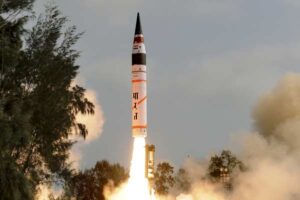
What is Advanced Agni-5 Missile?
- About: The advanced Agni-5 is an Intermediate-Range Ballistic Missile (IRBM), though its range of 5,000–5,800 km effectively gives it ICBM-class reach.
- It is the most sophisticated variant in the Agni series, designed for long-range strategic strikes.
- It is a state-of-the-art, nuclear-capable surface-to-surface ballistic missile.
- Objective: Its core mission is to provide credible minimum deterrence under India’s “No First Use” policy.
- It ensures a robust second-strike capability by allowing a single launch to neutralise multiple strategic targets.
- Developer: The missile was designed and developed by the Defence Research and Development Organisation (DRDO), specifically laboratories like ASL, DRDL, and RCI, with manufacturing support from Bharat Dynamics Limited (BDL).
- Dimensions: The missile stands approximately 17.5 metres tall with a diameter of 2 metres.
- It has a launch mass of roughly 50,000 to 56,000 kg and can carry a payload (warhead) weighing up to 1.5 tons.
- Propulsion System: It employs a three-stage, solid-fuelled rocket motor. Solid propellants allow for long-term storage and rapid deployment, as they do not require fueling immediately before a launch.
- MIRV Technology: The latest “advanced” iteration features MIRV (Multiple Independently Targetable Re-entry Vehicle) capability, enabling one missile to carry 4 to 5 nuclear warheads.
- Each warhead can be programmed to hit different targets spread across hundreds of kilometres simultaneously.
- The maiden MIRV test, titled “Mission Divyastra”, was conducted in March 2024 from Dr. APJ Abdul Kalam Island.
- A subsequent advanced follow-through test on May 8, 2026, successfully validated multi-payload targeting in the Indian Ocean.
- This marks India’s entry into the elite group of nations possessing MIRV technology.
- Navigation: It utilizes a high-precision Ring Laser Gyro-based Inertial Navigation System (RLG-INS) coupled with Micro Inertial Navigation (MINGS).
- These systems interact with NavIC (Indian GPS) to achieve a Circular Error Probable (CEP) within tens of meters.
- Launch Platform: The system is canisterized, meaning the missile is stored and launched from a sealed container on a road-mobile or rail-mobile launcher.
- This significantly increases survivability and reduces launch preparation time.
- Terminal Speed: Upon re-entering the atmosphere, the warheads reach hypersonic speeds of up to Mach 24 (approx. 29,400 km/h).
- This extreme velocity, combined with potential evasive manoeuvres, makes interception by missile defence systems nearly impossible.
Significance
- BMD Saturation Capability: The most critical advancement is the ability to bypass Ballistic Missile Defence (BMD) systems.
- The missile forces an adversary’s interceptors to track and engage several targets simultaneously, making a comprehensive defense cost-prohibitive and technically overwhelming.
- Hardened Target Penetration: Unique to the latest configuration is its potential bunker-buster capability.
- Reports suggest the Agni-5 is engineered to penetrate up to 100 meters of reinforced concrete at high impact velocities.
- This allows for precise, deep strikes against hardened command centers and underground silos that were previously unreachable.
- Exo-Atmospheric MIRV Sophistication: Unlike regional competitors, India’s MIRV system utilizes a true exo-atmospheric bus.
- It dispenses warheads at optimal altitudes outside the atmosphere, providing a wider spatial distribution across hundreds of kilometers.
- Strategic Signal: The timing of tests like Mission Divyastra—conducted while tracking vessels were in range—serves as a high-visibility political signal of India’s “not to be trifled with” status.
- It recalibrates the Asian strategic balance by ensuring retaliatory power remains intact under any first-strike scenario.
- Transition to Agni-6: The Agni-5 serves as the technological testbed for the upcoming Agni-6.
- The validation of its MIRV and three-stage solid propulsion paves the way for a next-generation ICBM expected to have a range of 8,000–12,000 km and carry up to 10 warheads.
- Nuclear Triad: The missile plugs a critical gap in the land-based leg of the nuclear triad. When combined with the Arihant-class submarines and K-4 missiles, it matures India’s posture into a survivable, layered retaliatory force that ensures assured, punitive retaliation.
- Global Standing: With the successful MIRV trials, India joined an exclusive “strategic club” that includes the US, Russia, China, UK, and France.
- The missile effectively covers the entire Asian continent and parts of Europe and Africa.
|
Intermediate-Range Ballistic Missiles:
|
|
Also Read: India Successfully Tests Agni-III Nuclear-Capable Missile |