



Kusha Missile System – DRDO Tests Kusha LRSAM Missile Successfully
| General Studies Paper III: Defence Technology, Indigenization of Technology |
Why in News?
Recently, DRDO successfully conducted the maiden flight test of the indigenous Kusha Long-Range Surface-to-Air Missile System, strengthening India’s layered air-defence capabilities.
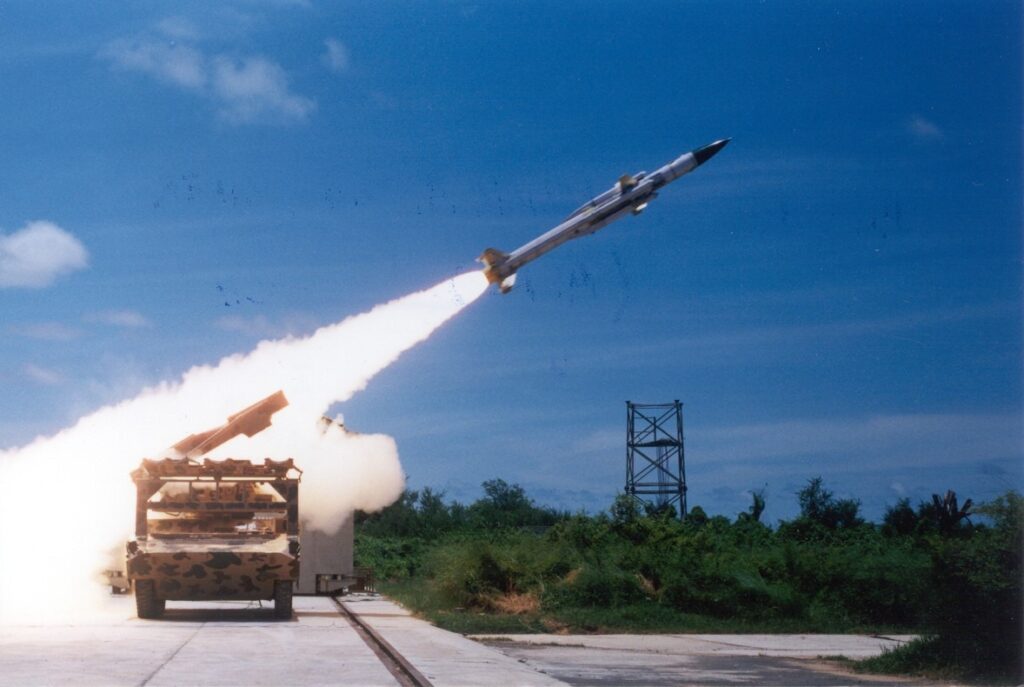
What is Kusha Missile system?
- About: Kusha is an indigenous Long-Range Surface-to-Air Missile (LRSAM) air-defence system developed to intercept aerial threats at long distances.
- It is also called an Extended Range Air Defence System (ERADS).
- It is a multi-layered area air-defence system designed for the Indian Air Force (IAF) under Project Kusha.
- Project Kusha is India’s programme to develop a fully indigenous long-range air-defence shield.
- The project includes three interceptor variants covering different engagement ranges to create layered air defence.
- The project was approved in 2022, while procurement received Acceptance of Necessity (AoN) in 2023.
- A budget outlay of ₹21,700 crore was approved to procure five initial squadrons for the Indian Air Force.
- Developed By: The system is being developed by the Defence Research and Development Organisation (DRDO) with Bharat Electronics Limited (BEL) serving as a major development and integration partner.
- Features:
- Multi-Layer Interceptor Family: The system uses three interceptor missiles—M1, M2 and M3. Their planned engagement ranges are approximately 150 km, 250 km and 350 km-400 km.
- High Speed: These advanced interceptors are projected to achieve operational speeds reaching approximately Mach 5.5.
- Wide Target Coverage: Kusha is designed to engage fighter aircraft, surveillance aircraft, cruise missiles, armed drones and helicopters. It focuses on defeating a broad spectrum of aerial threats through long-range interception.
- Network-Centric Architecture: The system integrates long-range surveillance radars, Integrated Air Command and Control System, and communication links into a single network, enabling coordinated target detection.
- Mobile Deployment: Kusha is designed as a road-mobile air-defence system. Its launchers, radars and command vehicles can be deployed rapidly and relocated according to operational requirements.
- Indigenous Technologies: The programme incorporates indigenous 3D long-range surveillance radars, seeker, guidance, propulsion and fire-control technologies developed within India’s defence ecosystem, reducing dependence on imported subsystems.
- Broader Defence Architecture: Project Kusha expected to integrate with QRSAM (Quick Reaction Surface-to-Air Missile), VSHORADS (Very Short-Range Air Defence System), and missile defenses to form India’s multi-layered air defense network.
- Flight Test: The first successful development flight tested the long-range Kusha interceptor from Dr. APJ Abdul Kalam Island, Odisha.
- The missile successfully tracked and hit an electronic target simulating high-speed, high-altitude threats.
- It proved the integrated performance of the missiles, tracking radars, and command network.
- It marked the beginning of developmental validation for India’s next-generation LRSAM family under Project Kusha.
- Target: Government aiming for a comprehensive deployment timeline between 2028-2030.
Significance for India
- Strengthens India’s Layered Air Defence: Project Kusha will strengthen India’s multi-layered air-defence architecture by adding an indigenous long-range interception layer. It complements existing systems rather than replacing them.
- Lessons from Operation Sindoor: The success of Operation Sindoor highlighted the importance of long-range air-defence systems against modern aerial threats. The experience accelerated the priority for indigenous long-range interceptor development.
- Counters China’s Military Capability: It directly challenges China’s expanding A2/AD envelope along the Line of Actual Control (LAC). It acts as an offensive-defensive counter-strategy, neutralizing China’s infrastructure advantages in Tibet.
- Outmatches Russian S-400 Triumf: It will strengthen India’s air defence capability and will reduce dependence on foreign platforms such as Russian S-400 Triumf in the long-range air-defence segment.
- Integration with Sudarshan Chakra: Kusha will become a key component of the Sudarshan Chakra national air-defence umbrella. It will operate alongside Barak-8, Ballistic Missile Defence (BMD) and other systems through an integrated network.
- Boost to Atmanirbhar Bharat: The programme advances Make in India by promoting indigenous research, design, production and system integration. It strengthens India’s domestic defence manufacturing ecosystem.
- Future-Ready Air Defence Network: Kusha supports the transition towards a network-centric and AI-enabled air-defence ecosystem capable of integrating sensors, interceptors and command systems into a unified operational framework.
What is Mission Sudarshan Chakra?
- About: It is India’s proposed integrated national air and missile defence architecture. It combines surveillance, command systems and interceptor weapons into a single nationwide defensive network.
- Vision: The mission was announced by the Prime Minister on 15 August 2025 as a long-term national security initiative.
- Its objective is to build an indigenous multi-layered defence shield by 2035.
- Objective: Its core objective is early detection, tracking, interception and neutralisation of enemy aerial threats before they reach strategic or civilian targets.
- Features: The architecture links ground radars, over-the-horizon radars, satellites, airborne sensors, communication networks, command centres and interceptor weapons into one real-time operational grid.
- The mission employs layered interception using systems such as S-400, Project Kusha, Ballistic Missile Defence (BMD), Akash NG and other air-defence assets to counter threats at different ranges.
- Mission Sudarshan Chakra incorporates Artificial Intelligence (AI), automated command-and-control, predictive analytics, electronic warfare and Directed Energy Weapons (DEWs) for faster threat response.
- The mission integrates the Army, Air Force and Navy into a common air-defence network, enabling seamless coordination.
FAQs:
1. What is the Kusha missile system?
Kusha is India’s indigenous long-range surface-to-air missile (LRSAM) air-defence system for intercepting aircraft, drones and cruise missiles.
2. Why is India testing the Kusha long-range missile system?
India is testing Kusha to build an indigenous long-range air-defence shield and reduce dependence on imported systems.
3. Who developed the Kusha air defence system?
The Defence Research and Development Organisation (DRDO) developed the Kusha air-defence system with Indian industry partners.
4. What is the range of the Kusha missile?
Kusha has three interceptor variants with planned engagement ranges of approximately 150 km, 250 km and 350–400 km.
5. How is Kusha different from the S-400 system?
Kusha is indigenous and mainly counters aerial threats, while S-400 also has dedicated ballistic missile interception capability.
Disclaimer: Information in this article is based on official announcements and public records. Regulations and implementation details may evolve over time.