India-North Macedonia Relations Expand Via Trade, Technology
| General Studies Paper II: Bilateral Groupings & Agreements |
Why in News?
Recently, President Droupadi Murmu’s historic visit to North Macedonia advanced India-North Macedonia Relations by targeting doubled trade and AI technology partnerships.
Highlights of India’s Visit to North Macedonia
- Historic Presidential Visit: President Droupadi Murmu became the first Indian President to undertake a State Visit to North Macedonia (20–21 July 2026).
- It marks a milestone in bilateral ties since diplomatic relations were established in 1995.
- The Indian President met with President Gordana Siljanovska-Davkova, Prime Minister Hristijan Mickoski, and Assembly Speaker Afrim Gashi in Skopje.
- Both Presidents held one-to-one and delegation-level talks, reaffirming relations based on shared democratic values.
- They also exchanged views on major regional and global developments.
- Gandhi Bust Unveiling: A bust of Mahatma Gandhi at the Museum of the City of Skopje was jointly unveiled.
- They emphasized the timeless values of peace and non-violence.
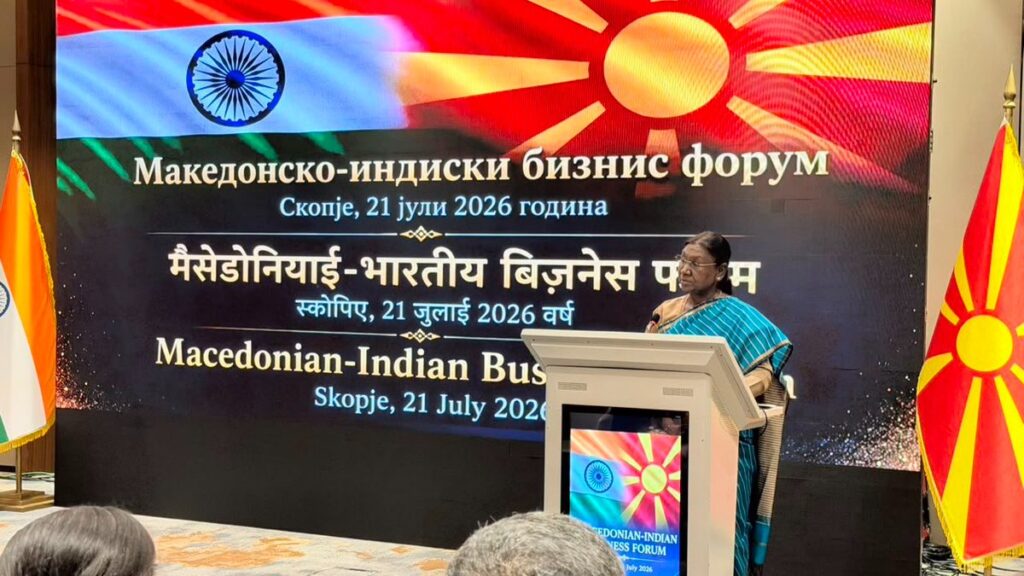
- Parliamentary Address: Indian President addressed the North Macedonian Parliament to reinforce multicultural and democratic shared values.
- 4T Model: To accelerate economic cooperation, both countries based their efforts on the ‘Four Ts’ model:
- Trade: Facilitating the exchange of goods and services.
- Technology: Promoting technological innovation and transfer.
- Tourism: Strengthening tourism and filmmaking culture between the two countries.
- Talent: Developing and sharing human resources.
- Trade Target: Bilateral trade between the two countries was approximately US$133 million in the year 2025.
- Both leaders acknowledged that this was far below the true potential of both economies and set an ambitious target of doubling current trade figures by the end of this decade.
- Technology and Innovation Cooperation: Priority sectors identified include Artificial Intelligence (AI), digital innovation, cybersecurity, IT/ITES and research partnerships.
- Both sides encouraged collaboration among start-ups, universities and technology enterprises to promote innovation-led growth.
- Investment Push: Addressing the India–North Macedonia Business Forum, President Murmu urged businesses to move beyond trade towards long-term investments, especially in green energy, healthcare, AI and digital technologies.
- Sector-Specific Collaboration: Cooperation will expand across pharmaceuticals, biotechnology, agriculture, food processing, textiles, tourism and film-making.
- Capacity Building: India announced that it would double Indian Technical and Economic Cooperation (ITEC) training slots for North Macedonia, including specialised programmes in Artificial Intelligence.
- Sustainable Development: India welcomed North Macedonia’s desire to join:
- International Solar Alliance (ISA),
- Coalition for Disaster Resilient Infrastructure (CDRI) and
- Global Biofuels Alliance.
- Health Agreement: The two countries have renewed the Memorandum of Understanding (MoU) on health cooperation for the next five years, with a special focus on traditional systems of medicine.
India–North Macedonia Relations
- Historical Ties: India established diplomatic relations with North Macedonia (then Republic of Macedonia) on 9 February 1995.
- India supported the country’s admission to the United Nations.
- India recognized it by its constitutional name before the Prespa Agreement (2018) changed its official name to North Macedonia.
- Bilateral relations have remained friendly despite limited engagement.
- Diplomatic Ties: India does not maintain a resident embassy in Skopje (Capital of North Macedonia).
- The Embassy of India in Sofia (Bulgaria) is concurrently accredited to North Macedonia.
- North Macedonia maintains an Embassy in New Delhi and honorary consuls in Mumbai, Chennai, Bengaluru and Kolkata.
- The relationship has witnessed gradual political expansion through ministerial and parliamentary exchanges.
- Bilateral Agreements: Important agreements include the Bilateral Investment Promotion and Protection Agreement (BIPA) signed in 2008, the Double Taxation Avoidance Agreement (DTAA) signed in 2013, and cooperation between diplomatic academies.
- Trade Relations: Bilateral trade remains modest but is expanding.
- Trade reached approximately US$37 million (2019–20). Trade volume stands around US$133 million (2025).
- India’s principal exports include pharmaceuticals, organic chemicals, textiles, machinery, vehicles, steel products and electrical equipment.
- Imports comprise iron and steel products, mineral fuels and floating structures. Both governments consider current trade significantly below potential.
- Investment: Indian investments have gradually increased:
- ArcelorMittal acquired Balkan Steel.
- BRG Group announced an investment of around €31 million in steel kitchenware manufacturing.
- Malhotra Cables invested around US$10 million in an automotive cable manufacturing plant.
- Education and Capacity Building: North Macedonian professionals receive training under India’s Indian Technical and Economic Cooperation (ITEC) Programme.
- Students are eligible for Indian Council for Cultural Relations (ICCR) scholarships, while diplomats participate in India’s Professional Course for Foreign Diplomats (PCFD).
- Diaspora: The Indian community in North Macedonia is very small, consisting of around 44 Indian nationals and 7 Overseas Citizen of India (OCI) cardholders working in professional fields like IT, steel, management and business sectors.
- Cultural Relations: Cultural ties are symbolized by Mother Teresa, who was born in Skopje and later became an Indian citizen.
- Her shared legacy provides a unique civilizational bridge between the two countries and promotes cultural diplomacy.
- Also, small local groups, including an ISKCON (Hare Krishna) community established in the late 1980s, maintain a presence centered around local philosophy and gatherings.
- Multilateral Cooperation: Both countries support cooperation against terrorism, uphold the rules-based international order, and increasingly engage on international peace, and cybersecurity issues.
- Both countries cooperate through the United Nations and support effective multilateralism.
- North Macedonia has consistently supported India’s bid for permanent membership in the United Nations Security Council (UNSC).
- Significance: North Macedonia also serves as India’s important engagement partner in the Balkan region, complementing India’s broader outreach to Europe.
- As a NATO member and an EU candidate state, it is located in the Western Balkans and serves as a strategic regional voice and gateway connecting the Mediterranean with Central Europe.
- Enhanced engagement strengthens India’s economic diplomacy, supports diversification of European partnerships and complements India’s expanding presence in Southeast Europe.
About North Macedonia:
- Location: It is a landlocked country located in the Balkan Peninsula of South-Eastern Europe.
- Borders: Kosovo and Serbia to the north, Bulgaria to the east, Greece to the south and Albania to the west.
- History: The region was part of the Macedonian Empire (to which Alexander the Great belonged) in ancient times.
- Later, it became part of the Ottoman Empire and then Yugoslavia.
- It gained independence from Yugoslavia through a peaceful referendum in September 1991.
- India was one of the co-sponsoring countries that got it admitted into the United Nations (UN) in 1992.
- Name change: In 2019, it was officially renamed the Republic of North Macedonia under the Prespa Agreement to resolve a long-standing historical name dispute with Greece.
- Governance system: Parliamentary Republic system is in force here.
- Official Language: Its main official language is Macedonian.
- Currency: The national currency here is Macedonian Denar (MKD).
FAQs:
1. How are India and North Macedonia expanding bilateral relations?
Through trade, investment, technology, education, and high-level political engagement.
2. What sectors are covered under the new cooperation initiatives?
IT, AI, pharmaceuticals, agriculture, biotechnology, textiles, tourism, hospitality, food processing, and films.
3. Why is North Macedonia important for India’s European engagement?
It strengthens India’s presence in the Western Balkans and expands strategic outreach across Europe.
4. How will the agreement strengthen trade between the two countries?
By promoting business forums, investments, joint ventures, and greater market access.
5. What technology partnerships have been announced?
Cooperation in AI, IT, digital innovation, cybersecurity, and start-up collaboration.
6. Are there any new investment opportunities under the agreement?
Yes. Opportunities include green energy, healthcare, manufacturing, technology, and joint ventures.
Disclaimer: Information in this article is based on official announcements and public records. Regulations and implementation details may evolve over time.
| Also Read: India-Seychelles Relations, India-Germany Relations |