


India-Norway Green Strategic Partnership
|
General Studies Paper II: Bilateral Groupings & Agreements, International Treaties & Agreements |
Why in News?
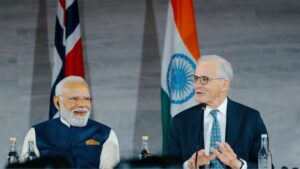
Recently, India and Norway officially elevated their bilateral ties to a Green Strategic Partnership during Prime Minister Narendra Modi’s visit to Oslo.
- Prime Minister Narendra Modi’s visit to Norway is the first by an Indian Prime Minister in 43 years, serving as a major diplomatic milestone following the last prime ministerial visit by Indira Gandhi in June 1983.
Highlights of India–Norway Green Strategic Partnership
- Framework: India and Norway elevated bilateral ties to a “Green Strategic Partnership”, giving strategic focus to clean energy, climate resilience, green technologies, resilient supply chains, blue economy and sustainable growth.
- Renewable Energy: Both countries agreed to deepen collaboration in renewable energy, offshore wind, solar projects, geothermal energy and clean energy transition.
- Norway’s expertise in hydropower and offshore technologies complements India’s renewable expansion goals under net-zero commitments.
- Investment Expansion: India and Norway linked the partnership with the India-EFTA Trade and Economic Partnership Agreement (TEPA), expected to attract nearly USD 100 billion investment and create around 1 million jobs over 15 years.
- The two leaders underlined the aim of doubling the value of current trade between India and Norway by 2030.
- Prime Minister Modi invited Norway to participate in Bharat Innovates 2026 to be held in France in June 2026.
- Indo-Pacific Oceans Initiative (IPOI): Norway officially decided to join India’s Indo-Pacific Oceans Initiative (IPOI) on 18 May 2026 to strengthen cooperation in maritime security, capacity building and sustainable ocean management across the Indo-Pacific region.
- Triangular Development Cooperation: Both countries signed a Triangular Development Cooperation Agreement aimed at supporting developmental projects in the Global South.
- The initiative focuses on human development, sustainability, climate resilience, digital inclusion and inclusive growth in developing nations.
- AI and Cyber Technology: India and Norway agreed to deepen cooperation in Artificial Intelligence (AI), cyber security, digital technologies and innovation ecosystems. The move supports secure digital infrastructure and emerging technology governance frameworks.
- Green Hydrogen: India and Norway identified Green Hydrogen and Carbon Capture, Utilisation and Storage (CCUS) as priority sectors.
- Cooperation will support industrial decarbonisation, energy security and low-carbon manufacturing technologies.
- The nations formalized collaborative R&D programs targeting carbon capture, utilization, and storage to aid heavy industries in their sustainable transition.
- Blue Economy: The partnership strengthens the long-running India-Norway Blue Economy Task Force focusing on sustainable fisheries, marine resources, coastal development and ocean governance. It aligns with SDG-14 and India’s maritime vision.
- The partnership reinforces support for a rules-based maritime order and complements India’s SAGAR doctrine and Indo-Pacific strategy.
- Green Shipping: Both nations prioritised green shipping and low-emission maritime transport.
- Norway’s advanced maritime technology and India’s shipping infrastructure can jointly promote cleaner global shipping corridors and decarbonised ports.
- Expanding the Green Maritime Partnership, over 10% of Norwegian ships are planned to be commissioned.
- Arctic Cooperation: India and Norway expanded collaboration in Arctic research, climate science and polar studies.
- Arctic cooperation is strategically important for India because Arctic changes influence the Indian monsoon, sea levels and climate systems.
- Space Sector: A new agreement on the peaceful use of outer space will enhance cooperation between ISRO and the Norwegian Space Agency in satellite applications, research and investment opportunities in the space economy.
- Digital Development: India and Norway launched a Digital Development Partnership focusing on digital public infrastructure, open digital ecosystems, artificial intelligence and digital governance, supporting India’s Digital India and Global South outreach initiatives.
- Health Sector: The signed health MoU promotes cooperation in digital health, AI-driven healthcare, medical research and high-quality health services, strengthening technological integration in healthcare delivery systems.
- Scientific Research: India’s CSIR and Norway’s SINTEF agreed to collaborate on bio-based materials, circular economy technologies, ocean energy and sustainable innovation, boosting joint scientific research capacity.
- Ocean Energy Development: A project implementation agreement was signed for offshore wind and wave energy technologies to develop sustainable deep-water renewable energy systems and enhance marine clean-energy infrastructure.
- Infrastructure Cooperation: Norway will provide specialised consultancy in tunnel construction, slope stability, geotechnical engineering and highway safety audits, improving India’s infrastructure resilience and mountain connectivity projects.
- Skill Development: The partnership includes collaboration in skills development, higher education, research exchange and talent mobility. Nordic expertise in advanced technology and India’s skilled workforce create opportunities for innovation-led economic growth.
- Arctic Research Station: Prime Minister Modi thanked Norway for continued support to India’s Arctic research station “Himadri” located in Svalbard.
- Cooperation in polar science is important for understanding climate change, glacier melting and monsoon variability.
- Climate Research: India’s National Centre for Polar and Ocean Research (NCPOR) and the Norwegian Polar Institute are jointly conducting advanced Arctic climate studies, including the PACT Project on Arctic-monsoon teleconnections.
- Digital Public Goods: Reaffirming the potential in digital transitions, the two governments tasked their ministries to create a dedicated Joint Working Group on Digitalization to drive joint innovation in digital public goods.
- Academic Mobility: The Research Council of Norway (RCN) and India’s DSIR/CSIR signed an MoU to promote joint degree programs, researcher exchange visits, and mutual recognition of qualifications.1
- Geo-strategic Alignment: Recognizing global geopolitical uncertainties, both leaders condemned cross-border terrorism, called for institutional UN reforms, and emphasized dialogue to prevent the weaponization of diplomacy and trade.
- Innovation Hubs & Hackathons: India proposed the creation of a Start-up Innovation Hub and periodic Green Innovation Hackathons to foster tech entrepreneurship and accelerate sustainability transition initiatives.
|
India–Norway Relationship:
|
|
Also Read: India-Mauritius Relations |