PM Modi Receives FAO Agricola Medal
|
General Studies Paper III: Food Security, International Recognition |
Why in News?
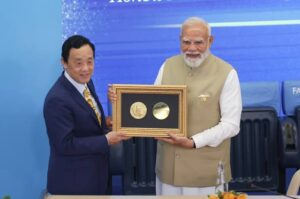
Recently, Prime Minister Narendra Modi received the UN Food and Agriculture Organization’s prestigious Agricola Medal in Rome, recognizing India’s advances in food security and farmer welfare.
What is FAO Agricola Medal?
- About: The FAO Agricola Medal is the highest honour awarded by the Food and Agriculture Organization (FAO) of the United Nations.
- It explicitly acknowledges supreme leaders who champion the global fight against hunger and poverty while fostering equitable agrifood systems.
- Origin: The medal was established in 1977 by FAO to honour leaders supporting global agricultural transformation and anti-hunger initiatives.
- The term “Agricola” originates from Latin, meaning “farmer” or “cultivator.”
- The award symbolizes FAO’s long-term mission of eliminating global hunger and strengthening agrifood systems.
- Objectives: The primary objective is to recognize outstanding leadership that aligns with the UN Sustainable Development Goals (SDGs).
- The award aims to encourage international leadership in achieving Zero Hunger (SDG-2), promoting resilient agriculture and supporting sustainable development.
- Selection Criteria: Recipients are chosen based on tangible metrics: scale of poverty reduction, execution of massive food safety nets, and agricultural modernization.
- Special emphasis is placed on introducing climate-resilient crop varieties and sustainable, future-ready farming ecosystems.
- The medal is conferred directly by the FAO Director-General upon leaders demonstrating long-term commitment toward food production.
- Physical Features: The Agricola Medal is a gold-toned ceremonial medal carrying customized inscriptions honouring recipients’ agricultural contributions.
- The reverse side prominently bears the official FAO emblem accompanied by the universal humanitarian motto “Fiat Panis” (Let there be bread).
- Many versions include engraved themes related to sustainable agrifood systems and food security cooperation.
- The medal is primarily made from high-quality metallic alloy with gold finishing, symbolizing dignity, agricultural prosperity, and global solidarity.
- It is housed inside an elegant, velvet-lined presentation case alongside an official parchment citation signed by the FAO Director-General.
- Global Recipients: Distinguished international holders of this medal include Pope John Paul II, King Bhumibol Adulyadej of Thailand, and French President Jacques Chirac.
- Other major recipients are Chinese President Jiang Zemin and Turkish Prime Minister Recep Tayyip Erdogan.
- Other notable recipients include Wen Jiabao, Joko Widodo, Michael D. Higgins, Recep Tayyip Erdoğan, and King Abdullah.
- Previously, former Prime Minister Dr. Manmohan Singh received it in 2008 for launching the National Food Security Mission.
- Significance: This award elevates agriculture to the top of the international political agenda, serving as a bridge for South-South cooperation.
- It proves that large-scale technology integration and environmental sustainability can seamlessly coexist to guarantee universal human welfare.
- It strengthens cooperation between FAO and member states in areas like food trade, rural technology, irrigation, and climate adaptation.
Why FAO Awarded Prestigious Agricola Medal to PM Modi?
-
- Comprehensive Income Support: India successfully rolled out historic financial inclusion programs like PM-KISAN scheme, delivering continuous, direct income support to a massive base of over 110 million farmers.
- Massive Security Net: The administration institutionalized a robust food-based social safety network like Pradhan Mantri Garib Kalyan Anna Yojana (PMGKAY), reliably supporting and protecting approximately 800 million citizens nationwide.
- Rural Infrastructure Deployment: The nation scaled up Digital Public Infrastructure (DPI) in rural belts, integrating advanced precision tools, agricultural drones, and sensor-based machinery.
- Scientific Adaptation Efforts: India focused deeply on science-driven agriculture, successfully developing and introducing around 3,000 climate-resilient crop varieties over a decade.
- Water Conservation: The organization highlighted India’s flagship “Per Drop More Crop” mission promoting micro-irrigation and efficient water management, strengthening water conservation in agriculture.
- Universal Millets Advocacy: The leadership spearheaded international public partnerships, working directly with the FAO to promote highly nutrient-rich, drought-resistant millets globally.
- India successfully collaborated with FAO during the International Year of Millets, strengthening nutritional security.
- Ecological Farming Transformation: The government minimized toxic chemical reliance by incentivizing farmer-centric reforms focused heavily on regenerative and natural farming methods.
- International Agrarian Agenda: During India’s high-profile G20 Presidency, the leader effectively prioritized hunger reduction and poverty alleviation on the international political spectrum.
- Tech-Driven Agrarian Interventions: Tech-driven agrarian interventions integrate drone-based precision spraying, AI-based micro-advisory weather networks, and satellite remote-sensing mapping. These technologies optimize inputs like water and pesticides, drastically reducing labor and resource costs.
India’s Agricultural Reforms and Food Security Achievements
- Record Production: India achieved historic foodgrain production exceeding 330 million tonnes in 2023-24, strengthening national food security and reducing vulnerability to global supply disruptions.
- MSP Expansion: The government continuously raised Minimum Support Prices (MSP) for major crops, ensuring farmers received at least 1.5 times production cost for several commodities.
- Insurance Coverage: Under Pradhan Mantri Fasal Bima Yojana, over 8 crore farmer applications annually received crop insurance protection against climate-related agricultural losses.
- Direct Transfers: The PM-KISAN scheme transferred more than ₹3 lakh crore directly into farmers’ bank accounts, improving rural purchasing capacity and reducing middlemen dependence.
- Storage Capacity: India rapidly expanded modern warehouses, silos, and cold-chain infrastructure under the Agriculture Infrastructure Fund, reducing post-harvest losses and improving supply efficiency.
- Digital Markets: The e-NAM platform integrated over 1,300 agricultural mandis, enabling transparent online trading and wider market access for millions of farmers nationwide.
- Programmes such as Namo Drone Didis modernized fertilizer spraying and precision farming practices in rural regions.
- Irrigation Growth: The Pradhan Mantri Krishi Sinchai Yojana accelerated irrigation coverage, helping increase agricultural productivity in water-stressed and rain-fed farming regions.
- Nutritional Security: India strengthened food security through the National Food Security Act, distributing subsidized grains to nearly 80 crore beneficiaries under the public distribution system.
- Export Expansion: Agricultural exports crossed nearly $50 billion annually, supported by reforms in logistics, processing, marine products, rice exports, and global agri-trade connectivity.
- The Mission for Aatmanirbharta in Pulses, launched with ₹11,440 crore, aims to raise pulses output.
- Cooperative Reforms: The creation of a separate Ministry of Cooperation strengthened dairy, fertilizer, and rural cooperative systems, improving grassroots agricultural financing and market participation.
- The Union Budget allocation for the Agriculture Ministry rose from ₹27,663 crore in 2013-14 to nearly ₹1.38 lakh crore in 2024-25.
Impact on India’s Global Agricultural Diplomacy
- South-South Leadership: The medal cements India’s role as an influential knowledge partner capable of exporting innovative farming blueprints to developing countries across the Global South.
- Multilateral Sourcing Trust: The honor boosts India’s diplomatic leverage within the United Nations, validating its alignment with critical global food security agendas.
- Global Standards Alignment: The award amplifies India’s Country Programming Framework (CPF), harmonizing domestic supply chains directly with authoritative global agrifood benchmarks.
- Technology Transfer Credibility: By showcasing domestic technological breakthroughs, India strengthens its position to export custom Digital Public Infrastructure (DPI) to emerging international markets.
- Sustainable Market Expansion: The recognition validates India’s ecological transformation, accelerating the export potential of certified, high-value organic products into strict global regulatory economies.
- Institutional Scientific Alliances: The milestone supports joint research breakthroughs, positioning domestic institutions to lead elite global agrifood research networks alongside world-class organizations.
- Climate Policy Influence: The distinction enhances India’s bargaining power in international climate summits, proving that climate-resilient crop deployment effectively preserves sovereign food systems.
|
Also Read: Food Security and Hunger: Ensuring Food Security for All |