



The Abraham Accords
|
General Studies Paper II: Global Groupings, Groupings & Agreements Involving India and/or Affecting India’s Interests |
Why in News?
Recently, the U.S. President Donald Trump urged Muslim-majority nations to join the Abraham Accords to normalize ties with Israel, linking regional integration with Iran peace negotiations.
What are Abraham Accords?
-
- About: The Abraham Accords are a series of U.S.-brokered diplomatic normalization agreements signed between Israel and several Arab-Muslim majority countries to establish official political, economic and diplomatic relations.
- The name “Abraham” symbolises the shared spiritual ancestry of Judaism, Christianity and Islam through Prophet Abraham.
- About: The Abraham Accords are a series of U.S.-brokered diplomatic normalization agreements signed between Israel and several Arab-Muslim majority countries to establish official political, economic and diplomatic relations.
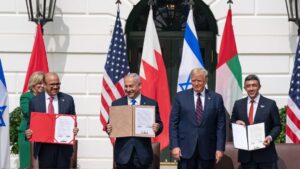
- Signing Year: The accords were officially signed on 15 September 2020 at the White House, Washington D.C., during the first presidency of Donald Trump.
- The agreements marked the first major Arab-Israeli normalization initiative since the Israel–Jordan Peace Treaty of 1994.
- Signed By: The Abraham Accords were initially signed by Israel, the United Arab Emirates (UAE), and Bahrain in September 2020, with the United States acting as a mediator and witness.
- Later in 2020, Morocco also signed a normalization agreement with Israel, and Sudan signed the foundational declaration.
- Kazakhstan formally joined the diplomatic grouping in late 2025.
- Objective: The principal objective of the accords was the normalization of diplomatic relations with Israel through embassies, trade cooperation, aviation links, tourism, technology partnerships and strategic dialogue.
- The framework also sought to institutionalize cooperation in sectors including energy, cybersecurity, finance, healthcare, agriculture, defence and innovation.
- The accords included commitments toward peaceful coexistence, interfaith dialogue, regional stability and economic integration in West Asia.
- The declaration emphasized “peace, mutual understanding and respect for human dignity and freedom.”
Countries Involved in Abraham Accords
- United States: The United States acted as the chief mediator and guarantor of negotiations.
- The Trump administration, especially adviser Jared Kushner, coordinated bilateral talks linking normalization with strategic, economic and defence incentives for participating Arab countries.
- Israel: Israel signed the accords to secure formal diplomatic acceptance from Arab states after decades of regional hostility following the 1948 Arab–Israeli conflict.
- Israel agreed to temporarily suspend proposed annexation plans in parts of the West Bank during negotiations with the UAE.
- United Arab Emirates (UAE): The United Arab Emirates became the first Gulf Arab country in nearly three decades to normalize ties with Israel.
- The UAE-Israel agreement was announced in August 2020 and formally signed in September 2020.
- Abu Dhabi viewed normalization as a pathway for advanced cooperation in technology, artificial intelligence, trade, defence and aviation.
- Bahrain: Bahrain joined the accords in September 2020, becoming the second Gulf nation to establish formal relations with Israel.
- Bahrain’s leadership supported stronger regional diplomatic coordination and security engagement amid changing geopolitical conditions in the Gulf.
- The agreement created formal diplomatic recognition, economic cooperation channels and direct governmental dialogue between Manama and Tel Aviv.
- Bahrain signed the “Declaration of Peace, Cooperation and Friendly Relations” alongside Israel and the United States at the White House ceremony.
- Morocco: Morocco normalized relations with Israel in December 2020 through a trilateral declaration involving the United States.
- Simultaneously, Washington recognized Moroccan sovereignty over Western Sahara, a major diplomatic development linked to the agreement.
- Sudan: Sudan agreed to join the Abraham Accords framework in 2020–21 after the United States removed Sudan from its list of state sponsors of terrorism.
- However, Sudan’s domestic political instability delayed full bilateral implementation with Israel.
- Kazakhstan: Kazakhstan announced in November 2025 that it would join the Abraham Accords, becoming the first Central Asian participant in the framework.
- Although Kazakhstan already maintained diplomatic relations with Israel since 1992, the move aimed to institutionalize cooperation in trade, cybersecurity, water management and strategic diplomacy with support from the United States.
Abraham Accords: Impacts and Challenges
- Impacts:
-
-
- Diplomatic Normalisation: The Abraham Accords transformed Israel–Arab relations by establishing official diplomatic ties between Israel, UAE, Bahrain, Morocco and Sudan.
- Breaking decades of isolation, countries swapped ambassadors and opened embassies.
- A three-way trade water accord signed between Israel, UAE and Jordan. In this Israel would either build a new desalination plant or deliver water to member countries.
- Economic Integration: Bilateral trade surged exponentially, transforming regional market dynamics.
- Total Accords trade volume is projected to touch $10 billion, with bidirectional investments crossing $5 billion.
- The UAE anchors this economic engine, with bilateral trade with Israel hitting $3.24 billion.
- Defence Cooperation: Shared intelligence and security frameworks revolutionized regional security.
- Driven by common threats, the alliance produced unprecedented defense deals, highlighted by a $2.3 billion contract for Elbit Systems to provide strategic air defense solutions to the UAE.
- Technological Advancements: Collaborative platforms accelerated high-tech innovation and infrastructure.
- Joint ventures blossomed in artificial intelligence, water security, and renewable energy via initiatives like the I2U2 Group.
- Major tech transfers between the nations reached $800 million.
- Aviation Expansion: People-to-people connections flourished through open skies and direct flight pathways.
- Tourism experienced a massive jump, recording over 250,000 visitors. Even during severe geopolitical turbulence, airlines like FlyDubai maintained continuous flight schedules to Tel Aviv.
- Diplomatic Normalisation: The Abraham Accords transformed Israel–Arab relations by establishing official diplomatic ties between Israel, UAE, Bahrain, Morocco and Sudan.
-
- Challenges:
-
- Iran Factor: The overarching Iran factor serves as the primary strategic catalyst for this alignment.
- Countering Tehran’s nuclear ambitions and regional proxy networks forced a unified deterrence posture.
- This created an integrated air and missile defense grid backed by the United States.
- Palestine Issue: The unresolved Palestine issue remains a severe structural fault line.
- The framework’s “outside-in” approach largely bypassed Palestinian statehood.
- This created a stark divergence between state-level pragmatic diplomacy and pro-Palestinian public sentiment across the Arab world.
- Domestic Backlash: Signatory regimes face intense internal dissent and public pushback.
- The military campaigns in Gaza strained public opinion severely.
- Many populations in the Arab world continued supporting Palestinian aspirations despite official state-level diplomatic normalization initiatives.
- Expansion Roadblocks: Broadening the treaty faces heavy diplomatic resistance. Further normalization, particularly involving Saudi Arabia, has slowed significantly.
- Riyadh strictly conditions its accession on a credible, verified pathway toward an independent Palestinian state.
- Multilateral Power Struggle: China’s growing influence in the Middle East challenges traditional US pre-eminence, as Beijing deepens strategic and economic ties with Israel, the UAE, and Saudi Arabia.
- Funding Constraints: Established under the Abraham Accords, the Abraham Fund originally allocated over $3 billion for private-sector development, but has seen no public activity in recent years.
- Iran Factor: The overarching Iran factor serves as the primary strategic catalyst for this alignment.
Strategic Implications for India
- West Asian Quad: The Abraham Accords directly facilitated the creation of the I2U2 Group, unofficaly dubbed the “West Asian Quad.”
- This grouping links India, Israel, the UAE, and the United States to cooperate on critical infrastructure.
- The institutional alliance has institutionalized a strategic Indo-Abrahamic construct to balance continental and maritime security.
- Trade Multipliers: Bilateral economic ties expanded massively under the updated trade rules.
- India’s bilateral trade with the UAE skyrocketed to $101.25 billion. Backed by the Comprehensive Economic Partnership Agreement (CEPA), target volumes aim for $200 billion by 2032.
- India–Israel trade crossed nearly $10 billion in recent years, strengthening connectivity across technology, defence and logistics sectors.
- Energy Security: The diplomatic thaw permanently de-risked India’s vital energy supply lines.
- West Asia supplies nearly 60% of India’s crude oil imports, making regional stability strategically important.
- The UAE acts as India’s 4th largest crude supplier. Crucially, the Gulf nation remains the sole foreign participant allowed in India’s Strategic Petroleum Reserve program.
- Food Corridors::The geopolitical realignment directly unlocked a $2 billion Emirati investment for integrated food parks across India.
- Designed to tackle Middle Eastern food insecurity, the projects in Gujarat and Madhya Pradesh integrate Israeli hydroponics technology.
- Maritime Geopolitics: The treaties shifted India’s focus from purely continental threats toward active maritime domain awareness in the Western Indian Ocean.
- This network links Indian ports directly to the Arabian Peninsula. The integration allows India to project power along the critical lanes of the Strait of Hormuz and the Bab-el-Mandeb.
- IMEC Pipeline: The Accords laid the primary foundation for the India-Middle East-Europe Economic Corridor (IMEC).
- Connecting Indian hubs like Mumbai to Israel’s Haifa Port via UAE rail links, the transit alternative promises to make trade with Europe 40% faster and 30% cheaper. This counters China’s Belt and Road Initiative.
- Strategic Autonomy: The normalization process provided massive diplomatic relief for India. It removed the tight zero-sum friction, allowing India to deepen defense and intelligence ties with both blocs simultaneously without diplomatic backlash.
- The accords strengthened India’s vision of a multipolar foreign policy based on strategic autonomy.
- India increasingly acts as a bridge between competing regional powers across the Indo-Pacific and West Asian regions.
- Defense Production::The triangulation of defense interests has created an emerging trilateral defense framework.
- India signed a new Strategic Defence Partnership with the UAE. This merges Israeli technological innovation, UAE capital, and India’s massive scale manufacturing capabilities to co-produce next-generation military hardware.
- Diaspora Safety: Over 3.5 million Indian expatriates reside in the UAE alone, making them the largest migrant group.
- The cooling of regional friction directly safeguards this diaspora. Their safety ensures steady capital flows, with annual remittance inflows to India remaining structurally secure against sudden geopolitical eruptions.
- Technology Transfers: Joint technological platforms are accelerating clean energy transitions inside India.
- The I2U2 framework is currently funding a $330 million feasibility study for a hybrid renewable project.
- The project introduces 300 megawatts of wind and solar capacity in Gujarat, aiding India’s goal of 500 GW of non-fossil capacity.
|
Also Read: Nuclear Non-Proliferation Treaty |