ICGS Akshay Commissioned into Coast Guard Fleet
| General Studies Paper III: Coastal Security, Security Architecture |
Why in News?
Recently, indigenously built Indian Coast Guard Ship (ICGS) Akshay was commissioned into the Coast Guard fleet at the Goa Shipyard Limited (GSL) facility.
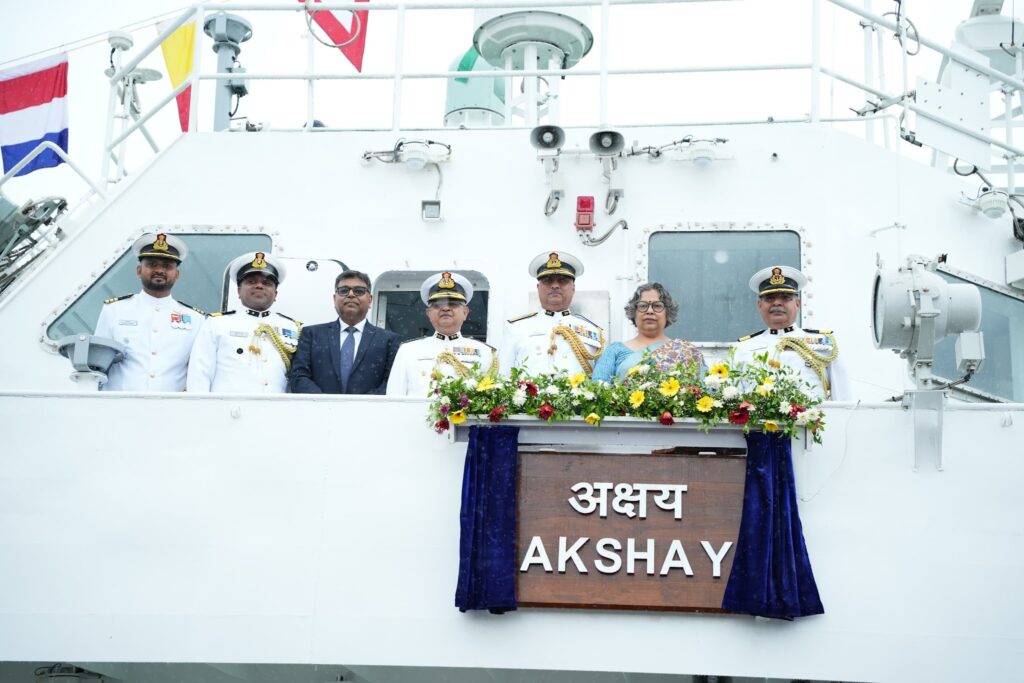
What is ICGS Akshay?
- About: ICGS Akshay is a new-generation Fast Patrol Vessel (FPV) of the Indian Coast Guard, built to strengthen coastal surveillance, maritime law enforcement, search and rescue (SAR), anti-smuggling, anti-piracy, and Exclusive Economic Zone (EEZ) protection.
- The name “Akshay” means “Indestructible”, symbolising enduring maritime security.
- Commissioning Details: ICGS Akshay was commissioned on 27 June 2026 at Goa Shipyard Limited (GSL), Vasco, Goa, into the Bharatiya Tatrakshak (Indian Coast Guard) Fleet.
- It was commissioned by Smt. Parama Sen, Additional Secretary (Personnel), Department of Expenditure, Ministry of Finance.
- Developed By: The vessel has been designed and built indigenously by Goa Shipyard Limited (GSL) under the Aatmanirbhar Bharat and Make in India initiatives.
- Class: It belongs to the Adamya-class FPV series.
- It is the fourth commissioned vessel of the Adamya-class programme.
- The Adamya class is highly agile and purposely engineered for patrol, interception, and law-enforcement operations in varying sea conditions.
- Design: The vessel has a total length of 52 metres and boasts a displacement of 320 tonnes.
- It incorporates over 60% indigenous content, demonstrating India’s growing capability in defence shipbuilding.
- Indigenous manufacturing reduces import dependence while strengthening domestic defence industries.
- The vessel operates with a focused crew complement consisting of 6 officers and 35 sailors, led by Commandant (Junior Grade) Deepak Choubey.
- Propulsion: It is equipped with highly efficient Controllable Pitch Propellers (CPP) paired with twin 3,000 kW diesel engines enabling speeds exceeding 27–28 knots.
- It enables better manoeuvrability, rapid interception, fuel efficiency, and improved operational flexibility during maritime missions.
- Combat and Surveillance: The FPV carries a 30 mm CRN-91 naval gun and two 12.7 mm stabilised remote-controlled machine guns.
- It also integrates modern navigation, surveillance, and command systems for round-the-clock coastal monitoring and maritime enforcement.
- Operational Roles: The vessel can perform coastal patrol, EEZ surveillance, anti-smuggling, anti-piracy, fisheries protection, search and rescue, pollution response, and maritime law enforcement, making it a multi-mission security platform.
- Strategic Significance: ICGS Akshay strengthens India’s ability to secure critical sea lanes, and improve domain awareness across the Indian Ocean Region (IOR).
- The patrol vessel acts as a major hub for Humanitarian Assistance and Disaster Relief (HADR).
Role of the Indian Coast Guard in Maritime Security
- Coastal Surveillance Agency: The Indian Coast Guard (ICG) is India’s primary maritime law-enforcement agency.
- It is a multi-mission maritime armed force and law enforcement agency operating under the Ministry of Defence.
- It was established by the Coast Guard Act of 1978.
- It functions on the motto “Vayam Rakshamah or We Protect“.
- The force is led by the Director General of the Indian Coast Guard (DGICG), operating from the Coast Guard Headquarters (CGHQ) in New Delhi.
- India’s coastline is divided into five main operational regions:
- Western Region (HQ: Mumbai) – Covers the west coast from Daman to Kanyakumari, including Lakshadweep.
- Eastern Region (HQ: Chennai) – Controls the coastline from Puvar to Ichchapuram.
- North-East Region (HQ: Kolkata) – Manages the upper eastern seaboard.
- North-West Region (HQ: Gandhinagar) – Focuses heavily on the sensitive maritime borders of Gujarat.
- Andaman & Nicobar Region (HQ: Port Blair) – Secures India’s strategic island territories in the Bay of Bengal.
- Using ships, aircraft, helicopters, radar stations, AIS, and coastal sensors, it detects suspicious movements and provides the first response against maritime threats.
- Coastal Security Coordination: Following the 2008 Mumbai terror attacks, the ICG became the lead agency for coastal security in territorial waters.
- It maintains continuous surveillance over the 7,516.6 km coastline, island territories, and ports.
- It coordinates the Indian Navy, Marine Police, Customs, Fisheries Department, Intelligence agencies, and State authorities, ensuring seamless maritime security through joint patrols, intelligence sharing, and Standard Operating Procedures (SOPs).
- Protection of Exclusive Economic Zone (EEZ): The ICG safeguards India’s EEZ, protecting offshore oil platforms, fisheries, seabed resources, and commercial shipping.
- It protects the 2.01 million sq. km Exclusive Economic Zone (EEZ).
- Regular patrols deter illegal fishing, poaching, piracy, and unauthorized exploration, securing India’s maritime economic interests.
- Maritime Law Enforcement: The force enforces maritime laws by conducting boarding, inspection, search, seizure, and arrest operations against smuggling, narcotics trafficking, arms movement, illegal migration, and maritime crimes.
- Search and Rescue (SAR) Operations: The ICG serves as India’s National Maritime Search and Rescue Coordinating Authority (NMSARCA).
- Through MRCCs at Mumbai, Chennai, and Port Blair, supported by 36 Maritime Rescue Sub-Centres, it coordinates rescue operations across the Indian Search and Rescue Region.
- Marine Environment Protection: The Coast Guard is India’s nodal agency for marine pollution response, detecting oil spills through aerial surveillance, deploying containment systems, and protecting fragile marine ecosystems while ensuring compliance with international maritime environmental obligations.
- Fishermen Safety and Community Outreach: The ICG protects fishermen through distress assistance, weather advisories, rescue missions, and Community Interaction Programmes (CIPs).
- These programmes educate coastal communities on maritime safety while encouraging them to act as the nation’s maritime “eyes and ears.”
- Offshore and Strategic Asset Security: The Coast Guard safeguards offshore development areas, artificial islands, oil and gas installations, Single Point Moorings (SPMs), and sea-based infrastructure against sabotage, terrorism, and illegal intrusions.
- International Maritime Cooperation: The ICG fulfils India’s obligations under the International Convention on Maritime Search and Rescue (SAR), 1979, cooperates with neighbouring countries, and participates in multinational maritime exercises.
- It significantly contributes to India’s maritime security, Blue Economy, and Indo-Pacific strategic interests.
India’s Indigenous Adamya-class FPV Programme
The Adamya-class Fast Patrol Vessel (FPV) programme comprises eight indigenously designed and built vessels for ICG. The ₹473-crore contract was awarded to Goa Shipyard Limited (GSL) in March 2022 under the Buy (Indian-IDDM) category. Deliveries are scheduled within 45 months.
- ICGS Adamya: ICGS Adamya became the first vessel of the class to enter service.
- It was commissioned on 19 September 2025 at Paradip Port, Odisha, and operates under Coast Guard Region (North East).
- The name “Adamya” means “Indomitable”, reflecting resilience and unwavering maritime vigilance.
- ICGS Akshar: ICGS Akshar was the second Adamya-class FPV to join the fleet.
- It was commissioned on 4 October 2025 at Karaikal, Puducherry, under Coast Guard Region (East).
- Its deployment significantly strengthened maritime surveillance along India’s southeastern coastline.
- ICGS Amulya: ICGS Amulya, meaning “Priceless”, was commissioned on 19 December 2025 at Goa.
- The vessel is based at Paradip, Odisha, operating under Coast Guard Region (North East).
- ICGS Achal: ICGS Achal was delivered on 31 March 2026 and commissioned on 9 May 2026.
- It operates under Coast Guard Region (North West), Gandhinagar, enhancing maritime security along India’s strategically important western seaboard.
- ICGS Akshay: ICGS Akshay, meaning “Indestructible”, became the fourth commissioned vessel on 27 June 2026.
- ICGS Atal: ICGS Atal was launched on 29 July 2025 by Goa Shipyard Limited.
- As of June 2026, it has not yet been commissioned into Coast Guard service and remains in the final stages of fitting out, trials, and acceptance.
- ICGS Ajit: ICGS Ajit was launched on 24 October 2025.
- The vessel is presently undergoing post-launch outfitting, harbour trials, and sea trials before formal induction.
- ICGS Aparajit: ICGS Aparajit, meaning “Unconquered”, is the eighth and final vessel of the Adamya-class project.
- Following its launch on 24 October 2025, it awaits delivery and commissioning.
FAQs:
-
What is CGS Akshay?
ICGS Akshay is an indigenous Adamya-class Fast Patrol Vessel commissioned into the Indian Coast Guard for maritime security operations.
-
Who built CGS Akshay?
CGS Akshay was designed and built by Goa Shipyard Limited (GSL) under the Aatmanirbhar Bharat initiative.
-
What is the primary role of CGS Akshay?
Its primary role is coastal surveillance, maritime law enforcement, search and rescue, anti-smuggling, and Exclusive Economic Zone protection.
-
Why is CGS Akshay important for India’s maritime security?
It strengthens coastal security, improves rapid response capability, and enhances surveillance across India’s vast maritime zones and sea lanes.
-
What are the key features of CGS Akshay?
It features indigenous construction, high-speed capability, advanced navigation systems, modern sensors, and multi-mission operational flexibility
-
What is Goa Shipyard Limited (GSL)?
Goa Shipyard Limited is a Defence Ministry shipbuilder specializing in indigenous naval and Coast Guard vessels.
-
How does CGS Akshay strengthen the Indian Coast Guard?
It expands operational capacity, improves coastal patrolling, enhances surveillance, and supports faster response during maritime emergencies.
-
Is CGS Akshay an indigenous vessel?
Yes, ICGS Akshay is an indigenously designed and built Fast Patrol Vessel with over 60% indigenous content.
-
What missions will CGS Akshay undertake?
It will undertake surveillance, fisheries protection, anti-piracy, anti-smuggling, pollution response, and humanitarian search and rescue missions.
-
How does this commissioning support India’s maritime capabilities?
The commissioning modernises the Coast Guard fleet, strengthens maritime security, and advances India’s indigenous defence manufacturing capabilities
Disclaimer: Information in this article is based on official announcements and public records. Regulations and implementation details may evolve over time.