



India Next-Gen Semi-Cryogenic Rocket Engine
| General Studies Paper III: Space Technology, Indigenous Space Technology |
Why in News?
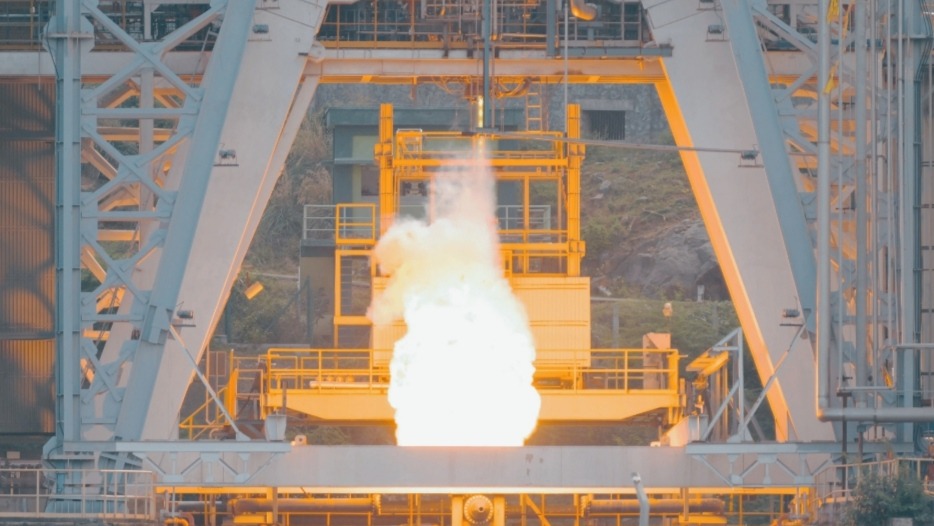
Recently, the Indian Space Research Organisation (ISRO) successfully hot-tested its next-generation semi-cryogenic engine power head at 175-tonne thrust.
What is India’s Next-Generation Semi-Cryogenic Rocket Engine?
- About: India’s Next-Generation Semi-Cryogenic Rocket Engine (SE2000/SCE-200) is an indigenous 2,000 kN-class high-thrust liquid rocket engine.
- It utilizes Liquid Oxygen (LOX) as an oxidizer and refined kerosene (RP-1/Isrosene) as fuel.
- Developed By: The engine is being developed by ISRO, with the Liquid Propulsion Systems Centre (LPSC) leading engine and stage design.
- Testing is conducted at the ISRO Propulsion Complex (IPRC), Mahendragiri, Tamil Nadu.
- Multiple ISRO centres contribute to propulsion, control systems and qualification activities.
- Objective: It is designed to power the SC120 semi-cryogenic stage, replacing the L110 liquid core stage of LVM3, delivering higher payload capacity and lower launch costs.
- The objective is to develop a high-thrust and reusable-compatible propulsion system capable of launching heavier communication satellites and future human spaceflight infrastructure.
- Technology Used: The engine employs LOX-Isrosene propellants, advanced turbopumps, pre-burner, gas-generator-based propulsion, sophisticated control systems and a high-pressure propellant feed architecture.
- It operates at a challenging chamber pressure of 180 bar, with propellant feed systems generating pressures up to 600 bar.
- Working Mechanism: Liquid oxygen and kerosene are pumped by high- and low-pressure turbopumps.
- A pre-burner generates hot gases that drive the turbine, powering the pumps before propellants enter the combustion chamber to produce nearly 200 tonnes (2,000 kN) of thrust for launch.
- Trials: The first Power Head Test Article (PHTA) hot test (28 March 2025) validated ignition and bootstrap operation.
- The second (24 April 2025) demonstrated 60% thrust. The third (28 May 2025) refined the start-up sequence.
- On 24 June 2026, the eighth PHTA test successfully achieved 175-tonne (88%) thrust with stable 400- and 500-bar turbopump pressures, marking the biggest milestone so far.
- Timeline: Following the successful demonstration, ISRO plans a 100% (200-tonne) power-head test before full engine qualification.
- ISRO has indicated a target of introducing the upgraded LVM3 with SC120 around 2027, subject to successful qualification.
- Significance: The engine represents India’s largest indigenous liquid propulsion system.
- Mastering semi-cryogenic propulsion places India among a select group of nations possessing advanced high-thrust rocket engine technology.
- It supports future Next Generation Launch Vehicles (NGLV), expands strategic self-reliance under Atmanirbhar Bharat.
- Unlike traditional fuels (like hydrazine) that release highly toxic and carcinogenic vapors, the SE-2000 ensures eco-friendly, non-hazardous handling and safer launchpad operations.
Difference Between Cryogenic and Semi-Cryogenic Rocket Engines
- Propellant Combination: A cryogenic engine burns Liquid Hydrogen (LH₂) with Liquid Oxygen (LOX), whereas a semi-cryogenic engine uses refined Kerosene (RP-1/Isrosene) with LOX.
- Only the oxidiser is cryogenic in semi-cryogenic propulsion, simplifying operations while retaining high performance.
- Operating Temperature: Cryogenic engines require storage of LH₂ at about –253°C and LOX at –183°C, demanding highly insulated tanks.
- Semi-cryogenic engines store only LOX at –183°C, while kerosene remains at ambient temperature, reducing thermal management complexity.
- Fuel Density: Liquid Hydrogen has very low density (~70 kg/m³), requiring large propellant tanks.
- Kerosene (~810 kg/m³) is nearly 11–12 times denser, allowing significantly smaller tanks, lighter structures and improved vehicle packaging efficiency.
- Specific Impulse: Cryogenic engines achieve the highest specific impulse (around 440–460 seconds in vacuum) because hydrogen has superior energy per unit mass.
- Semi-cryogenic engines typically deliver 330–360 seconds, sacrificing some efficiency for greater thrust and practicality.
- Thrust Characteristics; Semi-cryogenic engines generate higher thrust at lift-off due to dense propellants and greater mass flow, making them ideal for core stages.
- Cryogenic engines prioritize maximum efficiency, making them better suited to upper stages.
- Engineering Complexity: Cryogenic engines involve complex hydrogen turbopumps, ignition systems and thermal protection against embrittlement.
- Semi-cryogenic engines eliminate hydrogen-related challenges, improving manufacturing reliability and reducing maintenance requirements while retaining advanced turbomachinery.
- Operational Efficiency: Hydrogen production, storage and launch infrastructure are expensive.
- Semi-cryogenic propulsion lowers operational costs through cheaper fuel, compact tanks and simpler logistics, making frequent commercial launches more economical.
- Mission Applications: Cryogenic propulsion is preferred for Geostationary Transfer Orbit (GTO) insertion and deep-space upper stages requiring maximum efficiency.
- Semi-cryogenic propulsion is primarily used for booster or core stages, where high thrust and structural efficiency are critical.
IMPORTANT POINTS TO KNOW:
- LVM3 (Launch Vehicle Mark-3): It is ISRO’s heaviest operational three-stage launch vehicle, formerly known as GSLV Mk III.
- Renamed in 2022, it is designed for launching heavy communication satellites, interplanetary spacecraft, crewed missions and commercial payloads.
- LVM3 consists of two S200 solid strap-on boosters, one L110 liquid core stage powered by twin Vikas engines, and the C25 cryogenic upper stage using the indigenous CE-20 engine.
- The rocket stands 43.5 m tall, has a 4 m core diameter, 5 m payload fairing and 640-tonne lift-off mass.
- It can place about 4 tonnes into GTO and up to 10 tonnes into Low Earth Orbit (LEO) in its current operational configuration.
- LVM3 incorporates fully indigenous cryogenic technology, including the CE-20 engine, advanced avionics, navigation, guidance, composite structures and mission computers.
- LVM3 successfully launched CARE, GSAT-19, Chandrayaan-2, Chandrayaan-3, commercial OneWeb missions and was selected as the Human Rated Launch Vehicle (HRLV) for Gaganyaan.
- Through NewSpace India Limited (NSIL), LVM3 has entered the global launch market. Its capability to deploy multiple heavy satellites has expanded India’s commercial launch services
- Next Generation Launch Vehicle (NGLV): The Next Generation Launch Vehicle (NGLV) is an advanced heavy-lift launch vehicle under development by ISRO.
- It is being designed as a cost-effective, partially reusable launch system that will significantly reduce mission costs while increasing launch frequency.
- The NGLV is expected to deliver up to 30 tonnes of payload to Low Earth Orbit (LEO), representing a substantial improvement over India’s existing launch capabilities.
- Its modular architecture will enable the vehicle to support a wide range of missions, including construction of the proposed Bharatiya Antariksh Station.
- The rocket will feature a three-stage configuration.
- The first and second stages will be powered by Liquid Oxygen (LOX)-based propulsion systems, with the core stage expected to employ advanced semi-cryogenic engines using LOX and kerosene.
- The third stage will utilize an indigenous cryogenic engine, ensuring high performance during orbital insertion.
- The reusable first stage is intended to lower launch costs and enhance the long-term sustainability of India’s space programme.
FAQs:
-
What is a Semi-Cryogenic Rocket Engine?
A liquid rocket engine using Liquid Oxygen (LOX) as oxidiser and kerosene (RP-1/Isrosene) as fuel for high-thrust propulsion.
-
Why did ISRO test the Semi-Cryogenic Rocket Engine?
To validate high-thrust performance and develop an upgraded propulsion system for LVM3 and future heavy-lift launch vehicles.
-
What fuel does the Semi-Cryogenic Engine use?
It uses refined kerosene (RP-1/Isrosene) as fuel and Liquid Oxygen (LOX) as the oxidiser.
-
How is a Semi-Cryogenic Engine different from a Cryogenic Engine?
Semi-cryogenic engines use LOX-kerosene; cryogenic engines use LOX-liquid hydrogen, offering higher efficiency but greater complexity.
-
Which future ISRO missions will use this engine?
It will power upgraded LVM3 missions and support future NGLV heavy-lift, lunar and human spaceflight missions.
-
What are the advantages of Semi-Cryogenic propulsion?
It offers higher thrust, lower cost, easier handling, improved payload capacity and better operational efficiency.
-
What is ISRO’s Next Generation Launch Vehicle (NGLV)?
A reusable, cost-efficient heavy-lift rocket designed to carry up to 30 tonnes to Low Earth Orbit.
-
How will this engine improve India’s space capabilities?
It will increase payload capacity, reduces launch costs and strengthen India’s capabilities in commercial, lunar and human space missions
Disclaimer: Information in this article is based on official announcements and public records. Regulations and implementation details may evolve over time.
| Also Read: ISRO Launches LVM3-M5/CMS-03 MISSION |