India’s First Air-Filled Rubber Dams in Gujarat
| General Studies Paper III: Water Resources, Infrastructure |
Why in News?
Recently, Gujarat has initiated construction of its first air-filled rubber dams on the Heran and Ambika rivers using South Korean technology.
What is Air-Filled Rubber Dam?
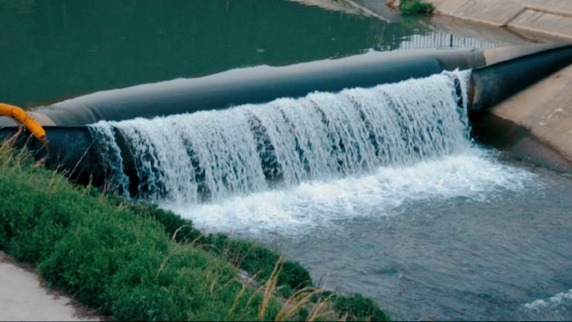
- Concept: An Air-Filled Rubber Dam is a flexible inflatable hydraulic structure installed across rivers, canals, or streams to regulate water levels.
- Unlike conventional concrete barrages, it consists of a reinforced rubber membrane anchored to a concrete foundation and inflated with compressed air.
- When inflated, it acts as a weir to store water; when deflated, it lies flat, allowing unrestricted river flow.
- This technology was first developed during the 1950s and is now widely used for irrigation and groundwater recharge.
- Structural Design: The dam comprises four primary components: rubberized synthetic-fabric membrane (generally nylon-reinforced), reinforced concrete foundation, air inflation system (blower, valves, pipelines), and an automated control and monitoring system.
- The membrane is securely bolted to the concrete base, ensuring structural stability under varying hydraulic pressures.
- Modern designs also incorporate pressure sensors, laser height sensors, and emergency air-release systems.
- Working Mechanism: Compressed air from an electric blower inflates the membrane until the required operating pressure is achieved.
- The inflated structure raises the upstream water level for irrigation, drinking water supply, and recharge.
- During floods or excessive inflow, automatic sensors trigger controlled deflation by opening exhaust valves, restoring natural river flow.
- Features: These dams generally function as low-head diversion structures, commonly below 5 metres in height, while spans may extend to around 100 metres or more, depending on site conditions.
- They permit precise regulation of river discharge, sediment flushing, and seasonal operation with minimal civil infrastructure.
- The inflatable design enables rapid installation, lower construction costs, easy maintenance, improved sediment management, earthquake resilience, and flexible water regulation.
- It minimises obstruction to river ecology while enhancing irrigation efficiency, groundwater recharge, and flood management.
Gujarat’s First Air-Filled Rubber Dam Project
- Location: Gujarat is constructing its first two Air-Filled Rubber Dams.
- The dams are being built at Rajvasana village on the Heran River in Bodeli Taluka, Chhota Udepur district, and Pathakwadi village on the Ambika River in Dolvan Taluka, Tapi district, covering eastern and southern Gujarat.
- Technology: Both projects utilize South Korean air-filled rubber bladder technology, replacing rigid concrete gates with inflatable rubber membranes.
- It is between 18 mm and 32 mm thick.
- The material withstands temperatures above 50 degrees Celsius.
- It has an estimated service life of 30 years.
- The dams also use SCADA-based automation systems. These systems inflate and deflate the bladders based on operational needs.
- Investment: The combined investment is over ₹162 crore.
- The Rajvasana project cost over ₹82.97 crore and the Pathakwadi project cost over ₹79.13 crore.
- Benefits: The Rajvasana dam is designed to irrigate approximately 3,420 hectares across 25 villages, while the Pathakwadi project will provide assured irrigation to nearly 650 hectares.
- Stored river water will significantly enhance groundwater replenishment, improving well yields and strengthening long-term water security in drought-prone rural areas.
- During periods of high discharge, the inflatable structures can deflate automatically, allowing sediment to pass safely while reducing upstream flood risks.
- The projects represent Gujarat’s shift towards adaptive hydraulic engineering, capable of responding efficiently to variable monsoon rainfall.
- Reliable irrigation will support Kharif and summer crops, reduce rainfall dependence, and improve farmers’ income through assured water availability.
- The dams form part of Gujarat’s broader ‘Catch the Rain’ and integrated water conservation initiatives focused on maximizing local water harvesting.
- These structures require less concrete, facilitate sediment flushing, maintain ecological river flow during deflation, and reduce environmental disturbance.
- Progress: The Rajvasana Project has achieved nearly 75% construction and is expected to be commissioned by September 2027.
- The Pathakwadi Project is about 90% complete, making it the most advanced among the two ongoing projects.
Government’s Sustainable Water Management Policies
- National Water Policy Framework: The National Water Policy (2012) promotes Integrated Water Resources Management (IWRM), emphasizing river basin planning, water-use efficiency, aquifer protection, recycling, and participatory governance.
- National Water Mission (NWM): Launched under the National Action Plan on Climate Change (NAPCC), the National Water Mission seeks to improve water-use efficiency by 20%, strengthen water databases, and promote basin-level planning.
- Jal Jeevan Mission (JJM): Launched in 2019, Jal Jeevan Mission aims to provide Functional Household Tap Connections (FHTCs) with sustainable water sources.
- As of March 2026, over 15.82 crore rural households (81.71%) had tap water connections, with mandatory focus on rainwater harvesting, greywater reuse, and source sustainability.
- Jal Jeevan Mission 2.0: The Union Cabinet has extended JJM until 2028 with an overall outlay of ₹8.69 lakh crore, shifting emphasis from infrastructure creation to long-term service delivery, operation, maintenance, and sustainable water security.
- Atal Bhujal Yojana: The ₹6,000 crore Atal Bhujal Yojana, implemented with World Bank support, promotes community-led groundwater management across seven water-stressed States, encouraging crop diversification.
- Jal Shakti Abhiyan: The nationwide “Catch the Rain” campaign promotes rainwater harvesting, groundwater recharge, revival of traditional water bodies, and public participation before every monsoon.
- Jal Sanchay Jan Bhagidari: This participatory initiative integrates governments, communities, and institutions for groundwater recharge.
- By May 2026, it had recorded over 1.55 crore cumulative conservation works, including 1.22 crore completed structures across India.
- Pradhan Mantri Krishi Sinchayee Yojana (PMKSY): PMKSY promotes “Har Khet Ko Pani” and “Per Drop More Crop” through micro-irrigation, watershed development, and irrigation expansion, reducing agricultural water consumption while improving productivity.
- Groundwater Management: The Government supports scientific aquifer mapping, groundwater monitoring, recharge planning, and sustainable extraction through Central Ground Water Board programmes.
- River Rejuvenation: Programmes such as Namami Gange integrate pollution control, sewage treatment, ecological flow restoration, afforestation, and basin management to improve river health and long-term water sustainability.
- Community Participation: Government programmes increasingly emphasize Jan Bhagidari, involving Panchayati Raj Institutions, Water User Associations, and local communities in planning, monitoring, and maintaining water assets.
FAQs:
1. What is an air-filled rubber dam?
An air-filled rubber dam is an inflatable rubber membrane barrier that regulates river water by controlled air pressure.
2. How does an air-filled rubber dam work?
Compressed air inflates the membrane to store water; deflation releases flow during floods or maintenance.
3. Why has Gujarat constructed air-filled rubber dams?
To enhance irrigation, groundwater recharge, water storage, and flood management using climate-resilient hydraulic infrastructure.
4. What are the benefits of rubber dam technology?
It offers low-cost construction, rapid installation, flexible operation, groundwater recharge, sediment flushing, and efficient water regulation.
5. How are rubber dams different from conventional dams?
Rubber dams are inflatable and flexible; conventional dams are permanent rigid concrete structures.
6. How do rubber dams improve water conservation?
They store seasonal river water, increase groundwater recharge, and reduce water loss through efficient flow regulation.
7. Can rubber dams help in flood management?
Yes. They automatically deflate during high flows, allowing floodwaters to pass safely and reducing upstream flooding.
Disclaimer: Information in this article is based on official announcements and public records. Regulations and implementation details may evolve over time.
| Also Read: China’s Tsangpo Dam Project |