




Government Introduces Indian Statistical Institute Bill 2026 in Lok Sabha
| General Studies Paper II: Government Policies & Interventions |
Why in News?
Recently, the government introduced the Indian Statistical Institute Bill, 2026 in Lok Sabha on August 3, 2026, which seeks to replace the older Indian Statistical Institute Act of 1959.
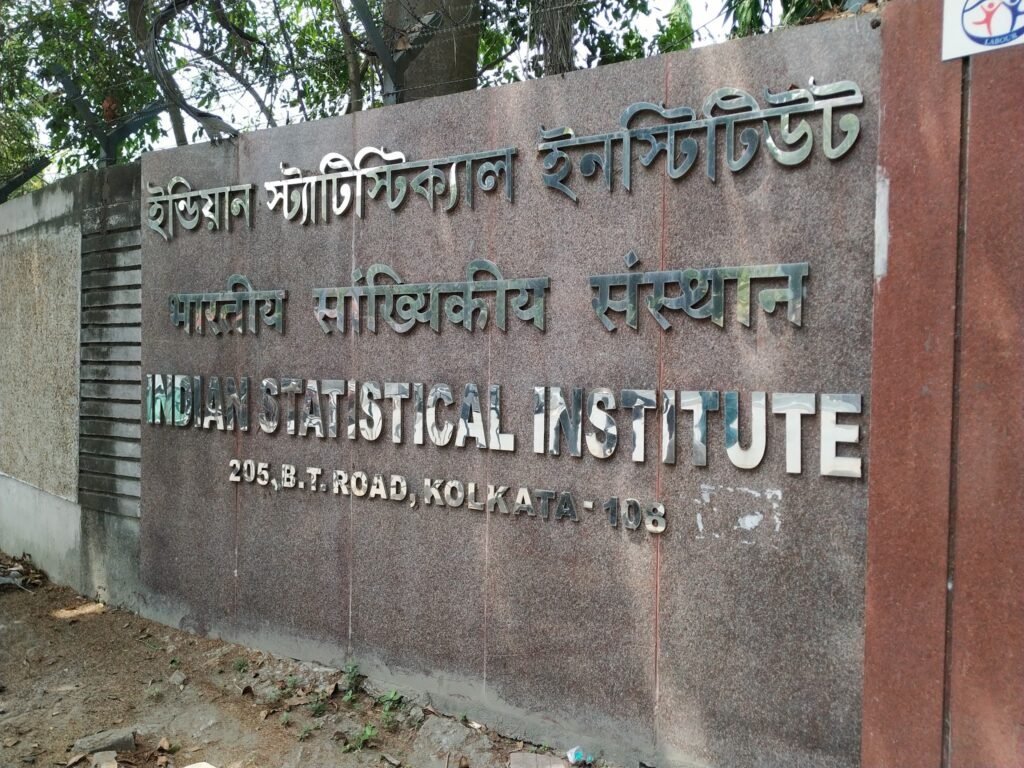
What is Indian Statistical Institute (ISI)?
- About: The Indian Statistical Institute (ISI) is a premier public research university and Institution of National Importance (INI).
- Establishment: ISI was established on 17 December 1931 by Prof. Prasanta Chandra Mahalanobis in Kolkata.
- It emerged from the Statistical Laboratory of Presidency College.
- In April 1932, it was registered under the Societies Registration Act of 1860, and later re-registered under the West Bengal Societies Registration Act of 1961.
- Legal Status: The Indian Statistical Institute Act, 1959 declared ISI an Institution of National Importance (INI).
- This status empowers it to award degrees and undertake nationally significant research.
- ISI functions under the Ministry of Statistics and Programme Implementation (MoSPI).
- Vision: ISI promotes statistical theory, develops research methodologies, and applies statistics to natural sciences, social sciences, industry, planning, and public policy.
- Its objective is evidence-based national development through scientific decision-making.
- Institutional Network: ISI headquarters are in Kolkata, with major centres at Delhi, Bengaluru, Chennai, and Tezpur.
- Additional units in Hyderabad, Mumbai, Pune, Vadodara, and Coimbatore provide consultancy and industrial support.
- Structure: A 33-member Council governs the organization.
- It is led by an elected chairman, including six Central government representatives from MoSPI, the Finance Ministry, and the RBI, alongside external scientists.
- Oversight is provided by a General Body of more than 1,000 members. Any regulatory changes require a three-fourths approval vote from this larger body.
- Roles:
- Academic Excellence: ISI offers Undergraduate, Postgraduate, Doctoral, and Diploma programmes in Statistics, Mathematics, Computer Science, Quantitative Economics, Data Science, and Statistical Quality Control.
- Research Strength: It conducts advanced work in artificial intelligence, machine learning, cryptography, operations research, probability, economics, and mathematical sciences, publishing internationally recognised research.
- National Contribution: ISI pioneered sample survey methodology, statistical quality control, and contributed significantly to India’s planning process.
- Mahalanobis’ statistical framework influenced the Second Five-Year Plan and strengthened official statistics.
- Significance: ISI supports Census analysis, quality management, agricultural estimation, industrial productivity, and policy evaluation.
- ISI is internationally recognised for excellence in theoretical statistics, mathematical sciences, quantitative economics, and computer science.
- ISI housed Asia’s first digital computer in the 1950s, setting regional benchmarks in computer science engineering.
- ISI works closely with international bodies like the UN Statistical Office, influencing global economic planning.
- Recent Reform: The government introduced the Indian Statistical Institute Bill, 2026 in Lok Sabha on August 3, 2026, citing that:
- The Indian Statistical Institute Act, 1959 was enacted over six decades ago. Rapid advances in data science, artificial intelligence (AI), and digital governance created the need for a contemporary legal framework.
- Despite four Review Committees recommending a smaller Council, the ISI governing body expanded to 33 members.
- The fourth committee specifically criticized an over-reliance on elections rather than merit-based appointments for key decision-making roles.
- To fix these governance issues, the government aims to restructure ISI to match other Institutions of National Importance like IITs and IIMs.
Provisions of the Indian Statistical Institute Bill, 2026
- Statutory Body Corporate: It transitions ISI into a statutory body corporate.
- The Bill will repeal and replace the outdated Indian Statistical Institute Act, 1959.
- This will create a not-for-profit legal entity with an independent, permanent framework.
- Appointment of Visitor: The President of India will be designated as the official Visitor of ISI, aligning it with IITs.
- The Visitor will hold binding powers to order inquiries, conduct inspections, and review work progress.
- Board of Governors: The existing Council will be replaced by a compact 11-member Board of Governors. It will consist of:
- Chairperson: Nominated by the Visitor via Central recommendation.
- Government Officials: Two members at Joint Secretary-level or higher.
- Statistical Experts: Four eminent persons chosen by the Chairperson.
- Institute Representatives: Four members, including two from the Academic Council.
- Board Secretary: The Registrar of ISI.
- This board will serve as the principal policy-making executive body accountable to the Union government.
- Board Composition: The Board Chairperson will be nominated by the Visitor and must be an eminent person from academia, industry, or public policy.
- It will include two representatives from MoSPI (not below Joint Secretary) and four eminent experts.
- Academic Council: An Academic Council will be established as the principal academic body to manage admissions, courses, and examinations.
- It will be chaired by the Director and include all full-time professors.
- Appointment of Director: The Board will appoint the Director as Chief Executive Officer with prior approval from the Visitor.
- The Board will be able to remove the Director under specified conditions, subject to Visitor approval.
- Financial Oversight: A dedicated Finance Committee will be formed to scrutinize institutional accounts and expenditure.
- Financial control will be tightened through mandatory Comptroller and Auditor General (CAG) audits.
- Structural Decentralization: The Bill mandates a Management Council for each center for local general superintendence.
- It permits establishing new centers in India or abroad with prior government approval.
- Central Government Intervention: The government will be able to issue directives solely for efficient administration.
- Crucially, the Bill will remove the 2-year takeover power the Centre held under the 1959 Act.
Concerns Regarding the Indian Statistical Institute Bill, 2026
- Centralised Governance: Critics argue that the proposed Board of Governors could increase Central Government influence.
- The government may directly or indirectly influence 8 of the 11 members, potentially reducing institutional autonomy and independent decision-making.
- Director’s Independence: The Bill provides for periodic performance reviews of the Director and includes government nominees in the selection process.
- Critics fear this may weaken academic independence and make the Director more vulnerable to executive influence.
- Reduced Role of Existing Council: The Bill replaces the existing Council-based governance with new statutory bodies.
- Critics believe this could diminish the participation of elected academic representatives in institutional policymaking.
- Limited Stakeholder Consultation: Faculty associations and student groups contend that the Bill was introduced without adequate consultation with the ISI community.
- The government counters that a national brainstorming session involving stakeholders was held in Bengaluru in July 2025 before drafting the legislation.
- Kolkata Headquarters Issue: The Bill does not explicitly designate Kolkata as ISI’s registered office.
- Critics fear this omission could permit a future relocation of headquarters, whereas the government has clarified that no proposal exists to shift the headquarters.
Frequently Asked Questions (FAQs):
1. What is the Indian Statistical Institute Bill?
It replaces the 1959 Act, modernising ISI’s governance while retaining its Institution of National Importance status.
2. Why was the Indian Statistical Institute Bill introduced in Lok Sabha?
To modernise governance, strengthen research, expand academic capacity, and align ISI with emerging data-driven scientific needs.
3. What changes does the Bill propose for the Indian Statistical Institute?
It creates a Board of Governors, Academic Council, updated governance, and enables new centres and academic programmes.
4. How will the Bill impact students and researchers?
It improves academic opportunities, research infrastructure, interdisciplinary programmes, and institutional efficiency for better learning outcomes.
5. What is the significance of the Indian Statistical Institute in India?
ISI advances statistics, data science, research, policy support, and evidence-based governance, strengthening India’s scientific ecosystem.
Disclaimer: Information in this article is based on official announcements and public records. Regulations and implementation details may evolve over time.