




Veer Guardian 2026: Japanese Fighter Jets India Debut and the Joining of Indigenous Tejas
| General Studies Paper III: Defence Cooperation, Various Security Forces & Agencies |
Why in News?
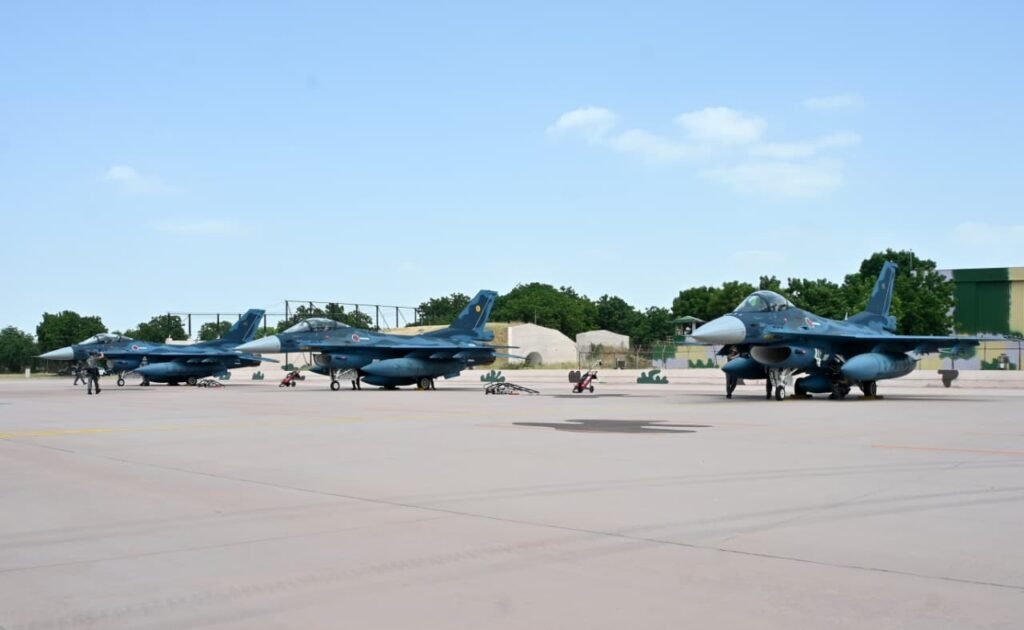
Recently, Japan’s F-2A fighter jets made their historic debut on Indian soil at Jodhpur Air Force Station for Exercise Veer Guardian 2026, integrating with India’s indigenous HAL Tejas.
What is Exercise Veer Guardian 2026?
- About: Veer Guardian is a bilateral air exercise between the Indian Air Force (IAF) and the Japan Air Self-Defense Force (JASDF).
- It is designed to improve air-combat interoperability, tactical proficiency, operational understanding and professional cooperation between the two air forces.
- It forms part of the expanding India-Japan defence relationship, complementing broader military cooperation.
- Edition: It is the second edition and is being conducted at Air Force Station Jodhpur, Rajasthan, from 9 September to 22 September 2026, making it a 14-day bilateral exercise.
- The first edition, Veer Guardian-2023, was held in Japan.
- It followed the September 2022 India-Japan 2+2 Foreign and Defence Ministerial Meeting, where both sides agreed to expand defence cooperation.
- The inaugural exercise took place at Hyakuri Air Base and surrounding airspace from 12–26 January 2023.
- The first edition, Veer Guardian-2023, was held in Japan.
- Participation: The IAF is participating with a diverse combination of frontline combat aircraft: the indigenous Light Combat Aircraft (LCA) Tejas, Su-30 MKI, and Rafale jets.
- The JASDF contingent brought approximately 110 personnel, two C-2 transport aircraft, and three Mitsubishi F-2A fighter aircraft from Tsuiki Air Base.
- This is the first time Japanese fighter aircraft have operated from Indian territory during a bilateral exercise with India.
- In 2023, India deployed four Su-30MKI, two C-17 Globemaster III and one IL-78 aircraft, while Japan deployed four F-2 and four F-15 aircraft.
- Training covered air-combat manoeuvring and air-defence missions, including Visual Range and Beyond Visual Range scenarios.
- This is the first time Japanese fighter aircraft have operated from Indian territory during a bilateral exercise with India.
- The JASDF contingent brought approximately 110 personnel, two C-2 transport aircraft, and three Mitsubishi F-2A fighter aircraft from Tsuiki Air Base.
- Focus Areas: The exercise includes advanced operational missions, mission-planning conferences, subject-matter-expert exchanges, and professional interaction concerning engineering and aerospace safety.
- The training primarily prioritizes Air Combat Manoeuvring (ACM), complex tactical coordination, and tactical proficiency.
- As of 21 September 2026, Japanese F-2A fighters have operated from Indian soil, while IAF and JASDF personnel have conducted operational and professional interactions.
- Operating it alongside Tejas, Su-30MKI and Rafale creates opportunities for dissimilar-aircraft training and comparison of operational approaches.
- On 20 September, IAF Chief Air Chief Marshal A.P. Singh and JASDF Chief of Staff General Takehiro Morita participated in a Tejas formation sortie, providing a high-level demonstration of mutual confidence and professional engagement.
Japanese Mitsubishi F-2A Fighters
- About: The Mitsubishi F-2A is a single-seat multirole/support fighter operated by the JASDF.
- It was developed from the American F-16 design, but substantially modified for Japan’s geographical conditions.
- Development: The F-2 emerged from a Japan-US joint development programme known initially as FS-X. Mitsubishi Heavy Industries (MHI) was the primary Japanese contractor.
- While Lockheed Martin and Japanese companies including Kawasaki Heavy Industries and Fuji Heavy Industries participated in the programme.
- The development agreement dates to 1988; the prototype first flew in October 1995, the first prototype was delivered in March 1996, and the first production aircraft was delivered in September 2000.
- A 1997 U.S. Government Accountability Office assessment projected an average procurement cost of about US$80 million per aircraft in constant 1996 dollars, while Japan’s overall programme cost was estimated at about US$14 billion.
- Technology: Compared with the F-16, the F-2 has a larger wing, incorporating advanced materials and composite structures.
- Its enlarged wing improves manoeuvrability, while weight-reduction technologies contribute to aerodynamic performance.
- Features:
- One of its major technological distinctions is its active electronically scanned/active phased-array radar capability.
- The aircraft also incorporates an integrated electronic-warfare system, advanced onboard computer systems, and sophisticated navigation.
- The F-2A uses the F110-GE-129 turbofan engine and has a maximum speed of approximately Mach 2.0.
- JASDF specifications list the aircraft at 15.5 m length, 11.1 m wingspan and 5 m height.
- The F-2 was designed with particular emphasis on maritime defence and anti-ship warfare.
- Its design supports long-range anti-ship missile employment, alongside 20-mm cannon, radar-guided air-to-air missiles and infrared-guided air-to-air missiles.
- The aircraft incorporates an integrated electronic-warfare system, improved structural and cockpit protection, and a fly-by-wire control system.
- Japan continues upgrading F-2 capabilities, including anti-ship attack and networking functions.
- Japan’s defence planning identifies the F-2 as an aircraft approaching replacement, with its successor being developed through the Japan-led Global Combat Air Programme (GCAP) with the UK and Italy.
What is Light Combat Aircraft (LCA) Tejas?
- About: The LCA Tejas is a fourth-generation-plus, single-engine, delta-wing, lightweight multirole supersonic fighter aircraft designed for the Indian military.
- It is the smallest and lightest supersonic combat aircraft in its class worldwide.
- The name Tejas, meaning “Radiance” in Sanskrit, was officially bestowed by the Indian government in 2003.
- Developed By: The aircraft was conceptualized and designed by the Aeronautical Development Agency (ADA), functioning under India’s Defence Research and Development Organisation (DRDO).
- It is manufactured by the state-owned aerospace giant Hindustan Aeronautics Limited (HAL) to equip the Indian Air Force (IAF) and Indian Navy.
- Origin: The program originated in 1983 under the Light Combat Aircraft (LCA) programme.
- Its primary objective was to replace the aging, Soviet-era MiG-21 fleet that formed the backbone of India’s air defense.
- The project sought to cultivate a robust domestic defense industrial base and eliminate reliance on foreign suppliers.
- Evolution: The LCA’s design was finalized in 1990, leading to its maiden flight in January 2001.
- It achieved Initial Operational Clearance (IOC) in 2011 and Final Operational Clearance (FOC) in 2019.
- The platform evolved from the base Mark 1 variant to the more advanced Tejas Mk-1A, which integrates over 65% indigenous components.
- The first operational IAF squadron, 45 Squadron, was established in 2016, followed by the induction of Tejas into another operational squadron.
- Features:
- Tejas features an unstable aerodynamic configuration coupled with a quadruplex digital fly-by-wire flight control system for high maneuverability.
- It boasts a glass cockpit with Hands-On Throttle and Stick (HOTAS) controls, an AESA radar, an electronic warfare suite, and air-to-air refueling.
- It carries a 7,700 lb payload across eight hardpoints, including Beyond-Visual-Range (BVR) missiles.
- Tejas uses a compound delta, tailless configuration, extensive composite materials, quadruplex digital fly-by-wire controls, an open-architecture mission computer, nine hard points and compatibility with various air-to-air and air-to-ground weapons.
- Tejas represents India’s transition toward absolute Aatmanirbharta (self-reliance) in high-tech defense engineering.
- It serves as a catalyst for local MSMEs and has successfully established a multi-generation aerospace ecosystem.
- With massive domestic orders totaling roughly 180 jets, Tejas also anchors India’s emerging global defense export strategy.
- Developments:
- In September 2025, the Ministry of Defence signed a ₹62,370-crore contract for 97 Mk1A aircraft, comprising 68 fighters and 29 twin-seaters.
- The 2025 procurement specifies additional indigenous systems such as UTTAM AESA radar, Swayam Raksha Kavach and control-surface actuators.
- HAL and ADA are actively advancing the Tejas Mark 2 (Medium Weight Fighter), featuring a more powerful GE F414-INS6 engine, integrated infrared search and track (IRST), and close-coupled canards.
- It will replace larger legacy jets like the Mirage 2000 and Jaguar. Prototype rollout is targeted for 2026, paving the way for mass production.
- In September 2025, the Ministry of Defence signed a ₹62,370-crore contract for 97 Mk1A aircraft, comprising 68 fighters and 29 twin-seaters.
Significance of Exercise Veer Guardian 2026
- Veer Guardian improves India-Japan Air Force interoperability by allowing two air forces with different aircraft, doctrines, communications practices and operational procedures to train together.
- Mission planning helps identify practical differences before any real-world joint operation or coordinated contingency.
- The JASDF fighter aircraft landed and operated from an Indian air base for the very first time. This historic deployment signals a profound shift from traditional symbolic diplomacy to real-world, operational military synergy.
- It demonstrates Japan’s evolving capacity to project and sustain combat power far from its shores across the critical sea lanes of the Indo-Pacific.
- India and Japan share an interest in a free, open and rules-based Indo-Pacific.
- Greater air-force cooperation contributes to their broader strategic engagement in a region characterised by important contested maritime spaces and evolving security challenges.
- Conducted amid growing geopolitical friction, the drill reinforces the India-Japan strategic alignment against coercive regional actions.
- By elevating bilateral air defense cooperation, both nations reaffirm their commitment to a rules-based regional order.
- This functions as a vital pillar alongside multilateral frameworks like the Quad.
- For the IAF, practicing directly with F-2A fighters offers a unique tactical advantage.
- Since the F-2A shares its core airframe lineage with the American F-16 Falcon, the drills provide Indian pilots with invaluable, first-hand combat simulation and tactical experience against a platform widely operated by regional adversaries.
- The inclusion of India’s indigenous LCA Tejas alongside frontline multirole Su-30MKI and Rafale jets highlights the maturing capabilities of Make in India aerospace technology.
- Security cooperation supports a relationship extending well beyond military affairs.
- India-Japan bilateral trade reached US$25.15 billion in FY2024-25, while cumulative Japanese FDI in India stood at approximately US$44.4 billion.
- Around 1,400 Japanese companies are registered in India, with nearly 5,000 business establishments, while Japanese ODA has supported Indian infrastructure and development for decades.
Frequently Asked Questions (FAQs):
1. Why did Japanese fighter jets operate from Indian soil for the first time?
To strengthen operational interoperability, strategic trust, deployment capability and Indo-Pacific defence cooperation between India and Japan.
2. What is Veer Guardian 2026 air exercise?
It is a bilateral air exercise between the IAF and JASDF, conducted at Jodhpur from September 9–22, 2026.
3. Which Japanese fighter aircraft are participating in Veer Guardian 2026?
The Japan Air Self-Defense Force’s Mitsubishi F-2A fighter aircraft are participating in the exercise.
4. Which Indian fighter jets are participating in the India-Japan exercise?
India is participating with LCA Tejas, Su-30MKI and Rafale frontline combat aircraft.
5. When did Japanese F-2A fighters arrive in India?
Japanese F-2A fighters arrived at Jodhpur in September 2026, deployed from Tsuiki Air Base, Japan for the exercise.
Disclaimer: Information in this article is based on official announcements and public records. Details may evolve over time.