President To Present National Teachers Awards 2026 at Vigyan Bhawan
| General Studies Paper II: Awards & Recognition, Important Personalities |
Why in News?
President Droupadi Murmu will confer National Teachers’ Awards 2026 on 48 school teachers on Teachers’ Day ( September 5) at Vigyan Bhawan, recognising measurable contributions to student development.
What are National Teachers’ Awards?
- About: The National Teachers’ Awards (NTA) are the Union Government’s national-level recognition for meritorious school teachers whose commitment, innovation and impact improve educational quality and enrich students’ lives.
- The NTA is given annually to exceptional teachers from across the country.
- Origin: The Awards were instituted in 1958 to recognise remarkable teachers and headmasters.
- Objectives: It seeks to celebrate exemplary teaching, encourage innovation, and motivate teachers to contribute towards holistic student development.
- Ministry: The Awards function under the Ministry of Education, with the Department of School Education & Literacy (DoSEL).
- DoSEL is responsible for organising the annual national ceremony and administering the selection framework.
- Award Presenter: Awards are traditionally presented by the President of India or Vice-President on 5 September—Teachers’ Day.
- Teachers’ Day marks the birth anniversary of Dr. Sarvepalli Radhakrishnan (1888-1975).
- Eligibility: Eligible applicants include regular teachers and Heads of Schools with at least 10 years’ service in recognised schools.
- Contractual teachers, Shiksha Mitras, education administrators and inspectors are excluded.
- Eligibility extends across State/UT schools, local-body and aided schools, CBSE/CISCE schools, and Central institutions including KVs, JNVs, Sainik Schools, AEES and EMRS.
- Selection Process:
- Eligible school teachers and heads of institutions directly register and submit their portfolios via the official National Awards Portal.
- District / Regional Selection Committee (DSC / RSC) scrutinises applications and verifies all submitted physical and digital data. They shortlist candidates to advance to the state tier.
- The assessment gives 10 marks to objective criteria and 90 marks to performance—including innovation, learning outcomes, teaching-learning materials, experiential learning and co-curricular initiatives.
- State-level State / Organisation Selection Committee (SSC / OSC) screen the district nominees. They then forward the highest-ranked candidates to the national level.
- An independent National Jury reviews the finalists, often conducting video conference (VC) interviews. They make final selections based on innovative teaching, and learning outcomes.
- Following the jury’s decision, names are sent to the Union Education Minister for executive sign-off.
- Components: Each Award has carried a certificate of merit, ₹50,000 cash prize and silver medal.
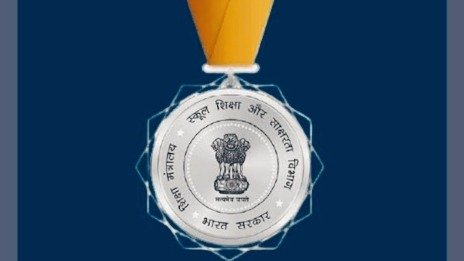
- The circular sterling silver medal features the State Emblem of India on the front and “National Award to Teachers” in the back. It comes on a ribbon inside a velvet-lined case.
- Significance: The Awards reinforce National Education Policy (NEP) 2020 priorities—quality teaching, experiential learning, innovation, and improved learning outcomes.
- It honors exceptional primary, middle, and secondary school educators who drive educational excellence.
- This recognition celebrates educators making a tangible, lasting difference within their classrooms and communities.
National Teachers’ Awards 2026
- Total Selection: 48 school teachers have been selected for the National Teachers’ Awards 2026.
- The awardees represent 27 States, 7 Union Territories and 6 Central Government organisations.
- The composition includes 26 male and 22 female teachers.
- Presentation: The awards will be conferred by President Droupadi Murmu on 5 September 2026 (Teachers’ Day) at Vigyan Bhawan, New Delhi.
| National Teachers’ Awards 2026 List | |||
| No. | Awardee | State / UT / Organisation | School / Institution |
| 1 | J Prakash Rao | Andaman & Nicobar Islands | PM SHRI GMSSS Mayabunder, Pokadera |
| 2 | Rajesh Kouluri | Andhra Pradesh | MPPS Chinamallupeta |
| 3 | Yaku Tame | Arunachal Pradesh | Government Secondary School, G-Sector Naharlagun |
| 4 | Rajesh Bordoloi | Assam | Adarsha Tribal Higher Secondary School, Jorhat |
| 5 | Khushboo Kumari | Bihar | Urdu Primary School Bidaydih |
| 6 | Pushpa Prasad | Bihar | Middle School Kuchaikote Kanya |
| 7 | Radha Rajesh | CISCE | New Horizon Public School, Indiranagar |
| 8 | Sangeeta Yadav | CBSE | St. Joseph’s Convent Sr. Sec. School |
| 9 | Ravi Jaiswal | Chandigarh | Government Model High School, Maloya Colony |
| 10 | Sunita Yadav | Chhattisgarh | Govt M S Khichari |
| 11 | Patel Purnima Mohanlal | DNH & DD | GHS Dalwada |
| 12 | Suman Goel | Delhi | GSKV Pooth Kalan |
| 13 | Md Zafar Alam | EMRS | EMRS Karanjia, Binuria (Tato) |
| 14 | Mahadev Hanamant Shinde | Goa | Gujarati Samaj-Special School, Aquem |
| 15 | Nitin Kumar Mahendrakumar Pathak | Gujarat | Rangpur Primary School |
| 16 | Anil Kaushik | Haryana | GMSSSS Sanghi, Rohtak |
| 17 | Manjari V Mahajan | Himachal Pradesh | Government Senior Secondary School, Bhaleth |
| 18 | Mohd Ayaz Raina | Jammu & Kashmir | HSS Dalhori |
| 19 | Munmun Bhattacharjee | Jharkhand | MS Barmasia |
| 20 | Rathnakumari S | Karnataka | Government Higher Primary School Samatagaru |
| 21 | Amutha J | KVS | PM SHRI KV No. 2, Madurai |
| 22 | Manisha Khetrapal | KVS | PM SHRI KV NFR Rangiya |
| 23 | Sunil Kumar KP | Kerala | GHSS Irikkur |
| 24 | Mohd Mustafa Kumal | Ladakh | Government Middle School Zgangjing, Sankoo |
| 25 | Archana Shukla | Madhya Pradesh | Govt Mahatma Gandhi Sandipani Hr. Sec. School, Bhopal |
| 26 | Shailendra Pratap Singh | Madhya Pradesh | Government Middle School Kanjwar |
| 27 | Kavita Narsingrao Gitte | Maharashtra | Sane Guruji Niwasi Vidyalaya, Kaij |
| 28 | Kunda Jayawant Bachhav | Maharashtra | NMC School No. 18, Anandwali, Nashik |
| 29 | Wanglembam Gobin Singh | Manipur | Laikon Upper Primary School |
| 30 | Lalnunmawii | Mizoram | Government Electric Veng High School |
| 31 | R Ronald Meru | Nagaland | GHSS Sechu Zubza |
| 32 | Vaibhav Vasantrao Kulkarni | NVS | PM SHRI Jawahar Navodaya Vidyalaya, Latur |
| 33 | Padaraj Umakanta Nayak | Odisha | Government High School Alipingal |
| 34 | Ganesan S | Puducherry | Viduthalai Veerar R Seenuvasan Government High School |
| 35 | Dinesh Kumar | Punjab | Govt Victoria Girls Senior Secondary School, Patiala |
| 36 | Divyendu Sen | Rajasthan | Mahatma Gandhi Government School, Pachpahar |
| 37 | Vartika Gulati | Rajasthan | GGUPS Tumli Ka Bas Chaksu, Jaipur |
| 38 | Shivprasad Arvind Tingare | Sainik Schools | Sainik School Satara |
| 39 | Sushma Tamang | Sikkim | PM SHRI Government Senior Secondary School, Dikling |
| 40 | Thanga Raj M | Tamil Nadu | Panchayat Union Primary School, Puliyampatti |
| 41 | Bhavani Bompelly | Telangana | MPPS Girls Gandhari |
| 42 | Ranjan Debnath | Tripura | PM SHRI Sabroom Girls HS School |
| 43 | Renu Tripathi | Uttar Pradesh | Government Balika Inter College, Vijay Nagar, Ghaziabad |
| 44 | Iftkhar Khan | Uttar Pradesh | Government Inter College, Ballia |
| 45 | Shalini Kushwaha | Uttar Pradesh | Composite School Rasoolabad |
| 46 | Gabar Singh | Uttarakhand | Government UPS Musyakhand |
| 47 | Palash Chowdhury | West Bengal | Sri Ramkrishna Sarada Vidyapith Primary School |
| 48 | Santanu Patra | West Bengal | Government Model School, Nayagram Block |
Teachers’ Day in India
- About: Teachers’ Day is observed annually on 5 September in India to honour teachers and recognise their contribution to education, character-building and nation-building.
- Origin: The date commemorates the birth anniversary of Dr. Sarvepalli Radhakrishnan.
- 5 September was chosen because Dr. Radhakrishnan was born on 5 September 1888.
- Teachers’ Day emerged in 1962, the year Radhakrishnan became India’s second President.
- When admirers wanted to celebrate his birthday, he suggested observing 5 September as Teachers’ Day instead.
- About Radhakrishnan:
- He was an eminent philosopher, educationist, professor and statesman.
- He was born into a Telugu family in Tiruttani town of Tamil Nadu.
- His academic career included teaching at the University of Mysore and University of Calcutta.
- His scholarship helped introduce Indian philosophy to Western audiences.
- He grounded his philosophy in Advaita Vedanta, reinterpreting the tradition to fit a modern, global audience.
- He regarded education as more than information acquisition. His approach emphasised reason, democratic spirit, moral values and responsible citizenship.
- He held numerous prestigious academic positions throughout his career.
- Between 1921 and 1952, he served as the King George V Chair at Calcutta University, Vice-Chancellor at both Andhra and Banaras Hindu Universities, and Professor of Eastern Religion and Ethics at the University of Oxford.
- Radhakrishnan served as Vice-President (1952–1962) and subsequently President (1962–1967).
- He also served as India’s Ambassador to the Soviet Union (1949–1952) and held major academic positions, linking scholarship with public life.
- His major works include highly influential books like Indian Philosophy, The Hindu View of Life, and An Idealist View of Life.
- For his distinguished service to education, he was knighted by King George V in 1931, though he stopped using the title “Sir” after India gained independence.
- In 1954, he became one of the inaugural recipients of the Bharat Ratna, India’s highest civilian honor.
Frequently Asked Questions (FAQs):
1. When will the National Teachers Awards 2026 be presented?
5 September 2026, at Vigyan Bhawan, New Delhi, on Teachers’ Day.
2. How many teachers will receive the National Teachers Awards in 2026?
A total of 48 school teachers will receive the National Teachers Awards 2026.
3. Who will present the National Teachers Awards 2026?
President Droupadi Murmu will confer the National Teachers Awards 2026.
4. Why is September 5 celebrated as Teachers’ Day in India?
It marks Dr. Sarvepalli Radhakrishnan’s birth anniversary, honouring his contributions as an educationist and philosopher.
5. Who is eligible for the National Teachers Award?
Eligible applicants include teachers from Central, State, UT, local-body, aided and recognised private schools, subject to guidelines.
6. How are teachers selected for the National Teachers Awards?
Selection proceeds through District/Regional committees, State/Organisation committees and an Independent National Jury, followed by approval.
Disclaimer: Information in this article is based on official announcements and public records. Regulations and implementation details may evolve over time.
| Also Read: National Anubhav Awards 2026 |