



2026 Europhysics Prize: Šmejkal, Sinova, and Jungwirth Won For Altermagnetism
| General Studies Paper III: Developments and Applications in Science and Technology |
Why in News?
Recently, Dr. Libor Šmejkal, Prof. Jairo Sinova, and Prof. Tomas Jungwirth were awarded the 2026 EPS Europhysics Prize for their groundbreaking discovery and theoretical foundation of “Altermagnetism”.
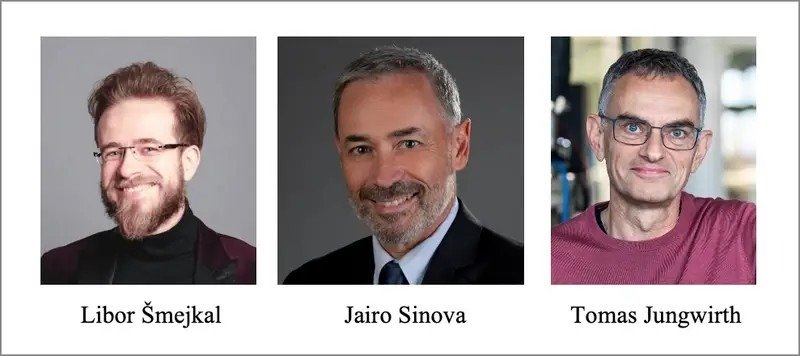
Image Credit: European Physical Society
2026 Europhysics Prize Highlights
- Announcement: The 2026 EPS Europhysics Prize was officially announced on July 24, 2026, by the European Physical Society (EPS).
- The laureates received this honor on September 22, 2026.
- The ceremony took place during the Awards Session of the 32nd General Conference of the EPS Condensed Matter Division (CMD32) held in Graz, Austria, organized jointly with the Austrian Physical Society.
- Winners: The award was jointly bestowed upon three distinguished physicists: Dr. Libor Šmejkal, Prof. Jairo Sinova, and Prof. Tomas Jungwirth.
- This marked the very first time that the Europhysics Prize was awarded to Czech scientists.
- All three laureates were affiliated with the Institute of Physics of the Czech Academy of Sciences.
- Prof. Jairo Sinova holds a prominent position at the Johannes Gutenberg University Mainz (JGU) in Germany and Texas A&M University.
- Discovery: The prize was awarded for the groundbreaking discovery of altermagnetism, a third fundamental class of collinear magnetic order.
- The scientists theorized altermagnetism to explain specific unconventional magnetic transport phenomena, such as the crystal anomalous Hall effect, which could not be accounted for by traditional classes.
- Šmejkal developed key theoretical concepts; Sinova contributed expertise in spintronics and condensed matter physics; Jungwirth played a central role in the collaborative research programme.
- Amount: EPS Europhysics Prize includes a cash award of €10,000, which is equally shared among the designated winners, alongside an official diploma.
About Europhysics Prize
- The EPS Europhysics Prize is one of Europe’s most prestigious awards in the domain of condensed matter physics.
- It is awarded by the Condensed Matter Division of the EPS. It was established in 1975.
- It is honoured to prominent, well-identifiable discovery, breakthrough, or contribution to condensed matter physics (pure or applied) where a significant portion of the work was carried out in Europe.
- Candidates must be nominated by peers via submission of a complete CV, a publication list, and key papers; self-nominations are strictly excluded.
- The final recipients are selected by an independent international Selection Committee appointed by the EPS.
- Prominent recipients include Albert Fert, Peter Grünberg and Stuart Parkin (1997) for giant magnetoresistance, a breakthrough underlying modern data-storage technologies.
- Claudia Felser and Andrei Bernevig (2023) for contributions to topological quantum materials; and Andrea Cavalleri (2024) for research on photo-induced phases in quantum materials.
What is Altermagnetism?
- About: Altermagnetism represents a newly verified, third fundamental class of collinear magnetic order.
- It bridges the historical dichotomy between ferromagnetism and antiferromagnetism.
- Principal: Its core principle is zero net macroscopic magnetization paired with an asymmetric internal electronic structure.
- Neighboring atomic spins are strictly antiparallel, eliminating stray magnetic fields.
- Its sublattices are connected by crystal rotation symmetries rather than simple spatial inversion or translation.
- In ferromagnets, magnetic moments align predominantly in the same direction, producing net magnetisation.
- In antiferromagnets, opposing moments cancel, generally producing zero net magnetisation.
- Mechanism: The underlying mechanism is governed by non-relativistic spin splitting (NRSS) of electronic bands in momentum space.
- Strong electronic correlations and local crystallographic distortions break time-reversal symmetry.
- This generates an alternating d-, g-, or i-wave parity spin polarization across the Brillouin zone.
- This robust energy-level splitting occurs intrinsically due to lattice symmetries, entirely independent of relativistic spin-orbit coupling (SOC).
- Discovery:
- The groundwork began with Landau and Lifshitz (1984) classifying magnetic space groups.
- In 2019, Libor Šmejkal, Tomas Jungwirth, and Jairo Sinova theoretically predicted altermagnetism using spin symmetry analysis.
- In 2022, the term was officially coined. A major breakthrough arrived in early 2024, when teams led by Juraj Krempasky (at the Swiss Light Source) and researchers at Johannes Gutenberg University Mainz experimentally confirmed the phase using spin-polarized photoemission spectroscopy on manganese telluride (alpha-MnTe) crystals.
- Breakthroughs and Applications:
- Spintronics: Altermagnets host spin-polarized currents and giant magnetoresistance without unwanted ferromagnetic dipole couplings, enabling dense, crosstalk-free device architectures.
- Quantum Materials: They introduce novel spin-triplet Cooper pairing and zero-field superconducting Josephson junctions, paving the way for topologically protected quantum computing qubits.
- Energy-Efficient Computing: Operating natively in the terahertz (THz) dynamics spectrum, they allow ultrafast digital switching and field-free perpendicular memory write cycles, dramatically curbing heat dissipation.
- Global Research:
- In April 2026, when researchers at the Oak Ridge National Laboratory confirmed a key signature of altermagnetism in hematite, a widely abundant and stable mineral.
- In August 2026 by a Rice University team led by Pengcheng Dai successfully isolated hexagonal manganese telluride into a single magnetic-domain state to accurately characterize its intrinsic magnetic structure.
- In October 2026, University of Nottingham-led team utilized the MAX IV synchrotron facility to verify that altermagnetic devices could operate up to 1,000 times faster than current memory technology while dramatically reducing energy consumption.
- A team led by Professor Madhab Neupane at the University of Central Florida reported further experimental evidence of the phenomenon in cobalt-intercalated tantalum diselenide (Co1/4TaSe2).
- The validation of over 200 altermagnetic candidates including metallic Chromium Antimonide (CrSb) and low-cost Manganese Silicide has ignited a global race in material synthesis.
- Industrial potential centers on scaling Magnetic Random-Access Memory (MRAM) to the 10 nm limit.
- Altermagnetism opens research pathways connecting quantum materials, unconventional superconductivity and topological physics.
- National science policies are heavily shifting funding toward semiconductor sovereignty and eco-friendly quantum infrastructure.
Frequently Asked Questions (FAQs):
1. Who received the 2026 Europhysics Prize for altermagnetism?
Libor Šmejkal, Jairo Sinova, and Tomáš Jungwirth received the prize for discovering altermagnetism.
2. What is altermagnetism?
Altermagnetism is a distinct magnetic order combining zero net magnetisation with momentum-dependent spin splitting of electronic energy bands.
3. Why is altermagnetism a major scientific breakthrough?
It establishes a third fundamental class of magnetism, potentially enabling faster, energy-efficient spintronic devices and advancing quantum-materials research.
4. How does altermagnetism differ from ferromagnetism and antiferromagnetism?
Ferromagnets have net magnetisation; antiferromagnets have compensated opposing moments; altermagnets combine compensation with symmetry-driven spin-split electronic bands.
5. Who are Jairo Sinova, Libor Šmejkal and Tomáš Jungwirth?
They are physicists specialising in spintronics, magnetism and quantum materials whose collaborative theoretical research established altermagnetism as a distinct magnetic class.
6. What is the European Physical Society’s Europhysics Prize?
Established in 1975, it is a prestigious condensed matter physics award recognising outstanding discoveries and contributions, particularly research substantially conducted in Europe.
Disclaimer: Information in this article is based on official announcements and public records. Details may evolve over time.
| Also Read: Nobel Prize 2026 in Physiology or Medicine |