


China Science Island Project Launched, Geopolitical and Scientific Implications
| General Studies Paper II: Science and Technology, Environment and Security |
Why in News?
Recently, China started the engineering construction phase for its Deep-Sea Floating “Science Island” project.
What is China’s Science Island Project?
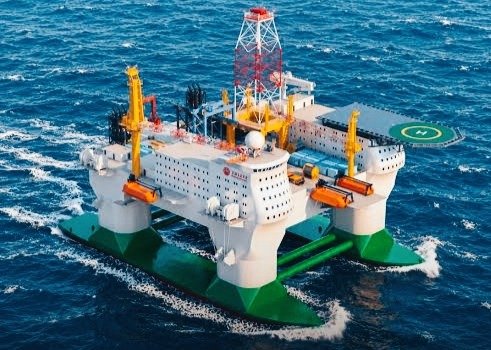
- About: China’s Science Island Project, also known as the Deep-Sea All-Weather Resident Floating Research Facility or China’s Offshore Floating Island, is a proposed mobile, semi-submersible marine research platform designed to support prolonged scientific and engineering operations in deep oceans.
- It will be the world’s first ultra-large, mobile, and self-sustaining artificial research platform.
- Vision: The project’s vision is to strengthen China’s deep-sea scientific capabilities, marine technological independence and sustainable ocean-resource utilisation.
- Need: Traditional research ships struggle to stay still or operate precision optical and analytical instruments in gale-force winds and heavy waves.
- Fixed platforms are stable but cannot move to new locations. Regular ships move easily but lack long-term stability.
- Location: The project is being developed in Shanghai, eastern China.
- Its supporting infrastructure includes the Shanghai Changxing Island base and Sanya base in Hainan.
- Agencies: Development is led by Shanghai Jiao Tong University (SJTU) alongside major engineering entities like Shanghai Waigaoqiao Shipbuilding, a subsidiary under the state-owned China State Shipbuilding Corporation (CSSC).
- The China Ship Design and Research Centre (708 Institute) developed the platform design.
- Fund: The platform construction contract is valued at approximately 2.76 billion yuan (RMB 2.763 billion), equivalent to around US$410 million at reported exchange rates.
- Development: The project entered its construction phase on 28 March 2026, when its development was formally initiated in Shanghai.
- On 18 October 2026, Shanghai Jiao Tong University signed the platform construction contract with Shanghai Waigaoqiao Shipbuilding.
- Delivery is scheduled for June 2030, subject to construction progress.
- Features:
- The platform uses an innovative semi-submersible twin-hull design, combining stability with independent navigation.
- The facility’s length: 138 meters, Width: 85 meters and Main deck height: 45 meters above the waterline.
- Its maximum displacement is approximately 74,000 tonnes, designed speed is 11 knots, and accommodation capacity is 238 people.
- It is designed to operate in Sea State 7 and safely withstand a Force 17 typhoon while in its designated survival condition.
- The platform boasts a comprehensive system hosting six distinct shipborne laboratories.
- These will be focused on testing multi-ton heavy marine equipment and deep-sea mineral extraction technologies.
- It features a nuclear-blast-proof design utilizing special metamaterial sandwich panels to absorb and dissipate shockwaves.
- It is equipped with a large moon pool capable of deploying up to 300-ton equipment to depths of 6,000 meters.
- Applications: The island will serve as a global hub for deep-sea mining systems evaluation, offshore oil and gas technology testing, marine biodiversity research, high-precision typhoon forecasting, and meteorological tracking.
- It will observe fragile marine ecosystems at depths reaching 10,000 meters.
- It will also facilitate testing of large subsea equipment under actual marine conditions.
China Floating Science Island Project Concerns
- Geopolitical:
- The project strengthens China’s position in oceanographic research and deep-sea engineering.
- Advanced marine infrastructure can increase its scientific influence, technological competitiveness and ability to undertake prolonged operations in distant ocean regions.
- Several technologies developed for civilian marine research, including underwater robotics, sonar, navigation, and communication, can also have defence applications.
- It can allow China to monitor underwater topography, acoustic signatures, and allied submarine paths near critical choke points.
- The Indo-Pacific contains important maritime trade routes, energy corridors and strategic waterways.
- The semi-submersible platform can function as a mobile logistics hub that can shift to contested corridors like the South China Sea or the Indian Ocean.
- This flexibility can extend China’s operational reach far beyond the First Island Chain.
- The deployment directly challenges deterrence structures established by the United States, India, and Australia.
- By embedding mobile sovereign assets across vital global sea lanes, Beijing can disrupt allied anti-submarine networks and limit the operational effectiveness of minilateral coalitions like the Quad.
- China can encroach upon the Exclusive Economic Zones (EEZs) of Southeast Asian states.
- This behavior can effectively normalise de facto Chinese administrative control.
- By lingering near transpacific undersea fiber-optic communication cables, it can present long-term risks regarding data interception, cable mapping, and potential strategic disruption during a conflict.
- Deep oceans contain valuable resources, including polymetallic nodules, cobalt-rich crusts and polymetallic sulphides.
- Better exploration and testing capabilities could improve China’s technological position in future seabed-resource industries.
- China plans to deploy the mobile platform in sensitive regions like the South China Sea, which often bypasses traditional multilateral environmental impact assessment frameworks established under bodies like the United Nations Convention on the Law of the Sea (UNCLOS).
- The project strengthens China’s position in oceanographic research and deep-sea engineering.
- Environmental:
- Equipment testing, seabed operations and repeated offshore activities could disturb habitats that recover extremely slowly.
- This can disrupt fragile benthic (seafloor) habitats and stir up sediment plumes.
- Continuous operation of machinery in remote or pristine waters generates persistent underwater noise.
- This can interfere with marine mammals (such as whales and dolphins) that rely on echolocation for navigation, communication, and feeding.
- Equipment testing, seabed operations and repeated offshore activities could disturb habitats that recover extremely slowly.
- India:
- This directly challenges the Indian Navy‘s role as the primary Net Security Provider in the Indian Ocean Region (IOR) by anchoring a permanent Chinese strategic presence.
- Its high-fidelity data collection capacity can enable the People’s Liberation Army Navy (PLAN) to map the dynamic “thermal layers” of the ocean, compromising the stealth of Indian Arihant-class ballistic missile submarines (SSBNs).
- In future, China can assert aggressive extraction claims in international waters, including the Central Indian Ocean Basin where India holds exclusive exploration rights granted by the International Seabed Authority (ISA).
- India’s Samudrayaan Project aims to develop MATSYA-6000, an indigenous manned submersible capable of carrying three aquanauts to a depth of 6,000 metres.
- The Ministry of Earth Sciences (MoES) is executing a ₹4,077-crore initiative featuring the development of Matsya-6000.
- India has expanded its sensor networks through the Information Fusion Centre – Indian Ocean Region (IFC-IOR) in Gurugram, tracking Chinese hydrographic survey vessels and dual-use assets in real time via white shipping agreements with over 20 partner nations.
- Launched on 7 September 2021, India’s Deep Ocean Mission is implemented by the Ministry of Earth Sciences.
- Its approved financial outlay is ₹4,077 crore for 2021–2026. The mission covers deep-sea technologies, ocean-climate services, and biodiversity conservation.
- India’s Samudrayaan Project aims to develop MATSYA-6000, an indigenous manned submersible capable of carrying three aquanauts to a depth of 6,000 metres.
- To counter China, India should accelerate indigenous development of underwater mining machines, autonomous underwater vehicles and remotely operated vehicles.
- India must strengthen its oceanographic research, and maritime domain awareness.
- India should examine the feasibility of developing a Deep Ocean Research and Testing Platform with long-duration operational capability.
Frequently Asked Questions (FAQs):
1. What is China’s aircraft carrier-sized Science Island project?
China’s Offshore Floating Island is a mobile, semi-submersible deep-sea research platform designed for prolonged ocean exploration.
2. What is the main objective of China’s Science Island?
Its primary objective is strengthening deep-sea research, marine engineering, resource exploration and ocean-weather forecasting through long-duration offshore operations.
3. What are the expected features of the floating research platform?
It will feature 74,000-tonne displacement, six laboratories, 238-person capacity, twin hulls and extreme-weather resistance.
4. How will the Science Island support China’s marine scientific research?
It will enable continuous ocean observations, deep-sea equipment testing, marine biodiversity studies, meteorological research and large-scale offshore experiments.
Disclaimer: Information in this article is based on official announcements and public records. Details may evolve over time.