



ASI Dwarka Underwater Exploration: Key Facts, Findings and Significance
| General Studies Paper II: Historical Places, Government Policies & Interventions |
Why in News?
Recently, the Archaeological Survey of India (ASI) moved to approve fresh deep-dive marine explorations off Dwarka and Bet Dwarka, Gujarat to uncover submerged historical and cultural ruins.
Dwarka Underwater Exploration
- Location: The Dwarka Underwater Exploration operates off the coasts of Dwarka and Bet Dwarka in Devbhoomi Dwarka, Gujarat, spanning the Gomati Creek mouth and the Arabian Sea.
- Dwarka lies on the Saurashtra peninsula, near the Gulf of Kutch.
- Bet Dwarka (Shankhodhara) is an island located off the Okha coast.
- Launched By: The Ministry of Culture through the revived Underwater Archaeology Wing (UAW) of the Archaeological Survey of India (ASI) launched this mission.
- Objective: The mission aims to locate, document, and preserve India’s submerged cultural heritage while establishing the exact antiquity of underwater ruins.
- Importance: Revered as one of Hinduism’s sacred Char Dham pilgrimage sites, Dwarka is traditionally believed to be the ancient kingdom founded by Lord Krishna that later sank beneath the ocean.
- The site bridges epic heritage with empirical maritime history, revealing a thriving ancient port city and vital hub of Indo-Arabian trade whose gradual submergence resulted from Holocene sea-level fluctuations, tectonic subsidence, and severe coastal erosion along the Okhamandal Peninsula.
- Exploration:
- Pioneering marine investigations began in 1983 under Dr. S.R. Rao and the National Institute of Oceanography (NIO).
- Following the UAW’s establishment in 2001, ASI conducted major onshore and offshore excavations from 2005 to 2007, unearthing 26 cultural layers near the Dwarkadhish Temple.
- Following renewed national focus after Prime Minister Narendra Modi’s February 2024 underwater dive, the ASI revived its mission in February 2025.
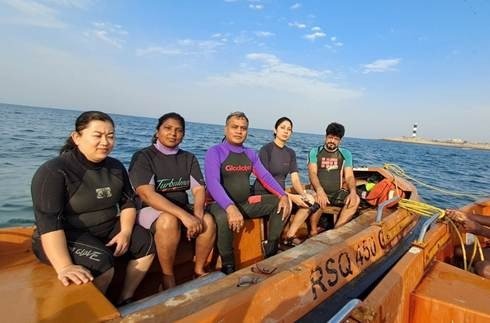
- It is led by Prof. Alok Tripathi featuring three women archaeologists.
- New surveys resumed near Gomati Creek, expanding into deeper offshore expeditions across 2025–2026 under India’s 2030 submerged heritage plan.
- According to the 13 November 2026 report, ASI is preparing another exploration programme. Activities could begin in December 2026.
- Funding: In its March 2025 parliamentary reply, the Ministry of Culture reported an initial allocation of ₹10 lakh for the current fieldwork.
- The government reported an ASI Underwater Archaeology Wing allocation of ₹75.40 lakh for 2025–26 and ₹66.50 lakh for 2026–27, as reported up to July 2026.
- Strategy: The ASI spearheads multidisciplinary research alongside the Indian Navy and NIO, seamlessly integrating onshore excavations with deep-sea surveys.
- Their modern strategy combines SCUBA diving, bathymetric mapping, side-scan sonar, Remotely Operated Vehicles (ROVs), and 3D photogrammetry to document submerged semicircular bastions without disturbing fragile marine ecosystems.
- It is complemented by radiocarbon and thermoluminescence dating to verify historical timelines and coastal settlement evolution.
- Their modern strategy combines SCUBA diving, bathymetric mapping, side-scan sonar, Remotely Operated Vehicles (ROVs), and 3D photogrammetry to document submerged semicircular bastions without disturbing fragile marine ecosystems.
Dwarka’s Connection with Ancient Indian Literature and Heritage
- Dwarka, derived from the Sanskrit word dvara meaning gate, stands on the Saurashtra coast where the Gomti River meets the Arabian Sea.
- Ancient texts call it Kushasthali, Dwaravati, and Mokshapuri.
- According to tradition, Lord Krishna migrated from Mathura with the Yadava clan to protect them from Jarasandha and reclaimed twelve yojanas of land from Samudradeva.
- The celestial architect Vishwakarma designed this fortified coastal capital.
- The Mahabharata and its appendix, the Harivamsa, portray Dwarka as a prosperous maritime city-state protected by natural sea barriers and massive walls.
- These epics describe broad avenues, royal gardens, the Sudharma assembly hall, and bustling trade ports.
- In the Mausala Parva, Arjuna evacuates the residents before the ocean swallows the golden city immediately after Krishna’s departure, marking the symbolic dawn of Kali Yuga.
- The Bhagavata, Vishnu, and Skanda Puranas celebrate Dwarka as a timeless seat of dharma and spiritual liberation.
- Classical traditions recognize it among the seven sacred Sapta Puri cities and the four Char Dham pilgrimage sites.
- Later, Adi Shankaracharya established the western Sharada Peeth here, cementing its enduring intellectual legacy in Advaita Vedanta, monastic discipline, and classical Sanskrit scholarship.
- Today, the five-storied Dwarkadhish Temple, also known as Jagat Mandir, anchors the city’s living heritage.
- Originally linked to Krishna’s great-grandson Vajranabha and rebuilt in the 16th century, its Chalukyan architecture showcases intricate limestone carvings and soaring temple spires.
- Neighboring landmarks like Nageshwar Jyotirlinga, Rukmini Devi Temple, and Gomti Ghat sustain centuries of devotion, and living coastal traditions.
- Bet Dwarka was mentioned as Antardvipa in the Mahabharata.
- It was ruled by the Gujarat Sultanate (conquered by Mahmud Begada in 1473), later by the Gaekwads of Baroda, and briefly controlled by Vaghers during the 1857 rebellion before being recaptured.
- Opened in February 2024, the Sudarshan Setu (Okha–Beyt Dwarka Signature Bridge) is India’s longest cable-stayed bridge (~2.32 km), connecting the island directly to the mainland.
Archaeological Evidence at Dwarka
- In 1983, explorations near the Gomti River revealed extensive submerged remains at depths between 3 and 12 meters, alongside deeper anomalies extending down to 40 meters.
- Divers documented dressed sandstone blocks, L-shaped fortification walls, circular bastions, pillars, and stone jetties arranged in geometric patterns.
- At Bet Dwarka, researchers uncovered rock-cut slipways engineered for launching boats alongside rubble protection walls.
- Dr. Rao interpreted these formations as Bronze Age port fortifications matching epic descriptions.
- Several semicircular and rectangular block alignments also reflect historical to medieval harbor installations.
- Over 130 stone anchors of diverse typologies—including triangular, composite, ring, and Indo-Arabian grapnel varieties—were recovered from the seabed among and beyond the structural ruins.
- These heavy anchors, alongside copper ingots, coppersmith stone moulds, and iron artifacts, confirm that the Okhamandal coast operated as a major international maritime anchorage.
- Excavations yielded Late Harappan pottery, Lustrous Red Ware, Red Polished Ware, and amphora fragments, establishing continuous coastal occupation.
- Notable finds include a Late Indus three-headed animal seal and an inscribed terracotta jar bearing Indus-Brahmi script characters, plus terracotta beads, shell bangles, and kārṣāpaṇa copper coins recovered from onshore stratigraphic trenches.
- Thermoluminescence and radiocarbon dating place the earliest ceramic and organic layers between 1900 BCE and 1500 BCE, with continuous urban rebuilding spanning eight sequential settlements into the historical era.
Significance
- Dwarka’s submerged archaeological remains represent an important component of India’s underwater cultural heritage.
- Scientific documentation helps prevent the irreversible loss of valuable archaeological information.
- Submerged archaeological sites provide valuable evidence for studying historical sea-level fluctuations, shoreline migration and coastal geomorphology.
- Geological investigations can help distinguish gradual coastal changes from local subsidence, erosion and other natural processes.
- Studying Dwarka’s submergence enables Indian oceanographers to reconstruct paleo-shorelines and model long-term climate change impacts along the Arabian Sea coastline.
- These multi-decade explorations strengthen India’s indigenous oceanographic capabilities and deep-sea research infrastructure.
- Integrating geophysical mapping with heritage management positions India as a regional leader in Indian Ocean maritime studies.
Frequently Asked Questions (FAQs):
1. Why is the Archaeological Survey of India planning a fresh underwater exploration at Dwarka and Bet Dwarka?
To investigate unexplored submerged remains, establish their antiquity, and scientifically document Gujarat’s ancient maritime and cultural heritage.
2. When is the proposed deep-sea exploration at Dwarka expected to begin?
The proposed exploration could begin in December 2026, subject to ASI approval and availability of resources.
3. Who is expected to lead the underwater archaeological exploration?
Former ASI Additional Director-General Professor Alok Tripathi is expected to lead the exploration alongside underwater archaeology experts.
4. What archaeological objects were discovered during the earlier exploration of Dwarka?
Discoveries included terracotta objects, beads, fragmented bangles, copper rings, iron ingots, pottery and stone anchors.
5. What is the main objective of underwater archaeology at Dwarka and Bet Dwarka?
To document submerged archaeological remains, determine their antiquity through scientific analysis, and reconstruct ancient settlement and maritime history.
Disclaimer: Information in this article is based on official announcements and public records. Details may evolve over time.
| Also Read: Balirajgarh Site Excavation |