



OpenAI ChatGPT Wallet Launched, Enabling Agent-Led Payments
| General Studies Paper III: Science & Technology, Economy, Fintech |
Why in News?
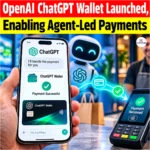
Recently, OpenAI launched ChatGPT Wallet, enabling AI agents to complete purchases through secure, tokenised payments, advancing autonomous AI-driven commerce.
What is ChatGPT Wallet?
- About: ChatGPT Wallet is a secure payment framework launched by OpenAI that enables autonomous AI agents to complete online purchases on a user’s behalf.
- Objective: Its primary objective is to bridge the gap between AI-assisted product discovery and final checkout for over 1.2 billion weekly users.
- It aims to streamline agentic commerce while maintaining direct merchant-customer relationships.
- Launch: It was unveiled on November 13, 2026. The feature rolled out initially through dots, OpenAI’s always-on personal AI agents.
- Availability: Access is currently restricted to ChatGPT Pro subscribers aged 18 and older residing in the United States who hold eligible US-issued credit cards.
- OpenAI is taking zero transaction fees at launch, focusing on testing reliability alongside payment providers like Stripe and Adyen before expanding globally.
- Technology: The underlying architecture relies on network tokenization to eliminate credential exposure during automated checkouts.
- Users enroll their card details once into an encrypted vault.
- Upon transaction approval, the payment network generates a one-time payment token containing a scoped card number, security code, and expiration date.
- Neither the AI agent nor the online merchant ever views or stores the user’s actual card numbers.
- Features:
- Single-Card Enrollment. Users store their eligible credit card once in the wallet, eliminating the need to manually re-enter billing information across different retail websites.
- Biometric Transaction Approval. Before any funds move, the agent presents the item list, total cost, and selected card for mandatory Face ID or fingerprint verification.
- Seamless Merchant Compatibility. The system operates over existing retail checkout infrastructures, supported by OpenAI’s Commerce Partner Playbook and Web Bot Auth to prevent automated blocks.
- Future Autonomous Delegation. OpenAI plans to introduce rule-based spending controls, enabling users to pre-authorize purchases based on spending limits, product categories, and set timeframes.
- Financial Institutions: It is built in direct collaboration with Visa, Mastercard, and American Express, alongside issuing banks like Chase.
- The wallet integrates established financial rails into AI workflows. These networks supply the cryptographic tokens and authenticate that transactions originate from verified users.
- Security & Privacy: Every purchase requires explicit human confirmation, generating an auditable authorization record.
- Because transactions route through official card networks, cardholders retain all existing credit card rewards, fraud liability shields, and dispute protections.
- Merchants remain directly responsible for order fulfillment, pricing, and returns.
- OpenAI partners with fraud-prevention leaders—including Forter, Riskified, Sardine, and Signifyd—so banking risk engines distinguish legitimate agent purchases from malicious bots.
Significance
- ChatGPT Wallet represents a shift from human-initiated e-commerce to agentic commerce. This may reduce transaction friction, improve shopping efficiency and create new business models.
- It could transform digital platforms into intelligent commercial intermediaries.
- Agentic commerce could reshape international trade across geographical boundaries. Automated purchasing may benefit global retailers, travel companies, logistics providers and small businesses.
- Conversational payment interfaces could make digital commerce easier for people who face difficulties. Voice-assisted shopping, multilingual interfaces and simplified transactions may improve accessibility for elderly people and persons with disabilities.
- AI-enabled purchasing could help Micro, Small and Medium Enterprises (MSMEs) reach customers through conversational platforms without developing sophisticated digital shopping infrastructure.
- The development could increase the importance of tokenisation providers, cybersecurity companies, AI platforms and payment gateways. It could also create new revenue opportunities.
- These developments indicate that the future of digital payments may involve human-to-machine, machine-to-merchant and machine-to-machine transactions.
Challenges
- AI agents may misunderstand instructions, select incorrect products or execute unintended purchases.
- AI-powered wallets may face phishing, account takeover, credential theft, malicious software and payment-token misuse.
- Malicious websites, advertisements or external content could manipulate AI agents through prompt injection or misleading instructions.
- A major challenge is determining responsibility when an AI agent makes an incorrect purchase or causes financial loss.
- Cross-border AI payments involve multiple jurisdictions, payment systems and data-protection regimes.
- Differences in consumer rights, taxation, foreign-exchange regulations and dispute procedures could complicate transactions.
Other AI-Powered Digital Payment Platforms
- Google’s Agent Payments Protocol (AP2) is an open protocol designed to facilitate secure payments initiated by AI agents.
- It extends Google’s Agent2Agent (A2A) and Model Context Protocol (MCP) ecosystems.
- It is developed with more than 60 organisations, including Mastercard, American Express, PayPal and Adyen.
- Mastercard Agent Pay is an agentic payment initiative designed to enable AI agents to conduct transactions securely on behalf of consumers and businesses.
- Its Mastercard Agentic Tokens build on existing tokenisation technology, enabling controlled transactions.
- Agent Pay for Machines (AP4M) extends agentic payments towards machine-to-machine transactions.
- Visa Intelligent Commerce (VIC) is Visa’s initiative for enabling AI agents to conduct authorised purchases using Visa payment credentials.
- It incorporates agent-specific payment tokens, identity validation, user-approved instructions and transaction controls.
- India offers significant opportunities because of its extensive Unified Payments Interface (UPI) infrastructure.
- UPI Circle already enables users to delegate payment authority to trusted secondary users.
- In November 2025, BHIM introduced a full delegation with spending limits of up to ₹15,000 per month.
- In September 2026, Reuters reported that India is preparing an AI-agent payment framework for UPI, potentially called the Unified Agent Protocol. Such integration could strengthen India’s position in global digital public infrastructure.
- Backed by the Reserve Bank of India (RBI) and public-sector initiatives, tools like MuleHunter.AI target fraud and mule accounts.
- The Unified Lending Interface (ULI) connects multi-source data via AI to streamline frictionless credit.
Frequently Asked Questions (FAQs):
1. What is OpenAI’s new ChatGPT Wallet?
An AI-powered payment facility enabling ChatGPT agents to complete user-authorised purchases securely.
2. How does ChatGPT Wallet allow AI agents to make payments?
Users review purchases and approve transactions through biometric verification before agents complete checkout.
3. Which payment companies have partnered with OpenAI?
American Express, Mastercard and Visa are OpenAI’s payment-network partners.
4. How does ChatGPT Wallet protect actual card details?
It uses payment tokenisation, replacing actual card credentials with substitute payment credentials.
5. Who can currently access ChatGPT Wallet?
US-based ChatGPT Pro subscribers aged 18 or older, with eligible US-issued cards and a US billing address.
Disclaimer: Information in this article is based on official announcements and public records. Details may evolve over time.
| Also Read: OpenAI Expands Safety Leadership |