Air India CEO Campbell Wilson Resigns
|
General Studies Paper III: Business and Aviation Market |
Why in News?
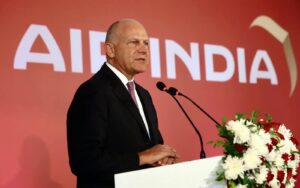
Recently, Air India CEO Campbell Wilson has resigned after nearly four years, amid mounting losses, safety concerns, and regulatory scrutiny.
- He will continue temporarily until a successor is appointed as the airline undergoes a leadership transition.
CEO Campbell Wilson and His Contributions
- About: Campbell Wilson is a New Zealand business executive born in October 1971 in Christchurch.
- He spent his early years in New Zealand and attended Shirley Boys’ High School.
- Before starting his professional career, he spent a year backpacking across Europe and North America.
- Education: Wilson is highly qualified, holding a Master of Commerce (M.Com) degree with First-Class Honours in Business Administration. He earned this degree from the University of Canterbury in New Zealand.
- Career: Wilson began his professional journey in 1996 as a Management Trainee with Singapore Airlines (SIA) in New Zealand.
- Over 26 years, he rose through the ranks, serving in senior leadership positions in Canada, Hong Kong, and Japan.
- His diverse roles included Vice President of operations in Canada and General Manager in Hong Kong and Japan.
- In 2011, Wilson was appointed as the founding CEO of Scoot, the low-cost, long-haul subsidiary of Singapore Airlines. He built the airline from a concept to a fully operational budget carrier.
- After a stint as Senior Vice President of Sales & Marketing at SIA, he returned to Scoot for a second term in 2020 to lead it through the COVID-19 pandemic.
- Entry in Air India: On July 25, 2022, Wilson officially assumed the role of CEO and Managing Director of Air India.
- He was the first CEO appointed after the airline’s privatisation by the Tata Group.
- His initial contract was for five years, aimed at spearheading a massive five-year transformation program called Vihaan.ai.
- Under the Vihaan.ai roadmap, Wilson led efforts to modernise Air India’s outdated systems and culture. His leadership focused on five key pillars: exceptional customer experience, robust operations, industry-best talent, commercial efficiency, and profitability.
- Under his leadership, Air India placed orders for 470 aircraft from Boeing and Airbus worth nearly $70 billion, one of the largest deals in aviation history.
- Wilson successfully steered the complex integration of four Tata-owned airlines into two unified brands, merging Air India with Vistara and combining Air India Express with AIX Connect.
- Wilson emphasised AI integration, data systems, and digital overhaul, replacing outdated legacy systems. These reforms significantly improved operational efficiency and decision-making capacity.
- The airline hired over 9,000 employees post-privatisation, reversing decades of stagnation. Wilson focused on talent acquisition and organisational restructuring to build a modern workforce.
- Air India witnessed improvements in passenger ratings and service quality, becoming one of the most improved airlines globally in terms of customer satisfaction.
- Wilson led a complete rebranding exercise, introducing a new logo and identity to reposition Air India as a premium global airline competing with international carriers.
- Introduction of modern aircraft like Airbus A350 and Boeing Dreamliner enhanced long-haul operations, strengthening connectivity to Europe, North America, and Asia.
|
Air India is India’s flag carrier airline, established in 1932 by J. R. D. Tata. After decades as a government-owned enterprise, it was re-privatised in 2022 by the Tata Group. The airline is currently undergoing a major transformation to become a global aviation leader. |
Key Reasons Behind Resignation of Campbell Wilson
- Mounting Financial Losses: One of the primary reasons was persistent financial losses faced by Air India. The airline reported losses of around ₹98 billion (₹9,800+ crore) in FY 2024–25, despite rising revenues. High fuel costs, operational expenses, and debt burden slowed the turnaround, creating pressure on leadership accountability.
- Regulatory Scrutiny: A major factor was increased regulatory scrutiny following safety lapses. Authorities flagged issues like non-compliance with safety norms and operational irregularities, including aircraft-related checks. This weakened confidence in management and intensified pressure on Wilson’s leadership.
- 2025 Air Crash Investigation: The 2025 fatal crash involving an Air India flight, which caused around 260 deaths, significantly impacted the airline’s reputation. Ongoing investigations and accountability concerns added institutional and public pressure, making leadership continuity difficult.
- Slow Pace of Turnaround: Despite reforms under the “Vihaan.AI transformation strategy”, progress was slower than expected. Challenges like delayed aircraft deliveries, supply chain disruptions, and integration issues hindered execution. This created dissatisfaction within stakeholders, including the Tata Group.
- External Pressures: The aviation sector faced external challenges such as geopolitical tensions, airspace restrictions, and post-COVID disruptions. Additionally, Wilson had already indicated his intent to step down earlier, stating that the “time is right” for a leadership transition as the airline enters its next growth phase.
|
Also Read: IndiGo CEO Pieter Elbers Resigns with Immediate Effect |