




Apple CEO Tim Cook Step Down
|
General Studies Paper III: Business |
Why in News?
Recently, Apple announced that Tim Cook will step down as CEO of Apple Inc. on September 1, 2026, after 15 years.
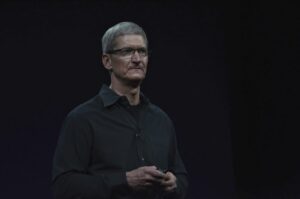
Apple Leadership Transition Announcement:
- Transition: On April 20, 2026, Apple Inc. announced a historic leadership transition. Current CEO Tim Cook will step down as CEO on September 1, 2026. He will be succeeded by John Ternus, the company’s current Senior Vice President of Hardware Engineering.
- The transition is a meticulously planned, long-term succession process that received unanimous approval from Apple’s Board of Directors.
- Tim Cook will remain in his current role through the summer of 2026 to work closely with Ternus. The official changeover occurs at midnight on August 31, 2026, with Ternus taking the helm on Labor Day, September 1.
- Future Roles:
- Tim Cook will transition to the newly created role of Executive Chairman of the Board. In this strategic capacity, he will focus on global policy engagement, engaging with world leaders and regulators.
- Arthur Levinson, the current non-executive chairman will shift to Lead Independent Director.
- Reasons for Change: The move signals a generational shift at Apple.
- After 15 years, the board is pivoting toward a leader with deep hardware engineering expertise as the industry moves toward a new era of AI integration and spatial computing.
- Cook has previously stated that knowing when to step aside is part of good leadership, and after doubling revenue, the board felt it was the right time.
- The transition also comes as Apple faces increased scrutiny in AI development and competition, requiring a tech-focused leader at the helm.
Tim Cook’s Contribution:
- Background: Cook joined Apple in 1998 after being recruited by Steve Jobs to overhaul the company’s struggling operations. He became CEO on August 24, 2011, just before Jobs’ death.
- Financial Achievements: Under Cook’s leadership, Apple achieved historic financial milestones that solidified its position as the world’s most valuable company.
- Market Capitalization: Apple’s valuation surged from approximately $350 billion in 2011 to a peak of $4 trillion by early 2026. It was the first U.S. company to reach $1 trillion (2018), $2 trillion (2020), and $3 trillion (2023).
- Revenue Expansion: Annual revenue nearly quadrupled, growing from $108 billion in fiscal 2011 to over $416 billion in fiscal 2025.
- Stock Performance: Apple shares increased by over 1,000% during his tenure, reflecting deep investor confidence in his operational steady hand.
- Key Contributions: He grew the Services division—including the App Store, iCloud, Apple Music, and Apple Pay—from $2.95 billion in 2011 to a business generating over $100 billion annually.
- New Product Categories: While critics initially doubted his creative vision, Cook successfully launched defining new categories: the Apple Watch (now the world’s top-selling watch), AirPods, and most recently, the Apple Vision Pro.
- Apple Silicon: Cook oversaw the historic transition to in-house M-series chips, giving Apple unprecedented control over its hardware performance and supply chain.
- Supply Chain: He perfected Apple’s “asset-light” manufacturing model. By utilizing contract manufacturers and implementing just-in-time (JIT) manufacturing, he reduced inventory turnover from months to just five days.
- Corporate Values: He championed user privacy as a “fundamental human right,” notably challenging the FBI over iPhone encryption.
- Sustainability: He committed Apple to becoming carbon neutral by 2030 across its entire footprint, already achieving carbon neutrality for corporate operations.
- Social Advocacy: In 2014, he became the first CEO of a Fortune 500 company to come out as gay, using his platform to advocate for LGBTQ+ rights and racial equality.
About Future CEO John Ternus:
- Background: John Ternus joined Apple’s product design team in 2001 and has spent his entire professional career at the company. A mechanical engineer from the University of Pennsylvania, he rose to lead Hardware Engineering in 2021.
- John Ternus represents the “younger generation” of Apple leadership, bringing a technical, hardware-first philosophy to the CEO role.
- Key Portfolio: Ternus has overseen engineering for almost every major Apple product, including the iPhone, iPad, Mac, and Apple Silicon transitions. He is credited with reviving Mac sales through the M-series chips.
- Future Ambitions: Ternus is described as having the “mind of an engineer and the soul of an innovator”.
- His leadership is expected to prioritize hardware-software integration, particularly in advancing generative AI on-device.
- He has already been the face of recent innovations like the ultra-thin iPhone Air and the MacBook Neo.
Impact of the Transition:
- Market and Investor Stability: The market’s reaction has been exceptionally stable because the move was pre-announced and Cook is staying on as Executive Chairman. This ensures Apple’s $4 trillion valuation remains protected by Cook’s operational wisdom.
- Shift to a “Product-First” Strategy: While Cook was a master of supply chains, Ternus is a hardware engineer. His leadership signals a return to product-led innovation. This will likely lead to more aggressive hardware redesigns and a renewed focus on making the iPhone and Mac the most technologically advanced tools in the market.
- Acceleration of Apple’s AI Roadmap: Ternus faces the immediate task of closing the gap in Generative AI. His deep expertise in Apple Silicon allows him to better integrate AI features directly into the hardware, ensuring Apple’s AI is faster, more secure, and maintains the company’s strict privacy standards.
- Expansion of the Services Ecosystem: Under Ternus, Apple’s $100 billion Services business will become even more integrated with hardware. Expect to see new revenue streams through Spatial Computing (Vision Pro) and advanced health features that bridge the gap between physical devices and digital subscriptions.