




Bharat Audyogik Vikas Yojna BHAVYA
| General Studies Paper II: Government Policies and Interventions, Development and Growth |
Why in News?
Recently, the Union Cabinet approved Bharat Audyogik Vikas Yojna (BHAVYA) with an outlay of ₹33,660 crore to develop plug-and-play industrial parks, aiming to boost manufacturing and create large-scale employment opportunities.
What is Bharat Audyogik Vikas Yojana (BHAVYA)?
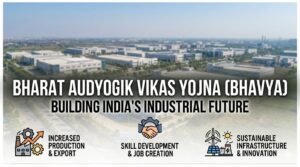
- About: BHAVYA is a flagship industrial infrastructure scheme designed to develop 100 plug-and-play industrial parks across India. The program focuses on creating investment-ready ecosystems where regulatory clearances are pre-developed to ensure immediate operational readiness for industries.
-
- Core Objectives: The primary goal is to unlock India’s manufacturing potential by removing entry barriers for global and domestic investors.
- It aims to significantly reduce the time-to-market for new industrial units and lower operational costs through world-class shared infrastructure.
- Financial Allocation: The Government of India has approved an expenditure of ₹33,660 crore for the scheme. This funding supports the development of approximately 34,000 acres of land, providing a grant of up to ₹1 crore per acre for essential infrastructure.
- Nodal Agency: The National Industrial Corridor Development Corporation (NICDC), under the Ministry of Commerce and Industry, serves as the nodal agency.
- It implements the scheme in partnership with State Governments, Central PSUs, and private developers through Special Purpose Vehicles (SPVs).
- Core Objectives: The primary goal is to unlock India’s manufacturing potential by removing entry barriers for global and domestic investors.
- Implementation Period: The scheme will run for six years, from FY 2026-27 to FY 2031-32. The first phase aims to establish 50 parks to kickstart development.
- Features:
- Plug-and-Play Ecosystem: The scheme provides a ready-to-use environment featuring pre-approved land and factory sheds. Industries can transition from intent to production rapidly because basic electricity, water, and environmental clearances are already in place before allotment.
- Scale of Development: Industrial parks under BHAVYA range from a minimum of 100 acres to a maximum of 1,000 acres. For hilly and North Eastern states, the minimum contiguous land requirement is relaxed to 25 acres to promote regional inclusivity.
- Selection via Challenge Mode: Projects are selected through a competitive challenge mode process. This ensures that only high-quality, reform-oriented proposals from states with effective single-window systems and investor-friendly policies receive federal support.
- Core Infrastructure Support: The financial grant covers internal roads, drainage systems, and common effluent treatment plants. It also funds ICT systems and administrative blocks to ensure a seamless digital and physical operating environment within the parks.
- Value-Added Facilities: The scheme funds ready-built factory sheds, specialized testing laboratories, and warehousing. These facilities allow MSMEs and startups to start manufacturing with minimal initial capital expenditure.
- External Connectivity: BHAVYA provides funding for up to 25% of the cost of external connectivity infrastructure. This ensures the parks are integrated with existing national networks, following PM GatiShakti principles for multimodal logistics.
- Social and Green Infrastructure: The parks prioritize sustainability with green energy integration and “no-dig” underground utility corridors. They also include social infrastructure such as worker housing and health centers to support the industrial workforce.
Significance of BHAVYA Yojna
- India’s Manufacturing Potential: BHAVYA is designed to transform India into a “Global Manufacturing Hub” by creating 100 industrial parks with ready infrastructure, reducing setup time and costs. This directly strengthens India’s share in global value chains, currently 3% in manufacturing exports, indicating vast untapped potential.
- Large-Scale Employment: The scheme is expected to generate nearly 15 lakh direct jobs, with additional indirect employment in logistics, MSMEs, and services. Industrial cluster models globally show 1 direct job creates 2–3 indirect jobs, amplifying socio-economic impact significantly.
- Reduce Import Dependence: By boosting domestic production capacity, BHAVYA reduces reliance on imports in sectors like electronics and capital goods. This strengthens economic resilience against global shocks (e.g., supply chain disruptions seen during COVID-19), improving trade balance stability.
- Foreign Investment Flows: With plug-and-play infrastructure and policy support, the scheme enhances India’s attractiveness for FDI and domestic capital. Industrial parks historically attract large investments—as seen in cluster-based schemes generating ₹40,000+ crore proposals in similar initiatives.
- Ease of Doing Business: BHAVYA reduces transaction costs, compliance burden, and approval delays through integrated infrastructure and clearances. This aligns with India’s reform trajectory, where industrial parks significantly lower entry barriers and improve investor sentiment.
- Regional Industrial Development: By promoting parks across states and UTs, the scheme reduces regional disparities. It enables industrialization in tier-2 and tier-3 regions, improving infrastructure, urbanization, and income levels beyond traditional industrial hubs.
- Future-Ready Industrialization: BHAVYA emphasizes green infrastructure, energy efficiency, and resource optimization, aligning with India’s net-zero commitments (2070). Industrial parks increasingly integrate renewable energy and sustainable practices, ensuring long-term environmentally responsible growth.
Key Government Initiatives Supporting Industrial Growth
|
| Also Read: Made in India Label Scheme |