



Global Power Alliance BRICS
|
General Studies Paper II: Important International Institutions, Groupings & Agreements Involving India and/or Affecting India’s Interests |
Why in News?
Russian President Vladimir Putin is confirmed to attend the 2026 BRICS summit in New Delhi this September, marking a significant visit aimed at strengthening ties with India.
- India holds the BRICS Chairship for 2026, with the theme “Building for Resilience, Innovation, Cooperation and Sustainability”.
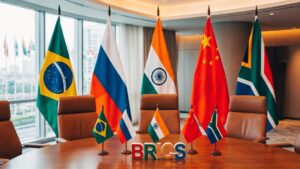
What is BRICS Group?
- About: BRICS is an informal, intergovernmental grouping that serves as a forum for political and diplomatic coordination among its members.
- It was formed to coordinate economic policies, which has evolved into a strategic bloc aimed at reforming the global financial and political architecture toward multipolarity.
- It acts as a pressure group to make international institutions—such as the UN, IMF, and World Bank—more representative and inclusive of developing nations.
- Objectives: The bloc’s mission is centered on three pillars:
- Political and Security: Aimed at achieving peace and reforming the global political system.
- Economic and Financial: Enhancing trade, sustainable development, and financial stability.
- People-to-People: Fostering cultural exchange, education, and youth development.
- Member Countries: As of 2026, the BRICS membership includes 11 full members: Brazil, Russia, India, China, and South Africa, Egypt, Ethiopia, Iran, Saudi Arabia, the United Arab Emirates and Indonesia.
- Origin: The acronym “BRIC” was first coined in 2001 by Goldman Sachs economist Jim O’Neill to describe the high growth potential of Brazil, Russia, India, and China.
- Formal diplomatic cooperation began in 2006 G-8 Outreach Summit with a meeting of foreign ministers at the UN General Assembly.
- The first formal summit was held in 2009 in Yekaterinburg, Russia.
- Expansion: South Africa joined in 2010, adding the “S” to the acronym.
- Egypt joined in 2024, enhancing the bloc’s strategic location near the Suez Canal and in North Africa.
- Ethiopia joined in 2024, representing a fast-growing East African economy.
- Iran joined in 2024, increasing the group’s influence in the Middle East and energy sector.
- United Arab Emirates (UAE) joined in 2024, providing a significant financial and logistics hub to the group.
- Saudi Arabia invited in 2023, accepted, and participated in meetings, though final bureaucratic formalization was reportedly delayed.
- Indonesia formally joined in January 2025, adding the largest economy in Southeast Asia.
- Belarus, Bolivia, Cuba, Kazakhstan, Malaysia, Nigeria, Thailand, Uganda, and Uzbekistan were added in 2024-2025 as “partner countries”.
- Working System: BRICS is not a treaty-based organization; it has no permanent secretariat or headquarters.
- It functions through a rotating chairship system where the host nation sets the annual agenda and organizes the summit. Decisions are made strictly by consensus.
- BRICS Sherpas are high-level representatives designated by heads of state or government, serving as the primary channel for communication, coordination, and negotiation among members.
- Financial Initiatives: To bypass Western-led systems, BRICS established two cornerstone institutions:
- New Development Bank (NDB): Headquartered in Shanghai, it finances infrastructure and sustainable projects in emerging economies.
- Contingent Reserve Arrangement (CRA): A $100 billion pool of currency swaps intended to provide short-term liquidity support during balance-of-payment crises.
- Specialized Initiatives: BRICS continues to innovate across multiple sectors:
- De-dollarization: Active efforts to use local currencies for intra-BRICS trade to reduce dependence on the U.S. dollar.
- BRICS PAY: A digital payment platform designed to facilitate seamless cross-border transactions among member states.
- Satellite Constellation: A joint remote sensing agreement to share space data for disaster management and climate monitoring.
- BRICS Network University: A network of educational institutions collaborating on research in IT, energy, and climate change.
Geopolitical Significance of BRICS in a Multipolar World
- Counterbalance to Western Dominance: BRICS serves as a strategic alternative to the Bretton Woods institutions (IMF and World Bank). The bloc advocates for the democratization of global governance, demanding an end to the “veto power” asymmetry and pushing for reforms in voting rights that reflect the actual economic weight of emerging markets.
- Economic Weight and GDP Supremacy: The bloc’s economic influence now surpasses that of the G7 in Purchasing Power Parity (PPP) terms. In 2024, BRICS accounted for 37.3% of global GDP compared to the G7’s 29.3%. By 2025, this share reached approximately 41%, driven largely by the high-growth trajectories of China and India.
- Representation of the Global South: BRICS acts as the primary diplomatic voice for the Global South, representing nearly 50% of the world’s population. It provides a platform for nations to assert strategic autonomy, allowing them to bypass Western-led geopolitical constraints and pursue independent foreign policies.
- Financial Architecture: The New Development Bank (NDB), with an authorized capital of $100 billion, provides critical funding for infrastructure without the stringent political conditions often attached by the World Bank. Complementing this, the CRA acts as a $100 billion safety net to protect members from global liquidity shocks.
- Resource and Energy Sovereignty: With the 2024 expansion, BRICS now includes major energy producers like Iran and the UAE, controlling nearly 30% of global oil output. This concentration of natural resources strengthens the bloc’s leverage in setting global energy prices and securing critical supply chains.
- Strategic Expansion (BRICS+): The transition to BRICS+ has incorporated new full members, alongside multiple partner countries. This “Big BRICS” model enhances the group’s geographic reach across Africa, the Middle East, and Asia, solidifying its role as a representative of the “World Majority”.
- Multipolar Diplomatic Adaptability: The bloc maintains a consensus-based working system that accommodates diverse political systems and interests. Positioning itself as a champion for a fairer multipolar order while sustaining dialogue during crises like COVID-19 and the Ukraine war, it resonates with Global South states seeking strategic autonomy and non-aligned diplomatic space.
Barriers to BRICS as a Unified Global Bloc
- Internal Geopolitical Conflicts: Strategic friction among core and new members remains the greatest barrier to consensus.
- The ongoing India-China border dispute at the LAC prevents deep security integration,
- The recent 2025-2026 Iran-Israel-West Asia conflict has tested the group’s ability to maintain a unified diplomatic stance, as some members hold U.S. alliances (UAE, Egypt) while others (Russia, Iran) maintain adversarial positions.
- Extreme Economic Asymmetry: There is a profound imbalance of power within the bloc’s GDP distribution.
- China currently accounts for nearly 70% of total BRICS GDP, raising fears of a “Sinocentric” alliance that prioritizes Beijing’s industrial interests.
- This asymmetry is visible in trade; for instance, India maintains a $209 billion trade deficit with its BRICS partners, primarily driven by manufactured imports from China.
- Barriers to Rapid De-dollarization: While the BRICS Pay blockchain platform aims to bypass SWIFT, the U.S. Dollar still facilitates approximately 85% of global trade transactions as of 2025.
- The lack of a common reserve currency and the high volatility of member currencies—like the Russian ruble and Iranian rial—make it difficult for global markets to trust local currency settlements for long-term reserves.
- Institutional and Structural Deficits: Unlike the G7 or EU, BRICS lacks a permanent secretariat, a formal charter, or a binding security architecture.
- This informal structure leads to inconsistent policy implementation and reliance on rotating annual presidencies, which can cause agenda fragmentation.
- The New Development Bank (NDB) still has authorized capital significantly smaller than the World Bank’s $800 billion+ portfolio.
- Vulnerability to External Sanctions: Western geopolitical pressure and secondary sanctions pose a risk to the group’s financial connectivity.
- Members with deep Western economic ties, such as India and the UAE, must balance their BRICS commitments against the threat of U.S. tariffs or exclusion from Western high-tech transfers, creating a “tightrope walk”.
Way Forward:
- To enhance its global effectiveness, BRICS must prioritize institutional strengthening by establishing a permanent secretariat and improving coordination mechanisms for faster decision-making.
- Bridging internal divergences, especially geopolitical tensions, is essential through sustained diplomatic dialogue and confidence-building measures.
- The bloc should deepen economic integration by expanding intra-BRICS trade, promoting local currency settlements, and strengthening institutions like the New Development Bank for inclusive financing.
- A calibrated approach to expansion is needed to maintain cohesion while increasing representation of the Global South.
- BRICS should focus on technology collaboration, climate action, and supply chain resilience to remain relevant in emerging global challenges.
|
Also Read: 17th BRICS Summit 2025 |