




ICAT First Certificate for 15 Metre Sleeper Bus Issued
| General Studies Paper III: Growth & Development |
Why in News?
Recently, the International Centre for Automotive Technology (ICAT) issued India’s first 15-metre sleeper bus certificate to Synaty Automotive under the Central Motor Vehicles Rules framework, enhancing long-distance safety and capacity.
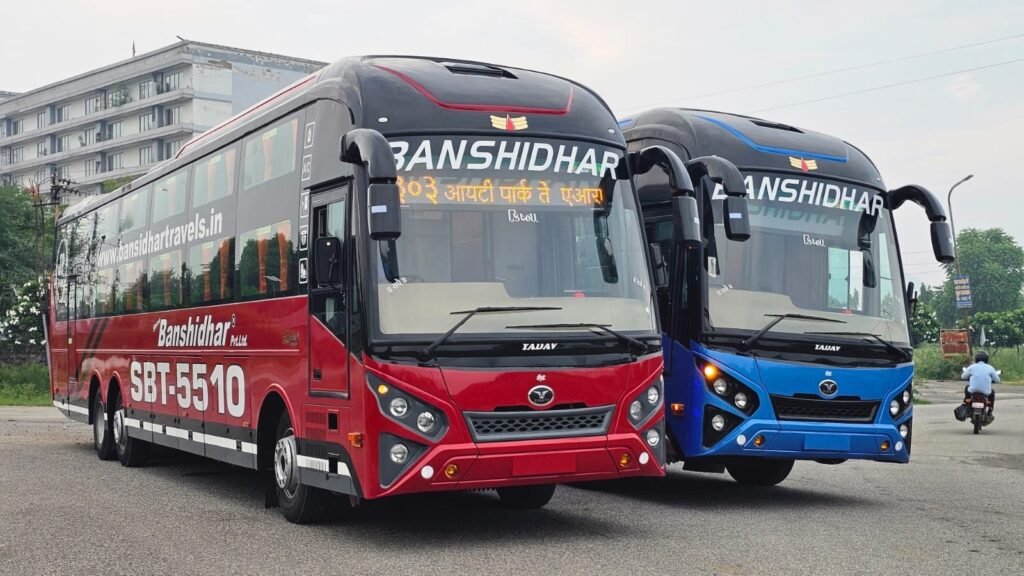
15-Metre Sleeper Bus ICAT Certification Highlights
- Issuence: On 26 August 2026, the International Centre for Automotive Technology (ICAT) issued its first compliance certificate for a 15-metre multi-axle sleeper bus.
- The certificate was awarded to Synaty Automotive Pvt. Ltd. for its 15-metre multi-axle sleeper bus.
- ICAT Director Saurabh Dalela formally handed it to Managing Director Naresh Kumar Yadav at Manesar, Haryana.
- Certification: The bus was certified under AIS-119 and AIS-153, demonstrating compliance with applicable Automotive Industry Standards.
- AIS-119 is related to sleeper coach requirements and AIS-153 is related to bus construction, structural integrity, ergonomics, and accessibility.
- This Certification covered requirements concerning vehicle safety, structural integrity, passenger accommodation and comfort.
- It also covered emergency safety, fire safety and passenger movement.
- Regulation: The certification was issued under applicable provisions of the Central Motor Vehicles Rules (CMVR).
- CMVR provides the broader regulatory framework governing vehicle construction, safety and compliance requirements in India.
- The regulatory framework has strengthened considerably: certification under the Bus Body Code is mandatory for buses with 13 passengers plus driver (13+D) and above, following the government’s 2024 notification.
- Features of Bus: Its multi-axle architecture is particularly relevant to high-capacity, long-distance passenger mobility.
- The vehicle has two configurations: a 42-berth fully sleeper version and a hybrid layout with 21 berths and 42 seats.
- The multi-axle configuration supports the vehicle’s large passenger-carrying architecture.
- Advanced full-air suspension systems to reduce road vibrations and ensure a smooth ride over long distances.
- It features individual charging ports, secure storage compartments, and ergonomic berth layouts.
- The certified vehicle represents one of the longest permissible bus-body configurations in India’s passenger-transport category.
What are Central Motor Vehicles Rules (CMVR)?
- About: The Central Motor Vehicles Rules, 1989 (CMVR) are the detailed rules governing motor-vehicle regulation in India. They were brought into force on 1 July 1989 under the Motor Vehicles Act, 1988.
- CMVR derives their authority from the Motor Vehicles Act, 1988, which provides the primary legislative framework for road transport.
- The Rules operationalise many requirements prescribed by the parent Act.
- The Central Government, principally through the Ministry of Road Transport and Highways (MoRTH), makes amendments to CMVR through notifications published in the Official Gazette.
- Preliminary Scope: The rules outline extensive legal definitions classifying vehicles into transport, non-transport, e-rickshaws, and specialized agricultural machinery. This standardizes structural categories across all Indian states.
- Driver Licensing: CMVR sets age limits, mandates a medical certificate for commercial operators, and outlines learner’s license criteria. It ensures that only competent individuals gain legal road access.
- Driving Schools: It regulates the licensing, syllabus, and technical infrastructure of authorized driving schools.
- Vehicle Registration: The rules dictate the process for obtaining a Certificate of Registration (RC). It also mandates that government-owned vehicles expire after a fixed 15-year period.
- National Permits: It streamlines administrative parameters for inter-state transit by regulating goods carriage permits. This controls cargo limits to eliminate the practice of vehicle overloading.
- Construction and Design: CMVR mandates precise manufacturing standards for the chassis, brakes, and steering systems.
- Safety Equipment: Every vehicle must feature specific components like seat belts, rearview mirrors, and reflectors. These basic features are required to maintain a highly secure driving environment.
- Emission Controls: The framework actively enforces the Pollution Under Control (PUC) certification system. It regulates mass emission thresholds for alternative fuels like CNG and LPG.
- Type Approval Testing: Under Rule 126, manufacturers must submit prototypes to designated government agencies for safety verification. A vehicle cannot enter mass production without this certification.
- Hazardous Cargo: Vehicles carrying dangerous goods must display highly visible emergency class labels and contact data. Drivers must also complete mandatory refresher training.
- Traffic Regulations: It codifies clear protocols on speed limits, lane discipline, overtaking, and the proper use of handheld devices. Violating these systemic statutes invites heavy financial penalties.
What is the International Centre for Automotive Technology (ICAT)?
- About: The International Centre for Automotive Technology (ICAT) is a Government of India automotive testing, certification and R&D organisation.
- It was established in 2006 under the Ministry of Heavy Industries.
- ICAT is based at IMT Manesar, Gurugram, Haryana, with major facilities including Centre-I and Centre-II.
- Its establishment is associated with the National Automotive Board (NAB), within Government’s institutional framework.
- It was established under the National Automotive Testing and R&D Infrastructure Project (NATRiP) to modernize testing infrastructure.
- Mandates:
- The institution’s primary mandate focuses on delivering vehicle homologation, comprehensive testing, engineering validation, and design consultancy.
- It ensures that all commercial vehicles comply rigidly with the Automotive Industry Standards (AIS).
- ICAT grants two foundational approvals: the Type Approval Certificate (TAC) for new product designs and the Conformity of Production (COP) certificate.
- The center utilizes specialized infrastructure, including a Powertrain Laboratory, Passive Safety Lab, and Electromagnetic Compatibility (EMC) room.
- It features designated setups for evaluating Noise, Vibration, and Harshness (NVH) profiles.
- Its services extend universally across two-wheelers, passenger cars, commercial trucks, defense equipment, and agricultural tractors. It evaluates large public transport configurations.
- To assist the green energy shift, ICAT acts as a key regulatory tester for Electric Vehicles (EVs) and battery systems.
- It systematically verifies electronic component safety based on rigorous AIS-156 and AIS-038 standards.
- ICAT holds recognition from the Bureau of Indian Standards (BIS) for evaluating safety glass and tires. It is additionally accredited by the Central Pollution Control Board (CPCB) for certifying power generator emissions.
- To foster industry innovation, ICAT runs the ASPIRE e-portal to encourage collaborative research between academia and manufacturers.
Frequently Asked Questions (FAQs):
1. What is the ICAT certificate for a 15-metre sleeper bus?
It is ICAT’s first compliance certificate for a 15-metre multi-axle sleeper bus under AIS-119, AIS-153 and applicable CMVR provisions.
2. Why is the first 15-metre sleeper bus certificate significant?
It marks a milestone in certifying one of India’s longest permissible bus-body configurations, supporting safer advanced long-distance passenger transport.
3. What is ICAT and what does it do?
ICAT is an automotive testing and certification agency that supports homologation, regulatory compliance, testing and automotive technology development.
4. Which company received the first ICAT certificate for a 15-metre sleeper bus?
Synaty Automotive Pvt. Ltd. received ICAT’s first compliance certificate for its 15-metre multi-axle sleeper bus.
5. What are the key safety requirements for a 15-metre sleeper bus?
Key requirements include structural integrity, emergency safety, fire safety, passenger movement, accommodation, comfort and overall vehicle safety.
6. How does ICAT certify commercial vehicles in India?
ICAT evaluates vehicles against applicable CMVR and Automotive Industry Standards, conducts prescribed testing, and issues certification after demonstrating regulatory and technical compliance.
Disclaimer: Information in this article is based on official announcements and public records. Regulations and implementation details may evolve over time.