




India Coconut Exports FY26 Rose 62% Globally
| General Studies Paper III: Agricultural Market & Growth, Government Policies |
Why in News?
Recently, India’s coconut exports FY26 rose 62% globally, reaching ₹7,038.35 crore from ₹4,349.03 crore in the previous fiscal year, reflecting strong global demand.
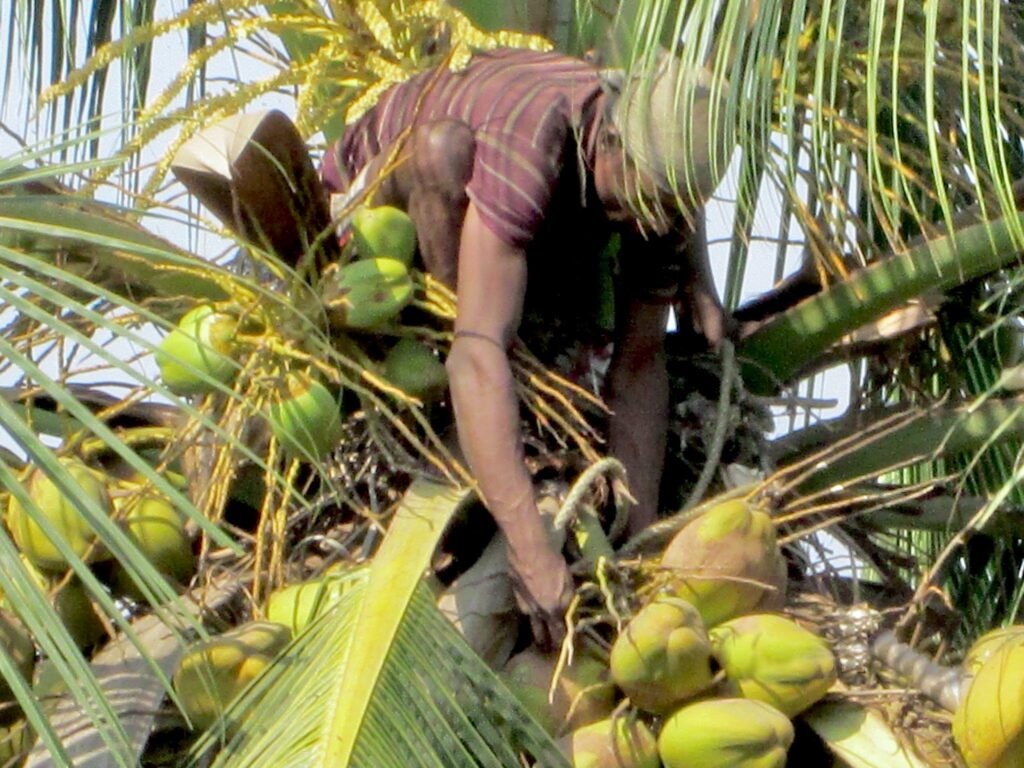
India’s Coconut Sector and Significance
- Global Position: India is currently the world’s largest coconut producer and ranks third in cultivation area, accounting for 31.24% of global production and 17.90% of global coconut area.
- Coconut (Cocos nucifera) is a tropical plantation crop often called the “Kalpavriksha” or Tree of Life.
- Production:
- Coconut cultivation is concentrated mainly in southern and coastal regions, particularly Keralam, Karnataka, Tamil Nadu and Andhra Pradesh.
- These four states mainly account for 91.11% of India’s total coconut production.
- Keralam leads in total area under cultivation, Tamil Nadu leads in production, and Andhra Pradesh records the highest productivity.
- Keralam has the country’s largest coconut area, covering approximately 7.54 lakh hectares, with production of about 5,149.87 million nuts in 2024-25.
- Tamil Nadu is the leading state in overall coconut production, while Andhra Pradesh records the highest productivity, followed by West Bengal and Tamil Nadu.
- The latest state-wise dataset for 2023-24 recorded production of 6,151.00 million nuts in Karnataka, 6,091.98 million in Tamil Nadu, 5,522.71 million in Kerala, and 1,707.08 million in Andhra Pradesh.
- In 2024-25, India produced approximately 20,301.22 million nuts from 2.19 million hectares, with average productivity of 9,249 nuts/hectare.
- Productivity was particularly high in Andhra Pradesh (15,899 nuts/ha), followed by West Bengal (12,790) and Tamil Nadu (12,367), against the national 9,871 nuts/ha in that dataset.
- Coconut cultivation is concentrated mainly in southern and coastal regions, particularly Keralam, Karnataka, Tamil Nadu and Andhra Pradesh.
- Coconut Export: India’s coconut export story has shifted from raw and traditional commodities towards value-added products.
- In FY 2025-26, exports of coconut and coconut-based products reached ₹7,038.35 crore (US$794.70 million), registering a remarkable 62% increase over ₹4,349.03 crore in FY 2024-25.
- The long-term transformation is even more significant: exports were only ₹25.3 crore in 2001-02.
- India’s export basket now includes activated carbon, coconut oil, fresh/frozen/grated coconut, copra, desiccated coconut, virgin coconut oil, coconut milk and coconut water, enabling greater value capture from each coconut.
- Activated carbon has consistently remained a major export item.
- India’s coconut products have moved beyond traditional regional markets and now serve North American, European, Middle Eastern and Asia-Pacific markets.
- During the last five years, major trading partners have included the United States, UAE, Sri Lanka, Germany, Russia, Türkiye, Belgium, United Kingdom and Netherlands.
- It reduces excessive dependence on a single market and creates opportunities for Indian processors.
- The rising demand for natural, plant-based and minimally processed products, particularly coconut water, virgin coconut oil and coconut milk, is supporting India’s movement up the global value chain.
- In FY 2025-26, exports of coconut and coconut-based products reached ₹7,038.35 crore (US$794.70 million), registering a remarkable 62% increase over ₹4,349.03 crore in FY 2024-25.
- Institutional Framework: The principal institution is the Coconut Development Board (CDB), functioning under the Ministry of Agriculture and Farmers Welfare.
- It was established on 12 January 1981 under the Coconut Development Board Act, 1979 (Act No. 5 of 1979), whose objective is the development of the coconut industry under Union control.
- The Act provides for the Board’s establishment, finance and functions.
- Headquartered at Kochi, CDB works across 22 States/UTs for integrated development of cultivation and industry.
- Its responsibilities include quality planting material, area expansion, productivity enhancement, pest and disease management, processing, product diversification, market development and export promotion.
- It also functions as the Export Promotion Council for coconut products other than those derived from husk and fibre.
- During 2025-26, ₹147.21 crore was released for implementation of activities under the Board.
- CDB has simultaneously expanded the commercial ecosystem: exporter registrations increased to 8,299 by FY 2025-26 and 8,700 by 31 July 2026.
- Over the last five years, the Board facilitated participation of entrepreneurs in domestic and international trade fairs, buyer-seller meetings and export-promotion activities.
- Government Policies:
- The Minimum Support Price (MSP) for copra provides a price floor for growers; for the 2026 season, MSP is ₹12,027/quintal for milling copra and ₹12,500/quintal for ball copra.
- National Agricultural Cooperative Marketing Federation of India Ltd. (NAFED) and National Cooperative Consumers’ Federation (NCCF) act as Central Nodal Agencies for procurement under the Price Support Scheme.
- CDB implements Productivity Improvement through Coconut-based Cropping System, supporting integrated farming and improving returns from existing holdings.
- In 2025-26, the programme covered 18,800 hectares, benefiting 48,696 farmers, while rejuvenation interventions targeted old, diseased and unproductive palms.
- A major recent intervention is the Coconut Promotion Scheme announced in Union Budget 2026-27.
- It seeks to address ageing plantations, pest outbreaks, diseases and low productivity through large-scale production of quality seedlings, expansion into suitable areas, phased replanting and rejuvenation, holistic crop-health management and establishment of integrated coconut processing units.
- The initiative forms part of a broader ₹350-crore allocation for high-value agriculture covering coconut, cashew and cocoa.
- It integrates farmers with the Bharat-VISTAAR platform, an AI-powered multilingual tool providing real-time crop health and market advisory services.
- The government finances structural interventions via the CDB:
- Demonstration-cum-Seed Production Farms (DSPFs), established to commercialize high-quality scientific seed rings. New farms receive ₹30 lakh for the first two years, and existing farms receive ₹1 lakh per hectare annually for maintenance until yield stabilizes.
- Nursery Support, provides up to 100% cost support for public sector nurseries (KVKs, SAUs) and 50% financial assistance for private nurseries alongside an official accreditation and rating framework to verify planting stock.
- Expansion of Cultivated Area provides financial assistance of ₹56,000 per hectare (disbursed in two equal annual installments) to expand cultivation into non-traditional, suitable territories.
- Replanting and Rejuvenation Programme specifically targets the removal of disease-advanced, senile, and crowded palms. It grants up to ₹54,000 per hectare over a two-year span to help farmers regenerate traditional gardens.
- Productivity Improvement Through Coconut-Based Cropping System (PICCS), implemented on a cluster basis, encourages multi-species cropping and integrated farming rather than relying exclusively on monoculture coconut yields.
- Offers a 100% subsidy (up to ₹42,000 per hectare).
- Supports intercropping, organic farming promotion, farm mechanization, and water resource creation (farm ponds, community tanks).
- Programs like Friends of Coconut Tree (FoCT), Cocomitra, and Kera Kaushal Kendra focus on training rural youth in traditional harvesting, plant protection, and running coconut-based micro-enterprises.
- Kera Suraksha Insurance Scheme, a targeted insurance framework providing accident coverage for traditional coconut tree climbers, Neera technicians, and plantation laborers.
- The Minimum Support Price (MSP) for copra provides a price floor for growers; for the 2026 season, MSP is ₹12,027/quintal for milling copra and ₹12,500/quintal for ball copra.
- Significance: The coconut sector has substantial socio-economic significance, supporting nearly 30 million people, including around 10 million farmers.
- Since coconut is predominantly cultivated by small and marginal farmers, it provides recurring farm income and supports rural employment across cultivation, harvesting, processing, trading and handicrafts.
- Its diversified applications create opportunities for MSMEs, women entrepreneurs, rural youth and Farmer Producer Organisations (FPOs).
- Coconut-based processing can convert a relatively low-value agricultural commodity into higher-value products, thereby increasing farmers’ share in the value chain.
Frequently Asked Questions (FAQs):
1. What is the growth rate of India’s coconut exports in FY26?
India’s coconut product exports grew 62% in FY26, rising from ₹4,349.03 crore to ₹7,038.35 crore.
2. Why did India’s coconut exports rise by 62% in FY26?
Growth was driven by rising global demand, product diversification, value addition, and expanded markets across Europe, Americas and Australia.
3. What was the value of India’s coconut exports in FY26?
India exported coconut products worth ₹7,038.35 crore (US$794.70 million) during FY26.
4. Which coconut products does India export?
Major exports include activated carbon, coconut oil, fresh/frozen/grated coconut, copra, desiccated coconut, virgin coconut oil, coconut milk and coconut water.
5. Which countries are the major buyers of Indian coconut products?
Major buyers include the USA, UAE, Sri Lanka, Germany, Russia, Türkiye, Belgium, UK and Netherlands.
6. What factors are driving India’s coconut export growth?
Value addition, diversified products, global demand, export-market expansion, processing capabilities and stronger market promotion are driving growth.
7. How important is coconut production to India’s agricultural economy?
Coconut supports nearly 30 million people, including 10 million farmers, strengthening rural livelihoods, agricultural income and value-added industries.
8. Which Indian states are major coconut producers?
Tamil Nadu, Karnataka, Kerala and Andhra Pradesh are major producers; Kerala leads in area, Tamil Nadu production, and Andhra Pradesh productivity.
Disclaimer: Information in this article is based on official announcements and public records. Regulations and implementation details may evolve over time.