




India First High-Altitude Flower Fields in Ladakh
| General Studies Paper II: Government Policies & Interventions, Growth & Development |
Why in News?
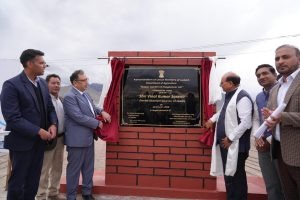
Recently, Lieutenant Governor of Ladakh Vinai Kumar Saxena laid the foundation stone for India’s first high-altitude flower fields at Choglamsar and Stakna in Ladakh.
Highlights of India’s First High-Altitude Flower Fields in Ladakh
- About: High-altitude flower fields are organised floriculture zones established in mountainous regions for cultivating ornamental and commercial flowers under cold-climate conditions.
- The Ladakh initiative is India’s first dedicated high-altitude floriculture project designed to promote scientific flower cultivation.
- The flower fields are designed as Ladakh’s own “Valley of Flowers”, introducing vibrant floral landscapes.
- Developing By: The initiative is being executed by the Ladakh Administration with support from horticulture specialists, botanists and floriculture experts.
- Location: Both sites lie along the Indus River corridor near Leh.
- The initiative consists of two flower fields in Leh district—one at Choglamsar and another at Stakna.
- Together, they form a twin-project model aimed at developing Ladakh into a recognised centre.
- Area: The Choglamsar Flower Garden covers 92,687 square metres, while the Stakna Floriculture Project occupies 1.02 lakh square metres.
- The combined area exceeds 1.94 lakh square metres, making it one of the largest organised high-altitude floriculture initiatives in India.
- Choglamsar: Choglamsar is being developed as one of the country’s largest organised high-altitude floriculture parks.
- Conceived as a flagship demonstration site, it will showcase the viability of commercial flower cultivation under Ladakh’s unique climatic conditions.
- The project complements ongoing ecological redevelopment in Choglamsar, including nature trails, biodiversity zones, cycle tracks, viewpoints and recreational spaces.
- Stakna: The Stakna project is located at the School of Agriculture Science and Technology, University of Ladakh.
- It is envisioned as a model centre for scientific floriculture, focusing on economic diversification.
- Partner Institution: Technical support will be provided by the CSIR–Institute of Himalayan Bioresource Technology (CSIR-IHBT), Palampur, Himachal Pradesh.
- A formal MoU with the Department of Agriculture, UT Ladakh will facilitate technology transfer, research support and scientific cultivation practices.
- Flower Cultivation: The projects will cultivate Lilium, Gladiolus, Tulips and other ornamental flowers with strong demand in domestic and international markets.
- The project will also focus on hardy, low-water and cold-resistant species including Petunia, Salvia, Marigold, Gitika, Champa, Blue Pine, Deodar and Cypress.
- Species selection will prioritise resilience to sub-zero temperatures, strong winds, intense solar radiation and water scarcity.
- Capacity Building: For the first time in Ladakh, farmers will receive structured floriculture training programmes.
- After training and establishment, flower fields will be progressively linked with cooperative-led commercial utilisation.
- Once trained, full operational control will be handed directly to local farmer cooperatives for long-term commercial utilization.
Significance of These Flower Fields
- Floriculture Development: The project introduces scientific high-altitude floriculture as a new agricultural sector in Ladakh.
- By promoting commercially valuable flowers adapted to cold-arid conditions, it expands crop diversification beyond traditional cereals and vegetables.
- The initiative can position Ladakh as a niche producer of premium mountain-grown flowers, strengthening India’s floriculture value chain.
- Farmer Livelihoods: Floriculture offers a high-value, market-oriented agricultural alternative with greater income potential per unit area than many conventional crops.
- The project provides technical training, market linkages and cooperative-based participation, enabling farmers to access new revenue streams.
- The focus on premium flowers can help improve farm profitability, encourage entrepreneurship and create opportunities for youth participation.
- Rural Development: The initiative supports rural economic diversification in a region where climatic constraints limit agricultural options.
- New activities such as nursery management, flower grading, packaging, transportation and marketing can generate employment across the value chain.
- The project also promotes local institutional capacity, strengthens community participation and creates opportunities for women and self-help groups in rural enterprise development.
- Biodiversity Conservation: The flower fields contribute to landscape enhancement and ecological enrichment through the introduction and management of diverse ornamental species.
- Ladakh possesses only about 0.4% green cover, prompting efforts to increase vegetation. The flower fields are expected to improve landscape aesthetics.
- Scientific selection of crops adapted to local conditions reduces ecological stress while encouraging awareness of plant diversity.
- Flower cultivation is expected to support pollinator populations, improve micro-habitats and strengthen local biodiversity.
- Sustainable Agriculture: The project promotes climate-responsive and resource-efficient agriculture tailored to Ladakh’s fragile mountain environment.
- Scientific cultivation practices, technology transfer and crop suitability assessments can improve productivity while minimising ecological impacts.
- Eco-Tourism Promotion: The flower fields create a new nature-based tourism asset in Ladakh, complementing the region’s existing mountain and cultural attractions.
- Seasonal floral landscapes can attract visitors, photographers, researchers and students, extending tourism opportunities.
- By combining recreation, education and environmental awareness, the initiative strengthens Ladakh’s emerging green economy and sustainable tourism model.
| Floriculture is a specialised branch of horticulture concerned with the scientific cultivation, production, processing and marketing of flowers and ornamental plants for commercial, aesthetic and landscaping purposes. It includes cut flowers, loose flowers, potted plants, bulbs, foliage plants and ornamental nursery crops. In India, floriculture is recognised as a high-value “sunrise industry” because it generates higher returns per unit area, promotes exports, creates rural employment and supports agri-diversification. |
Major Flower Gardens in India
- Indira Gandhi Memorial Tulip Garden: Located in Srinagar, Jammu and Kashmir, this garden spans 30 hectares at the foothills of the Zabarwan Mountains.
- Inaugurated in 2007, it is Asia’s largest tulip garden, featuring millions of blooming tulips, daffodils, and hyacinths during the annual spring festival.
- Lalbagh Botanical Garden: Found in Bengaluru, Karnataka, this historic park covers 240 acres.
- Established in 1760 by Hyder Ali, it features a cast-iron Glass House modeled on London’s Crystal Palace, ancient centuries-old trees, a floral clock, and a national geological monument watchtower.
- Government Botanical Garden: Situated in Ooty, Tamil Nadu, this sprawling 55-acre terraced garden was inaugurated in 1848.
- It features rare exotic flora, a fossilized tree estimated to be 20 million years old, and a vibrant annual flower show.
- Brindavan Gardens: Located in Mysuru, Karnataka, these expansive terraced gardens stretch alongside the Krishnarajasagara dam.
- Inaugurated in 1932, their most distinguishing feature is the spectacular, symmetrically lit musical and dancing fountain shows that light up every evening.
- Gulab Bagh: Found in Udaipur, Rajasthan, this 100-acre garden was inaugurated in 1887 by Maharana Fateh Singh.
- Known as Asia’s largest rose garden, it features the Saraswati Library, a mini zoo, and the state’s first dedicated bird park.
- Company Bagh (Chandrashekhar Azad Park): Found in Prayagraj (Allahabad), Uttar Pradesh, this expansive 133-acre park was opened to the public in the 1850s.
- It features colonial-era landscaping, the historic Victoria Memorial, and serves as a vital green lung holding major historical significance.
- Acharya Jagadish Chandra Bose Indian Botanic Garden: Located in Howrah, near Kolkata, West Bengal, this massive 270-acre garden was established in 1787.
- Its defining feature is the colossal 250-year-old Great Banyan Tree, which has a canopy that covers several acres.
- Kaas Plateau: Found in Satara, this 1,000-hectare biodiversity hotspot features seasonal endemic wildflowers and was inscribed as a UNESCO World Heritage site.
- Valley of Flowers: Located in Chamoli, Uttarakhand, this 8,750-hectare national park established in 1982 is globally celebrated for its ethereal alpine meadows.
- Dzüko Valley: Lying on the Nagaland-Manipur border, this 2,926-meter elevation valley is famous for the endemic Dzüko lily and summer floral blooms.
FAQs:
Q1. What are the new high-altitude flower fields in Ladakh?
They are India’s first high-altitude flower fields being developed at Choglamsar and Stakna in Leh for scientific floriculture.
Q2. Why are the flower fields important for biodiversity?
They promote native high-altitude flora, increase green cover, support ecological balance and strengthen biodiversity conservation in Ladakh.
Q3. Which rare flowers can be found in these meadows?
Ladakh’s alpine ecosystems support rare flowers including Blue Poppy, Primulas and several native cold-desert flowering species.
Q4. How will these flower fields boost tourism in Ladakh?
They will create colourful seasonal attractions, enhance landscape aesthetics and expand eco-tourism opportunities beyond adventure tourism.
Q5. What is the ecological significance of these flower fields?
They aid habitat restoration, soil conservation, climate resilience and sustainable development in Ladakh’s fragile cold-desert ecosystem.
Disclaimer: Information in this article is based on official announcements and public records. Regulations and implementation details may evolve over time.
| Also Read: India’s First Model Border Village in Ladakh |