




Malwi Potato, Garadu and Balam Kakdi from Madhya Pradesh Get GI Tag
| General Studies Paper lI: Heritage and Culture, Intellectual Property Rights (IPRs) |
Why in News?
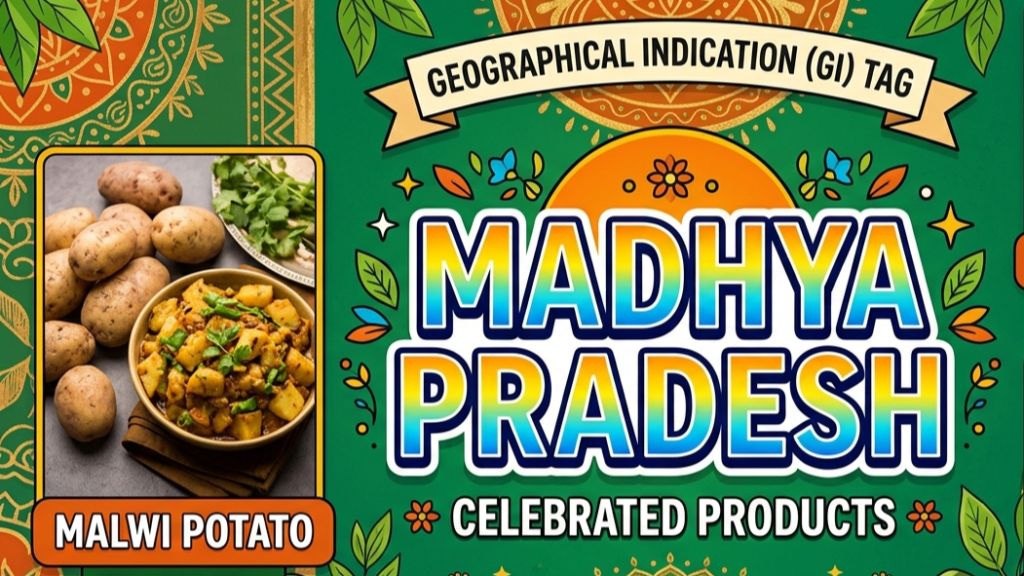
Recently, Madhya Pradesh got GI tags for Malwi Potato, Garadu, and Balam Kakdi, strengthening regional branding.
What is Geographical Indication (GI) Tag?
- About: A Geographical Indication (GI) Tag is an intellectual property right that identifies a product as originating from a specific geographical area, where its quality, reputation or characteristics are essentially linked to that location.
- The concept of GI is recognized under the World Trade Organization (WTO) framework and the TRIPS Agreement.
- It protects products whose uniqueness arises from geographical origin and traditional knowledge.
- Legal Basis: India protects GI products through the Geographical Indications of Goods (Registration and Protection) Act, 1999.
- The Act was enacted in 1999 and came into force on 15 September 2003.
- Products: GI protection can be granted to agricultural products, natural products, manufactured goods, handicrafts, industrial goods and food items.
- Criteria: For registration, the product must possess a specific quality, reputation or characteristic attributable to its geographical origin.
- The geographical link must be clearly established and documented.
- Authority: GI registrations in India are administered by the Geographical Indications Registry, Chennai, under the Department for Promotion of Industry and Internal Trade (DPIIT), Ministry of Commerce and Industry.
- Rights: A registered GI allows authorized producers to prevent unauthorized use, imitation and misrepresentation of the product name.
- Validity: A registered Geographical Indication (GI) is initially valid for 10 years and can be renewed indefinitely for successive 10-year periods to maintain legal protection.
- Significance: GI tags help secure premium pricing, strengthen market identity, improve export potential, increase rural incomes and support local producer communities through value addition.
- GI protection preserves traditional knowledge, indigenous skills, cultural heritage and region-specific production methods that may have evolved over centuries.
- Examples: Famous Indian GI products include Darjeeling Tea, Basmati Rice, Kanchipuram Silk Saree and Kadaknath Chicken.
- Total No: India currently safeguards over 650 unique products with GI tags.
- Among the states, Uttar Pradesh holds the highest number of GI-tagged products, crossing the 75 mark with items like Banarasi Silk Sarees and brassware.
About Madhya Pradesh’s Recent Three GI Products
- Malwi Potato: Malwi Potato is a distinctive potato grown in the Malwa Plateau of Madhya Pradesh, particularly around Indore, Ujjain, Dewas, Mandsaur, Ratlam and Neemuch.
- The crop is concentrated in the black-soil belt of western Madhya Pradesh.
- It grows best in well-drained fertile soils with cool winter temperatures.
- Potato tuber formation generally performs optimally at 15–18°C soil temperature, while average temperatures of 18–20°C support healthy crop growth.
- It is generally medium-sized, oval to round in shape, with a smooth skin, uniform appearance and good processing quality.
- Negligible starch prevents it from soaking up excess oil when fried, keeping the texture naturally crispy.
- Unlike other varieties, it retains a clean, bright white color after deep frying.
- It is widely used in central Indian street food for dishes like Aloo Chaat, Poha, Aloo Bada, and Khopra Petis.
- It serves as a strong source of complex carbohydrates, Vitamin C, potassium, and dietary fiber.
- It is among the region’s most profitable irrigated crops. It supports farm income, rural employment, transport, storage and food-processing sectors.
- Potatoes are cultivated across 45,000 hectares in Indore district, involving 30,000 to 35,000 farmers directly and indirectly.
- Garadu: It is a traditional tuber crop of the Malwa region of Madhya Pradesh, especially associated with Indore, Ujjain, Ratlam and surrounding districts.
- It belongs to the yam group (Dioscorea species) and is renowned for its distinctive taste and culinary value.
- The tuber is generally brown externally and white to cream internally.
- It possesses a rough outer surface, dense flesh and irregular cylindrical shape.
- Individual tubers commonly range from 200 grams to more than 1 kilogram, depending on variety and cultivation conditions.
- The crop grows best under warm tropical to subtropical conditions with moderate rainfall.
- Garadu performs well in deep, loose, well-drained loamy to black soils. The fertile soils of the Malwa region support healthy underground tuber development.
- Garadu is rich in complex carbohydrates, dietary fibre, potassium, vitamin C and antioxidants. Traditionally, it is valued as an energy-rich winter food and is considered beneficial for immunity and digestive health.
- Garadu is one of Indore’s most iconic street foods. The tubers are cut into cubes, deep-fried until crispy and served with spicy masala, lemon juice and herbs.
- Balam Kakdi: It is a traditional indigenous cucumber variety cultivated mainly in Sailana and Jaora areas of Ratlam district, Madhya Pradesh.
- The crop is strongly associated with Bali village of Sailana block, which is regarded as its place of origin. The name “Balam” is believed to have evolved from this locality.
- Balam Kakdi thrives in semi-arid conditions with limited water availability. Unlike many vegetables, excessive rainfall can reduce quality.
- Balam Kakdi is famous for its large size, significantly bigger than ordinary cucumbers. Fruits are generally elongated, cylindrical to bottle-gourd-like in shape, with thick juicy flesh.
- One of its most remarkable features is colour variation. Mature fruits may exhibit green, yellow and saffron-orange shades, making them visually distinct from conventional cucumbers that remain predominantly green.
- The fruit is known for its juicy texture, high water content and mildly sweet flavour. Consumers often describe its taste as a blend of cucumber, melon and papaya.
- Ratlam district cultivates Balam Kakdi on approximately 100 hectares, producing around 700–800 tonnes annually. The crop is largely grown through traditional farming methods and is considered nearly organic by nature.
- Balam Kakdi is a high-value seasonal crop. Individual fruits often sell for ₹80–₹150 per fruit, providing substantial returns to farmers in hilly regions. It supports local livelihoods and agricultural diversification.
Major GI-Tagged Products of Madhya Pradesh
- Maheshwar Saree: Originating from Maheshwar, Khargone district, it received a GI Tag in 2009 for its distinctive reversible border, lightweight texture and handwoven silk-cotton craftsmanship.
- Chanderi Fabric: Produced in Chanderi, Ashoknagar district, it obtained a GI Tag in 2005 due to its ultra-light texture, glossy appearance and traditional handloom weaving.
- Ratlami Sev: Originating from Ratlam district, it received a GI Tag in 2015 for its clove-pepper flavour, crispy texture and unique traditional preparation method.
- Kadaknath Chicken: Native to Jhabua and Alirajpur, it obtained a GI Tag in 2018 because of its black meat, high protein content and indigenous genetic traits.
- Bagh Print: Originating from Bagh village, Dhar district, it received a GI Tag in 2008 for its natural dyes, hand-block printing and traditional motifs.
- Leather Toys: Produced in Indore, these received a GI Tag in 2008 due to their handcrafted leather artistry, vibrant colours and cultural significance.
- Bell Metal Ware: Originating from Datia and Tikamgarh, it obtained a GI Tag in 2023 for its traditional lost-wax casting technique and durable alloy craftsmanship.
- Gond Painting: Native to the Gond tribal regions of Madhya Pradesh, it received a GI Tag in 2022 for its intricate dots, lines and depiction of tribal folklore.
- Batik Print: Produced mainly in Bhopal and Ujjain regions, it secured a GI Tag in 2023 for its wax-resist dyeing technique and artistic textile patterns.
FAQs:
1. What is a GI Tag?
A Geographical Indication (GI) Tag identifies products whose qualities or reputation are linked to a specific geographical region.
2. Why did Indori Malwi Potato, Garadu and Balam Kakdi receive GI status?
They received GI status for their unique qualities, reputation, climate-soil linkage and regional identity in Malwa and Sailana.
3. How does a GI Tag benefit farmers?
GI tags increase market value, premium pricing, branding, export opportunities and protection against imitation products.
4. What makes these products unique?
Their uniqueness comes from local climate, soil conditions, traditional cultivation methods and distinctive taste, texture or quality.
5. How many GI-tagged products does Madhya Pradesh have now?
With recent additions, Madhya Pradesh now has more than 20 GI-tagged products, including new agricultural and handicraft items.
Disclaimer: Information in this article is based on official announcements and public records. Regulations and implementation details may evolve over time.
| Also Read: GI-Tagged Indi & Puliyankudi Limes |