India Raises Petrol-Diesel Prices
|
General Studies Paper II: Government Policies & Interventions, Mobilization of Resources |
Why in News?
Recently, India increased petrol and diesel prices by nearly ₹3 per litre after four years, driven by surging global crude oil prices.
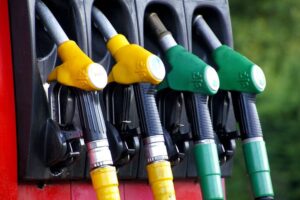
Reasons Behind India’s Petrol-Diesel Price Hike
- Global Crude Shock: The escalation of the US-Israel-Iran conflict pushed international benchmark Brent crude oil prices past $100 per barrel.
- This global surge directly impacts India, which relies on foreign imports to satisfy over 85% of its domestic crude consumption requirements.
- Hormuz Strait Blockade: Geopolitical tensions led to a partial blockade of the Strait of Hormuz by Iran, choked off a vital energy corridor.
- Because 30% of India’s crude imports transit through this narrow channel, the disruption sparked deep supply anxieties and loaded a hefty geopolitical risk premium onto cargo shipments.
- Depleted Refiner Buffers: Public sector fuel retailers had previously frozen retail pumps for nearly four years by offsetting expensive imports with past profits.
- However, sustained high crude prices exhausted their cheaper inventories, saddling firms with steep daily under-recovery losses of ₹20 per litre on petrol.
- Soaring Logistics Costs: Global shipping line re-routing and maritime security threats drastically drove up freight insurance rates.
- These surging distribution overheads inflated the landed cost of crude at Indian ports, forcing energy firms to pass the operational burden down to the consumer level.
- Currency Depreciation Pressures: International oil trade is settled predominantly in United States Dollars, making local pricing highly vulnerable to forex volatility.
- The weakening of the Indian Rupee against the USD structurally elevated import invoices, requiring more local currency to purchase the exact same quantum of crude oil.
- Domestic Tax Architectures: Even during global crises, central excise duties and state-level Value Added Taxes represent a massive chunk of pump rates.
- The compounding effect of state VAT levied on top of central duties keeps the baseline retail price highly rigid, leaving no cushion to absorb external supply shocks.
- Global Policy Push: The International Monetary Fund actively advised emerging economies to phase out artificial energy subsidies.
- This policy stance accelerated the domestic pass-through of market-linked costs, as keeping prices suppressed artificially would distort demand, widen the fiscal deficit, and worsen systemic inflation.
How Petrol-Diesel Prices are Decided in India?
India’s domestic fuel pricing follows a market-determined structure established after the deregulation of petrol in 2010 and diesel in 2014. Public sector oil marketing companies (OMCs) calculate daily retail pump rates based on a 15-day rolling average of international benchmarks.
- Trade Parity: The core mechanism uses Trade Parity Pricing (TPP), treating the base value as a weighted average.
- The calculation applies an 80:20 ratio between the Import Parity Price (IPP) and Export Parity Price (EPP), reflecting global fuel demand.
- Refinery Costs: Once crude is processed, the Refinery Transfer Price (RTP) is established.
- This represents the net amount paid by OMCs to domestic refineries to acquire the processed petrol or diesel.
- Inland Freight: OMCs map out the logistics of moving refined products via rail pipelines and road tankers.
- The inland freight charge is added to the base price, creating price variations between coastal and landlocked regions.
- Marketing Margins: To cover infrastructure maintenance, employee payrolls, and corporate overheads, OMCs add their domestic marketing margins.
- These margins safeguard operational cash flow and generate a net operational profit buffer.
- Currency Adjustments: Because global oil trading is denominated in US Dollars, the USD-INR exchange rate fluctuates daily.
- A depreciating Indian Rupee automatically increases the base import cost, inflating the retail bill.
- Central Excise: The Central Government levies a flat, fixed-rate Central Excise Duty nationwide.
- This duty includes a basic excise tax combined with specific allocations like the Agriculture Infrastructure and Development Cess (AIDC).
- State Taxes: Every individual state applies a varying Value Added Tax (VAT) or Sales Tax.
- Because VAT is often charged as an ad-valorem percentage on the cumulative base cost, it creates vast price disparities between different states.
- Dealer Commissions: Retail pump owners receive a fixed Dealer Commission per every litre sold.
- Revised periodically by OMCs, this fee averages roughly ₹3.77 per litre for petrol to cover local station operations.
- Daily Revision: Under the Dynamic Fuel Pricing mechanism, prices refresh every single morning at 6:00 AM.
- This constant adaptation aligns domestic rates with real-time swings in international fuel product benchmarks.
- Inflation Buffers: OMCs occasionally integrate a microscopic Buffer for Future Inflationary Aspects into their pricing matrix.
- This pricing cushion shields supply lines against sudden unexpected freight spikes or sudden maritime insurance hikes.
Economic Impact of Fuel Hike
- Retail Inflation Surge: The retail fuel rate adjustment directly impacts the Consumer Price Index (CPI).
- Economists expect a 25 to 30 basis point surge in headline inflation, forcing the May CPI projections up from 4.1% to roughly 4.3%.
- Wholesale Price Shock: Producer-side expenses are escalating sharply because petrol and diesel act as core industrial raw inputs.
- Driven by soaring mineral oils and logistics overheads, Wholesale Price Index (WPI) inflation jumped to a 42-month high of 8.3%.
- Partial OMC Relief: State-run fuel marketing corporations were absorbing steep operational under-recoveries up to ₹30 per litre.
- While the rate adjustment grants them crucial operational breathing room, OMCs still face a combined daily loss of ₹500 crore.
- Freight Cost Escalation: As diesel powers the heavy commercial transport sector, distribution networks are factoring in immediate price corrections.
- Higher logistics, cargo freight, and agricultural machinery operational costs are translating into pricier daily consumer commodities.
- Monetary Policy Tightening: Spike in core fuel components complicates the central bank’s consumer price management matrix.
- The Reserve Bank of India (RBI) is highly likely to hold the repo rate flat at 5.25%, stalling previous market easing expectations.
- EV Transition Acceleration: Sustained fossil fuel price spikes are altering consumer buying psychology in the auto marketplace.
- High retail costs are squeezing traditional car margins and proactively accelerating the structural shift toward cheaper Electric Vehicle (EV) adoption.
|
Also Read: India Bans Sugar Exports |