India Reservoir Crisis
|
General Studies Paper II: Water Resources, Climate Change, Government Policies & Interventions |
Why in News?
According to the Central Water Commission Data, India’s 166 monitored reservoirs lost nearly 8 BCM of water within two weeks, exposing severe hydrological stress.
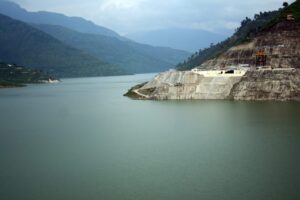
India’s Reservoir Water Crisis
- Reservoir Storage Status: The Central Water Commission (CWC) monitors 166 major reservoirs with a combined live storage capacity of 183.565 BCM, representing nearly 71.2% of India’s total estimated reservoir storage capacity of 257.812 BCM.
- Sharp Water Decline: CWC data shows reservoir storage fell from 71.082 BCM on 30 April 2026 to 63.232 BCM on 14 May 2026, indicating a rapid decline of nearly 8 BCM within just fourteen days.
- Current Capacity: Available water now stands at only 34.45% of total live storage capacity, compared to 38.72% at the end of April, reflecting accelerated depletion during the peak summer season.
- The number of major reservoirs storing less than 50% of their normal capacity increased from 9 to 13 within two weeks, indicating expanding hydrological stress across regions.
- The southern region recorded the weakest storage position, with 36 reservoirs below 40% capacity, the highest concentration of low-storage reservoirs in the country.
- Tamil Nadu’s Vaigai Reservoir retained only 12.47% of normal storage, while Aliyar Reservoir stood at 21.25%, among the lowest levels reported nationally.
- Kerala’s important Periyar Reservoir recorded only 41.65% of its normal storage level, placing it in the low-storage category.
- Three reservoirs—Chandan Dam (Bihar), Bhima Ujjaini (Maharashtra) and Maudaha Reservoir (Uttar Pradesh)—reported 0% live storage, effectively reaching dead-storage conditions.
- Critical reservoirs including Khandong (Assam), Tattahalla (Karnataka), Rajghat (Madhya Pradesh) and Tehri (Uttarakhand) reported severe storage deficiencies.
- Storage in the Ganga Basin declined to 43.34%, dropping significantly from around 50% recorded at the end of April.
- The Krishna Basin held only 19.31% water storage, making it one of India’s most stressed river-basin systems.
- Water Availability: Despite the rapid decline, total storage of 63.232 BCM remains approximately 24% above the long-term normal level for this period, though depletion rates remain exceptionally high.
Causes Behind Rapid Decline in Reservoir Storage
- Sedimentation Loss: Reservoir sedimentation is rapidly reducing India’s effective storage capacity.
- In 2025, the Union Jal Shakti Ministry informed Parliament that 24 dams across Punjab, Haryana and Himachal Pradesh lost 4,184 million cubic metres (MCM) of storage, nearly 20% of original capacity.
- The Bhakra Reservoir alone lost 2,568 MCM due to silt accumulation, directly lowering water retention during summer shortages.
- Thermal Evaporation: Extreme heat has accelerated surface-water evaporation across reservoirs.
- A 2026 Water Resources Department (WRD) review projected that reservoirs in six Vidarbha districts could lose 245.69 MCM, nearly 37% of planned water utilisation, purely through evaporation before August.
- IMD reported repeated 45–48°C temperatures across Rajasthan, Delhi, Haryana and central India during April–May 2026. Extreme heat accelerates surface evaporation from reservoirs, causing faster water loss.
- Demand Explosion: Reservoir withdrawals have surged due to rising irrigation, industrial and urban consumption.
- According to the WRD assessment, planned allocations included 223.06 MCM for irrigation, 115.37 MCM for drinking water, and 71.40 MCM for industries within a single seasonal review period.
- Such heavy extraction accelerated storage decline even before monsoon recharge began.
- Catchment Degradation: Degraded upper catchments are reducing natural runoff into reservoirs.
- Recent restoration of Tamil Nadu’s Madakulam Tank required large-scale desilting, channel clearance and bund strengthening after inflow pathways became blocked by erosion and waste deposition.
- Officials reported improved storage only after catchment rehabilitation measures were undertaken.
- Drought Persistence: Weak rainfall and prolonged dry conditions have severely reduced reservoir inflows.
- Storage levels continued declining sharply from February onward due to inadequate replenishment.
- Official forecasts indicated a moderate-to-strong El Niño probability during the second half of the monsoon, historically associated with weaker inflows into reservoirs.
- Management Gaps: Delayed desilting operations and inefficient reservoir management have worsened storage losses.
- The Jal Shakti Ministry linked increasing silt accumulation to inadequate maintenance in several dam systems.
- The government subsequently expanded interventions under the Dam Rehabilitation and Improvement Project (DRIP) to address declining reservoir efficiency.
- Upstream Damming: Growing upstream regulation and dam operations are altering downstream water availability.
- Recent debates surrounding Indus Basin projects, reservoir flushing and diversion infrastructure highlighted how upstream storage control can reduce downstream flows and accelerate local reservoir stress during low-rainfall periods.
Impact of Rapid Decline in Reservoir Storage
- Agricultural Crop Yield Decline: Agriculture absorbs over 90% of India’s water. Low storage slashes the irrigation capacity for major staple crops like rice, wheat, and sugarcane.
- This forces farmers into unsustainable groundwater extraction, eventually shrinking food reserves and depressing rural incomes.
- Acute Drinking Water Shortages: Declining surface levels drain basic domestic supplies, leaving millions without safe drinking water.
- Severe shortages elevate the risk of water-borne diseases and drastically increase healthcare costs for vulnerable populations.
- Hydroelectric Power Bottlenecks: Dwindling reservoir volumes restrict water flow to turbines, crippling hydel power generation.
- This forces the energy grid to rely on thermal plants and fossil fuels, which degrades air quality and drives up operating costs.
- Accelerated Groundwater Depletion: To offset surface water deficits, regions over-extract from deep aquifers.
- Continuous over-pumping causes severe water table depletion, threatening long-term farming sustainability and increasing vulnerability to droughts.
- Macroeconomic and GDP Contraction: Water scarcity disrupts manufacturing and industrial output.
- According to global research, prolonged water stress could reduce India’s GDP growth significantly, increasing rural poverty and causing major trade losses.
- Inter-State and Regional Disputes: Shrinking water basins intensify competition over shared resources.
- This exacerbates inter-state river sharing conflicts (e.g., Kaveri, Krishna) and strains federal cohesion, causing significant sociopolitical friction within the country.
- Ecological Degradation: Lower water levels disrupt wetland ecosystems, severely harming biodiversity.
- Reduced natural habitats often force wildlife to enter human settlements for basic needs, sharply escalating human-wildlife conflicts.
|
Government Water Management Reforms & Initiatives:
|
|
Also Read: India Big Cities Facing Water Crisis |