




India AS-HAPS Programme to Build Indigenous Stratospheric Airships
| General Studies Paper III: Defence Technology, Indigenization of Technology |
Why in News?
Recently, India accelerated its AS-HAPS (Airship-Based High-Altitude Pseudo-Satellite) programme to develop indigenous stratospheric airships, strengthening long-endurance ISR capabilities.
What is AS-HAPS Programme?
- About: The Airship-based High Altitude Pseudo Satellite (AS-HAPS) Programme is India’s initiative to develop indigenous stratospheric airships for long-endurance strategic missions.
- It seeks to establish a domestic capability in designing, developing and producing advanced airship systems.
- Objective: The programme aims to establish persistent, round-the-clock surveillance over India’s borders while strengthening indigenous aerospace capability.
- Approval: The programme received Acceptance of Necessity (AoN) from the Defence Acquisition Council (DAC) in February 2026.
- It marks the formal approval for procurement and development.
- Agency: The programme is being steered by the Ministry of Defence, with implementation involving the Indian Air Force and support from DRDO.
- The Directorate of Operations (Remote) of the Indian Air Force is steering the project.
- Funding: The programme has an estimated value of ₹15,000 crore. Under the Make-I model.
- The Government may fund up to 70% of prototype development costs, reducing financial risk for industry partners.
- Industry Participation: Indian private aerospace companies have been invited to compete for prototype development.
- Significance: The programme directly supports Aatmanirbhar Bharat by building critical capabilities within India.
- It strengthens domestic supply chains and reduces import dependence.
- It represents India’s entry into an advanced strategic technology domain.
- It bridges the capability gap between Low Earth Orbit satellites and Unmanned Aerial Vehicles (UAVs) by offering persistent coverage.
What are Stratospheric Airships?
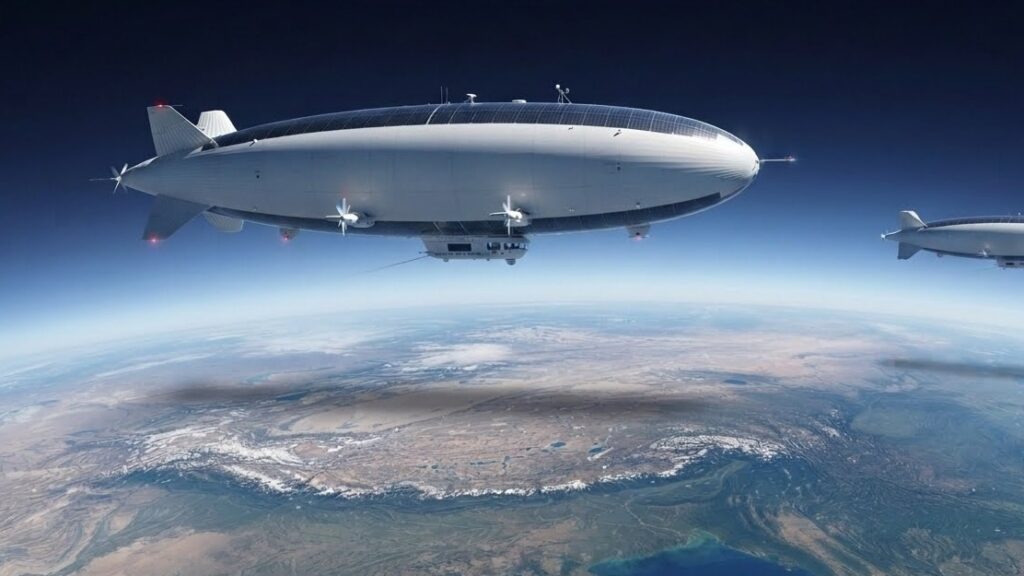
- About: Stratospheric airships are lighter-than-air, unmanned or optionally crewed platforms that operate in the stratosphere for long-duration missions.
- They provide persistent services while remaining nearly stationary over a selected region.
- They are also called High-Altitude Platform Systems (HAPS).
- It operates as a High-Altitude Pseudo-Satellite (HAPS).
- Operating Altitude: Stratospheric airships generally operate between 20–50 km above Earth’s surface.
- Most defence designs target around 20 km (66,000 ft), where weather disturbances are comparatively lower.
- Objective: These platforms provide persistent coverage, continuous monitoring and reliable communication support.
- History: Germany pioneered practical rigid airships through Count Ferdinand von Zeppelin, whose first successful Zeppelin flew in 1900.
- Pioneered in the 1960s with Raven Aerostar’s High Platform II reaching 70,000 feet in 1969, the concept gained significant traction.
- Design: The platform uses a large helium envelope, lightweight composite structure, propulsion units, control surfaces and a payload module.
- Power System: It uses solar panels with rechargeable batteries or fuel cells. The system stores daytime energy for continuous night operations.
- Working Principle: The airship generates buoyancy using helium.
- Propulsion systems maintain position, while onboard control systems regulate altitude, stability and navigation.
- Endurance: These airships remain airborne for weeks or months, depending on mission profile, and environmental conditions.
- Benefits: They provide low operating cost, wide-area coverage, reusability, rapid deployment and continuous service. They also support indigenous technological capability.
- Applications: They support telecommunications, Intelligence, Surveillance, Reconnaissance (ISR), remote sensing, weather observation, disaster management, environmental monitoring and scientific research.
- Progress: DRDO conducted the maiden flight trial of the Stratospheric Airship Platform (SAP) on 3 May 2025 from Sheopur, Madhya Pradesh.
- The platform reached about 17 km altitude during a 62-minute flight, marking India’s entry into indigenous high-altitude airship technology.
- Also, CSIR-National Aerospace Laboratories (NAL) developed an unmanned prototype, weighing 23 kg with a 12-meter wingspan, successfully completed tests at the Aeronautical Test Range in Challakere, Karnataka.
- Limitations: Strong stratospheric winds, extreme temperatures, ultraviolet radiation, and material degradation affect long-term operations.
- The stratosphere has very low air density, low atmospheric pressure, strong ultraviolet radiation and temperatures that may fall below −60°C.
Significance of Stratospheric Airships
- Enhanced China Border Vigilance: The airships are expected to improve surveillance along the Line of Actual Control (LAC), where India’s border with China extends for about 3,488 km.
- They could provide sustained observation of troop concentrations, military exercises, equipment deployment and infrastructure expansion in high-altitude regions.
- Improved Pakistan Border Monitoring: The programme is likely to enhance monitoring along the India–Pakistan border, particularly vulnerable infiltration routes.
- Continuous observation may assist in identifying cross-border infiltration attempts, launch pads, temporary camps, unusual vehicle movement and suspicious activity.
- Strategic Lesson from the Doklam Standoff: The 73-day Doklam standoff (2017) demonstrated the strategic importance of uninterrupted surveillance in contested border regions.
- The proposed airships could help detect incremental infrastructure construction, road extensions and military mobilisation at an early stage.
- Protection of Siliguri Corridor: The airships may strengthen surveillance around the Siliguri Corridor, commonly called the “Chicken’s Neck,” which is only about 20–22 km wide at its narrowest point.
- This corridor connects mainland India with the eight Northeastern States. Persistent observation could improve monitoring of surrounding border areas.
FAQs:
1. What are indigenous surveillance airships?
Indigenous surveillance airships are Indian-built stratospheric airships for persistent ISR and communication missions.
2. How will surveillance airships strengthen India’s border security?
They provide 24×7 ISR, early warning, and continuous monitoring across sensitive border regions.
3. Which agency is developing these airships?
The Ministry of Defence leads development with DRDO, IAF, and Indian industry participation.
4. What technologies are used in surveillance airships?
They use electro-optical sensors, thermal imagers, night vision, electronic intelligence, and communication payloads.
5. How are airships different from drones?
Airships use helium buoyancy and remain airborne longer; drones rely on powered flight.
6. Which borders will these airships monitor?
They will monitor India’s northern and western borders, including China and Pakistan frontiers.
Disclaimer: Information in this article is based on official announcements and public records. Regulations and implementation details may evolve over time.