




India First Government-Driven AI University: Karnataka AI University
| General Studies Paper III: Artificial Intelligence, Government Policies & Interventions |
Why in News?
Recently, Karnataka announced the establishment of India’s first government-driven AI University, aiming to create a robust AI talent pipeline.
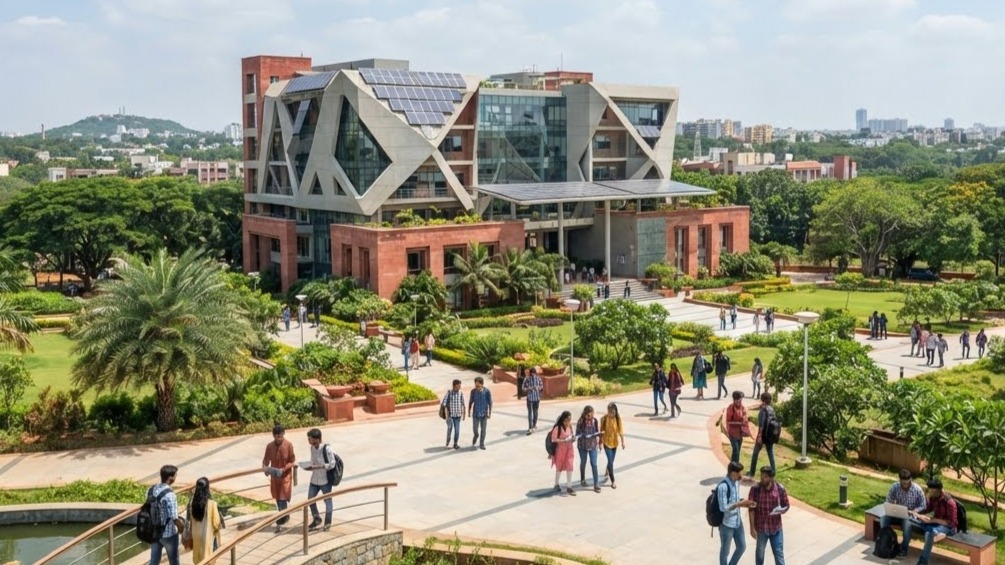
What is Karnataka AI University?
- About: It is the proposed first government-driven Artificial Intelligence University in India.
- The university will support responsible AI, advanced computing and industry-ready talent.
- Announcement: The initiative was announced on 14 July 2026 by Chief Minister D.K. Shivakumar during Google I/O Connect India 2026 in Bengaluru.
- Objective: The university seeks to create world-class AI professionals, promote cutting-edge research, encourage AI startups, strengthen industry-academia collaboration, and improve public service delivery through AI.
- It aims to establish Karnataka as a global hub for responsible AI innovation.
- Governance: The university will be government-driven under the Government of Karnataka.
- It is expected to function as partnerships with technology companies, and research institutions.
- Detailed statutory provisions are yet to be released.
- Features:
- AI-Focused Education: The university will offer specialised programmes in Artificial Intelligence and emerging technologies such as Machine Learning, Data Science, Robotics, Cloud Computing and AI governance.
- It will produce graduates with advanced technical and practical skills aligned with future employment needs.
- Research and Innovation: It will promote advanced AI research, interdisciplinary innovation and development of solutions for governance, healthcare, agriculture, and manufacturing.
- Startup and Industry Ecosystem: The proposed AI Innovation Hub will serve as an incubation platform where startups, companies and researchers can jointly develop AI products.
- Green Digital Infrastructure: The state plans to establish next-generation green data centres supporting energy-efficient AI computing, and sustainable digital infrastructure.
- These proposed green data centres for AI infrastructure possibly to be developed at Hoskote in Bengaluru and near Mangaluru.
- AI Talent Development: The initiative complements Karnataka’s broader AI strategy, including 50 AI laboratories in government colleges, helping create a continuous pipeline of skilled AI professionals.
- Significance: The initiative reinforces Karnataka’s leadership in technology, innovation and knowledge economy.
- It is expected to attract investment, generate high-skilled employment, and improve government AI adoption.
- It also supports India’s digital transformation and future workforce requirements.
Karnataka’s Technology and Innovation Ecosystem & Initiatives
- Ecosystem: Karnataka is India’s leading technology and innovation hub. Bengaluru is known as the country’s Silicon Valley because of its strong IT, startup, research and digital ecosystem.
- The state hosts 400+ Fortune 500 R&D centres, making Karnataka one of Asia’s largest research and product development ecosystems.
- Karnataka contributes nearly 40% of India’s IT exports. Bengaluru hosts a majority of global IT companies operating in India.
- Karnataka is among India’s top startup destinations. Karnataka hosts 230+ mid-sized Global Capability Centres (GCCs), accounting for nearly half of India’s mid-market GCC ecosystem.
- The state has 100+ fabless chip design companies, and contributes about 40% of India’s electronic design output.
- Karnataka contributes around 10% of India’s electronics output and over 22% of national electronics exports.
- The state has 35 GW installed power capacity, including 23 GW renewable energy, supporting reliable and sustainable digital infrastructure.
- Initiatives:
- Information Technology (IT) Policy 2025–30: Karnataka launched the IT Policy 2025–30 with an outlay of ₹967 crore.
- It aims to increase IT exports from ₹4 lakh crore to ₹11.5 lakh crore by 2030.
- The policy promotes Artificial Intelligence (AI), Quantum Computing, Cybersecurity, Blockchain, Green IT and balanced regional growth.
- Karnataka Digital Economy Mission (KDEM): KDEM is a Section 8 organization supported by the Karnataka Government.
- It coordinates IT, Startups, GCCs, Electronics, Biotechnology and Digital Economy.
- Beyond Bengaluru Mission: The Beyond Bengaluru Mission develops technology ecosystems in Mysuru, Mangaluru, Hubballi-Dharwad, Belagavi, Kalaburagi, Shivamogga and Tumakuru.
- By March 2025, it had onboarded 126 companies and created 5,500+ direct jobs through regional innovation clusters.
- Startup Karnataka: The state supports startups through Startup Karnataka, ELEVATE, ELEVATE NxT, Idea2PoC grants and incubation programmes.
- These initiatives promote deep-tech, AI, robotics, biotechnology and space technology innovation.
- Innovation and Incubation Network: Karnataka funds Technology Business Incubators (TBI 2.0), NAIN 2.0, Innovation Labs and the Karnataka Technology Innovation Museum. These programmes support student innovators, startups and deep-tech research.
- Quantum Technology Mission: Karnataka plans a ₹1,000-crore Quantum Mission with Q-City near Bengaluru.
- The mission targets 10,000+ skilled jobs, global research partnerships and leadership in quantum computing, communication and sensing.
- Information Technology (IT) Policy 2025–30: Karnataka launched the IT Policy 2025–30 with an outlay of ₹967 crore.
India’s AI Ecosystem
- Position: India is among the world’s leading AI nations. According to the Stanford AI Index, India ranks among the top four countries in AI capability and policies.
- It is also the second-largest contributor to AI projects on GitHub.
- Framework: The IndiaAI Mission (₹10,371.92 crore) is implemented by the IndiaAI Independent Business Division under Digital India Corporation (MeitY).
- Economy: AI is projected to contribute US$1.7 trillion to India’s economy by 2035.
- The country’s technology and AI ecosystem employs about 6 million people.
- India’s AI market is projected to reach about US$32 billion by 2031, making it one of the world’s fastest-growing AI markets.
- AI Startups: It has a massive ecosystem of over 3,100 AI startups that have raised more than $2.9 billion in cumulative funding.
- IndiaAI Startup Financing supports startups from idea to commercialization.
- Programs like the IndiaAI Startups Global Acceleration Program in partnership with Paris-based Station F and HEC Paris accelerated to transition local startups into European.
- Strategically channels resources outside major tech hubs, driving over 48% of deeptech innovations from Tier-2 and Tier-3 cities like Jaipur, Surat, and Indore.
- Indian AI startups secured over $1.06 billion in funding in the first half of 2026 alone.
- The Google Startup Accelerator 2026 batch selected 20 AI-first Indian startups to provide equity-free access to Gemini models.
- Infrastructure: The IndiaAI Compute Pillar has expanded from a target of 10,000 GPUs to 38,000 GPUs.
- Eligible researchers and startups can access compute power for as low as ₹65 per GPU-hour—a fraction of global commercial cloud prices.
- Education and Skilling: India is expanding AI education through YUVA AI, FutureSkills Prime, iGOT Karmayogi and new AI universities.
- National AI Literacy Campaign equips everyday citizens, students, and professionals with foundational AI skills.
- OpenAI rolled out its ChatGPT Edu model across premium Indian institutes—including IIT Delhi, IIM Ahmedabad, and AIIMS Delhi.
- Google launched its free, 56-hour AI Research Foundations curriculum in India.
- National Institute of Electronics & Information Technology (NIELIT) signed Mo with the Government of Andhra Pradesh to set up India’s first university campus focused on Quantum Technologies and Artificial Intelligence.
- Uttar Pradesh inaugurated India’s first private AI-augmented Chandigarh University campus in Unnao.
- Research: The IndiaAI Innovation Centre develops indigenous Large Multimodal Models (LMMs) and sector-specific foundation models.
- Under the mission’s Foundational Models pillar, 12 leading organizations and consortia (including Sarvam AI, Gnani AI, and a BharatGen consortium led by IIT Bombay) have been shortlisted.
- AIKosh Platform, a centralized national data platform designed to host high-quality, public-sector non-personal datasets required to train these indigenous models.
- Collaborations with firms like Google support AI education, responsible AI and developer ecosystems.
- Innovations: AI innovations are transforming India.
- BharatGen is India’s first government-funded, sovereign multimodal LLM.
- It is spearheaded by IIT Bombay under the National Mission on Interdisciplinary Cyber-Physical Systems (NM-ICPS).
- It is designed to understand and generate text, speech, and document-vision in 22 official Indian languages.
- Sarvam AI, a full-stack sovereign AI platform that builds foundational models from scratch in India.
- Backed by a $1.5 billion valuation and strategic investors like HCLTech, it provides commercially deployed applications.
- It offers text, speech (Bulbul V3), and vision-language models that support 22 official languages.
- Fine-tuned domain models like Ayur-PARAM are improving last-mile rural care delivery.
- BharatGen is India’s first government-funded, sovereign multimodal LLM.
- Initiatives: Major initiatives include AI Datasets Platform, AI Innovation Centre, and AI Safety tools.
- It strengthens Digital India, Viksit Bharat 2047, economic competitiveness and technological sovereignty.
FAQs:
1. What is Karnataka’s AI University?
India’s proposed government-driven university dedicated to AI education, research and innovation.
2. Why is Karnataka establishing an AI University?
To develop AI talent, promote research, startups and responsible AI innovation.
3. Is it India’s first government-driven AI University?
Yes. Karnataka announced India’s first government-driven AI University.
4. What courses will the AI University offer?
AI, Machine Learning, Robotics, Data Science and emerging digital technology programmes.
5. Who will manage the AI University?
The Government of Karnataka, with academia-industry collaboration, will oversee development.
Disclaimer: Information in this article is based on official announcements and public records. Regulations and implementation details may evolve over time.
| Also Read: Early AI Learning in Indian Education System |