




CSIR-NAL Micro Gas Turbine Engines – Indigenous NJ-05, NJ-50 and NJ-100 Engines
| General Studies Paper III: Achievements of Indians in Science & Technology, Defense Technology |
Why in News?
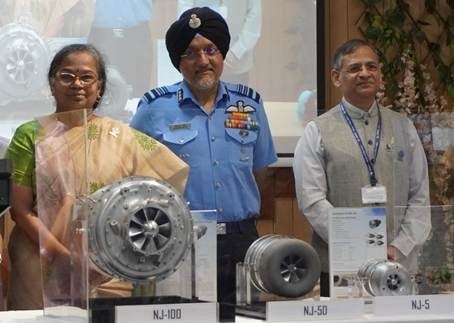
Recently, the Council of Scientific and Industrial Research-National Aerospace Laboratories (CSIR-NAL) unveiled three indigenous micro and small gas turbine engines to meet requirements of indigenous defence technologies.
What are Indigenous Micro & Small Gas Turbine Engines?
- About: Micro and small gas-turbine engines are compact propulsion systems that convert fuel energy into high-speed mechanical energy and thrust through continuous air compression, combustion, turbine expansion and nozzle discharge.
- Developer: The engines have been developed by CSIR–National Aerospace Laboratories (CSIR-NAL).
- It is a Council of Scientific & Industrial Research laboratory under the Ministry of Science & Technology.
- Technology: It incorporates advances in high-RPM turbomachinery and high-temperature combustion.
- The newly unveiled engine family is envisaged for tactical UAVs, drone interceptors and compact missile systems.
- Engine Types: On 25 August 2026, CSIR-NAL unveiled three engines: NJ-05, NJ-50 and NJ-100.
- They provide different propulsion classes for compact defence platforms.
- Features:
- NJ-05 is the smallest engine in the newly unveiled family, providing 5 kg thrust. Its compact thrust class makes it relevant to small unmanned aerial systems.
- It uses a centrifugal compressor, vaporizer combustor, axial turbine and convergent nozzle, with an integrated bearing housing and two-bearing arrangement.
- It has a 50 N design sea-level static thrust, 100,000 rpm engine speed, 2.0 pressure ratio, 0.20 kg/s mass-flow rate and 1.2 kg maximum engine weight; its maximum thrust is listed as 75 N.
- Its development began as a technology demonstrator during 2019–2022.
- Final prototype hardware was demonstrated and the engine was flight-tested on a small model aircraft, achieving TRL-9.
- It incorporates fuel-assisted bearing lubrication, using fuel plus 5% lubricant.
- NJ-50 belongs to the intermediate 50 kg thrust class, providing substantially greater propulsion capability than NJ-05.
- It is part of NAL’s effort to create a graded indigenous propulsion family for different unmanned and defence platforms.
- NJ-100 is the highest-thrust member publicly identified in the 2026 unveiling, delivering 100 kg thrust.
- It is a 100 kgf small gas-turbine engine, intended for tactical UAVs and cruise missiles.
- NJ-05 is the smallest engine in the newly unveiled family, providing 5 kg thrust. Its compact thrust class makes it relevant to small unmanned aerial systems.
Strategic Significance of CSIR NAL Gas Turbine Engines
- Atmanirbhar Bharat: Reduces heavy reliance on imported small turbojet engines for unmanned systems, securing supply chains against foreign export restrictions.
- By achieving 100% indigenous design ownership over the 5 kg–100 kg thrust spectrum, India ensures its mass-produced loitering munitions and tactical cruise missiles.
- National Security: Strengthens the tactical readiness of the Armed Forces by mastering high-RPM turbomachinery and high-temperature combustion technologies domestically.
- Developing such specialised technology domestically strengthens India’s control over a critical component of defence aerospace systems.
- Domestic propulsion capability can improve supply-chain resilience.
- Unmanned Defense Ecosystem: Powers tactical Unmanned Aerial Vehicles (UAVs), long-range loitering munitions, target drones, drone interceptors, and compact subsonic cruise missiles.
- It supports India’s transition towards increasingly unmanned, autonomous and network-centric warfare capabilities.
- Industrial Growth: Empowers private aerospace startups and local manufacturing partners to scale production of advanced propulsion hardware.
- The technology blueprints are structured to allow private Indian aerospace startups to absorb the technology.
- This transforms specialized laboratory prototypes into large-scale, automated manufacturing pipelines capable of supplying.
Other Similar Developments in India’s Indigenous Aerospace Propulsion
- DRDO’s 350-kg Expendable Turbojet: In July 2026, DRDO’s GTRE successfully developed India’s first indigenous 350-kg-thrust expendable turbojet engine.
- Azad Engineering manufactured and assembled it, demonstrating growing industry capability in advanced propulsion.
- NJ-100 Small Gas-Turbine: CSIR-NAL has separately developed the 100-kgf NJ-100, aimed at tactical UAVs and cruise missiles.
- NAL reported successful testing at 100% of design speed, making it an important precursor to the broader micro/small-engine family.
- Abhyas High-Speed Aerial Target: DRDO’s Abhyas uses an in-line small gas-turbine engine for propulsion. The expendable aerial target has demonstrated altitude, endurance, speed, range and manoeuvrability.
- Indigenous UAV Diesel Propulsion: DRDO’s 180-hp diesel engine for UAVs represents another propulsion pathway.
- It delivers 180 hp up to 11,000 ft, underwent high-altitude validation up to 17,664 ft, and was proven for more than 1,100 hours under stringent test profiles.
- Small Turbofan Engine Programme: DRDO’s GTRE has pursued Small Turbofan Engine (STFE) technology for UAV applications.
- Earlier development included a 400-kg-thrust-class engine, demonstrating India’s effort to build propulsion solutions.
- Kaveri Derivative for Unmanned Aircraft: The Kaveri Derivative Engine (KDE) is being pursued as a powerplant for the remotely piloted strike aircraft/IUCAV.
- Government-backed projects include Flightworthy Kaveri Dry Engine Development and technology demonstration of the derivative dry engine.
- Aravalli Next-Generation Helicopter Engine: A major 2026 development is the HAL–Safran Helicopter Engines agreement to jointly develop and manufacture the Aravalli engine for India’s next-generation helicopter platforms.
- It complements indigenous small-engine work by targeting higher-power helicopter propulsion.
- AMCA Combat-Engine Ecosystem: India is also pursuing indigenous high-thrust fighter-engine capability.
- In August 2026, Reliance Industries and Rolls-Royce announced a strategic partnership for an indigenous Advanced Medium Combat Aircraft (AMCA) combat engine, including plans for an aerospace gas-turbine complex in India.
Frequently Asked Questions (FAQs):
1. What are the indigenous micro gas turbine engines developed by CSIR-NAL?
CSIR-NAL unveiled NJ-05, NJ-50 and NJ-100, delivering 5 kg, 50 kg and 100 kg thrust, respectively, for compact defence applications.
2. What is CSIR-NAL?
CSIR-NAL is the National Aerospace Laboratories, a CSIR laboratory under India’s Ministry of Science & Technology, based in Bengaluru.
3. Why are micro gas turbine engines important for India?
They strengthen indigenous aerospace propulsion, reduce dependence on imported engines, and support defence technological self-reliance.
4. What applications can CSIR-NAL’s micro gas turbine engines have?
They are envisaged for tactical UAVs, drone interceptors and compact missile systems, supporting India’s expanding unmanned defence ecosystem.
5. How are micro gas turbines different from conventional gas turbine engines?
Micro gas turbines are miniaturised propulsion systems, requiring highly compact high-RPM turbomachinery and combustion technologies for useful thrust.
6. Is the micro gas turbine technology completely indigenous?
CSIR-NAL describes these engines as indigenous; however, it does not publicly claim every material or component is domestically sourced.
Disclaimer: Information in this article is based on official announcements and public records. Regulations and implementation details may evolve over time.
| Also Read: Supersonic Ramjet Engine ‘Tezz’ |