Israel Destroys Qasmiyeh Litani River Bridge
|
General Studies Paper II: Groupings & Agreements Involving India and/or Affecting India’s Interests |
Why in News?
Recently, Israeli forces destroyed the Qasmiyeh Bridge over the Litani River in southern Lebanon, cutting a key route linking Tyre and surrounding areas.
- Israeli forces claimed that the bridge was used by Hezbollah to move fighters and weapons amid the ongoing Israel-Hezbollah conflict.
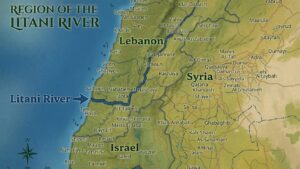
All About the Litani River
- Geographic Location: The Litani River (Arabic Nahr al‑Līṭānī) is the longest river entirely within Lebanon, flowing from the Beqaa Valley in eastern Lebanon and bending sharply westward to empty into the Mediterranean Sea north of Tyre in the South Governorate.
- Characteristics: The Litani stretches approximately 170 km (105 miles) with a basin area of 2,110 km², making it Lebanon’s largest watershed.
- The average discharge is around 29 m³/s, and annual flows vary with seasonal rainfall and climate influences.
- Source & Course: It originates near Al‑Aleeq Springs about 10 km west of Baalbek at an altitude of around 1,000 m.
- It flows southward along the Bekaa Valley, then turns west through a deep gorge in the Lebanon Mountains to the Mediterranean, with its lower course called Qāsimiyyah.
- Tributaries: Its major perennial tributaries include the Berdawni, Chtoura, Qib Elias, and the Ghzayel, which supply the vital Qaraoun Reservoir.
- Authority: Established in 1954, the Litani River Authority (LRA) was tasked with harnessing the river for irrigation, electricity generation, and development.
- Cultural Significance: Historically known as Leontes, the river marked territorial boundaries in ancient times and was significant for trade and agriculture under Phoenician, Hellenistic, and Roman civilizations.
- Environmental Crisis: The river faces severe pollution, with over 90% of wastewater in some areas discharged untreated. A $730 million government cleanup plan was announced to combat industrial and agricultural runoff.
Strategic Significance of Litani River Region
- Security Buffer & UN Resolution 1701: Since the 2006 Lebanon War, the Litani has served as the northern boundary of a UN-mandated demilitarized zone. Under UN Security Council Resolution 1701, the area between the Blue Line (UN-recognized border separating Lebanon and Israel) and the river must remain free of armed groups other than the Lebanese Army and UNIFIL.
- Hydroelectric Power Generation: The river is a primary source of renewable energy. Through the LRA, it produces approximately 7.5% to 10% of Lebanon’s national electricity. Major facilities include the Markaba, Awwali, and Joun power plants.
- Agricultural Backbone: The basin irrigates roughly 54,000 to 80,000 hectares of land. It supports 80% of agriculture in the Bekaa Valley and 20% in South Lebanon, making it essential for national food security.
- Qaraoun Reservoir: Built in 1959, the Qaraoun Dam created Lebanon’s largest artificial lake with a capacity of 220 million cubic meters. It serves as the central hub for both irrigation and power generation, hydroelectric capacity up to 185 MW.
- Water Scarcity & Hydro-politics: In a water-scarce region, the Litani’s annual flow of 700–800 million cubic meters makes it a “hydro-strategic” asset. Historically, control over these “sweet” waters (low salinity) has been a factor in regional territorial tensions.
- Geographic Defensive Barrier: The Litani River draining a basin of 2,110 km², about 20 % of Lebanon’s territory. Its lower course, known as Qāsimiyyah, lies roughly 29 km north of the Israeli‑Lebanese border, making it a natural geographical barrier. It’s deep gorges and rugged valley create a natural defensive line.
Tyre in Lebanon
- Location: Tyre (Arabic: Ṣūr) is a historic city in southern Lebanon, situated on the Mediterranean coast 83 km south of Beirut and 19 km north of the Lebanese‑Israeli border.
- It is the capital of Tyre District in the South Governorate with an urban population of around 174,000 including surrounding areas.
- Origin: Tyre is one of the oldest continuously inhabited cities in the world, with settlement traces dating back over 4,700 years (c. 2750 BCE) during the Bronze Age, making it among the earliest urban centres in the Levant.
- Maritime Power: As a leading Phoenician metropolis, Tyre dominated Mediterranean trade, known for advanced shipbuilding, navigation, and commerce.
- Its citizens established prosperous colonies including Carthage in the 9th century BCE.
- Significance: Legend attributes Tyre as the birthplace of Europa, Cadmus, and Elissa (Dido) — mythic figures tied to European and North African origins — reflecting its deep imprint on Mediterranean cultural memory.
- Tyre withstood major sieges, including a 13‑year siege by Nebuchadnezzar II in the 6th century BCE and was famously conquered by Alexander the Great in 332 BCE, who built a causeway turning the island into a peninsula.
- Under Roman rule from 64 BCE, Tyre was famed for its Tyrian purple dye from Murex sea snails — a luxury product more valuable than gold.
- Captured by Crusaders in 1124 CE, Tyre became a key crusader city and was later taken by Mamluks in 1291, after which its regional prominence diminished.
- Religion: By the 2nd century CE, Tyre had a substantial Christian community and structures like basilicas and necropoleis, integrating it into early Christian networks across the Roman East.
- UNESCO Status:The archaeological site of Tyre was inscribed as a UNESCO World Heritage Site in 1984, recognized for outstanding universal value in Phoenician, Roman, and Crusader remains.
- Conflict Damage: Tyre’s heritage and urban fabric suffered damage during conflicts in 1982, 1996, 2006, and concerns persisted following hostilities in recent years; UNESCO conducted damage assessments in 2025 and granted enhanced protection status.
|
Israel–Hezbollah Conflict:
|
|
Also Read: Israel Takes Control of Golan Heights Buffer Zone |