



Lt Gen N S Raja Subramai Appointed as India Next CDS
|
General Studies Paper III: Defence, Various Security Forces & Agencies & Their Mandate |
Why in News?
Recently, the Government of India appointed Lt Gen N S Raja Subramani as the next CDS. Succeeding General Anil Chauhan on May 30, 2026, he will lead tri-service integration.
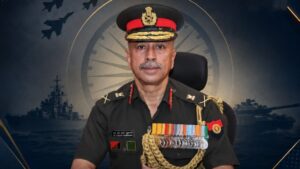
Who is Lt Gen N S Raja Subramani?
- Early Life: Lt Gen N S Raja Subramani is a retired Indian Army officer. He belongs to the prestigious Garhwal Rifles Regiment and has over 40 years of military experience.
- Military Training: He is an alumnus of the National Defence Academy and Indian Military Academy.
- He also studied at the Joint Services Command and Staff College and the National Defence College.
- Academic Profile: Lt Gen Subramani holds a Master’s degree from King’s College London and an MPhil in Defence Studies from Madras University, reflecting strong academic and strategic expertise in defence affairs.
- Army Commission: He was commissioned into the 8th Battalion of Garhwal Rifles on 14 December 1985. His career included command, intelligence, instructional and diplomatic responsibilities across multiple operational theatres.
- Operational Roles: He commanded 16 Garhwal Rifles during Operation Rhino in Assam, besides leading formations in Jammu & Kashmir, Sikkim, and the Western Front, giving him extensive counter-insurgency and border-security experience.
- Strategic Posts: He served as Defence Attaché in Kazakhstan, Deputy Director General Military Intelligence, and Chief Instructor at DSSC Wellington, strengthening India’s strategic and military diplomacy framework.
- He is widely regarded as an expert on the Pakistan and China fronts. His tenure as Chief of Staff, Northern Command, and his leadership in the Central Sector provided him with deep operational insights into both borders.
- Senior Commands: Lt Gen Subramani commanded the elite 2 Corps, one of India’s major strike formations, and later became GOC-in-C Central Command between 2023–24.
- Vice Chiefship: He served as the 47th Vice Chief of Army Staff from July 2024 to July 2025, playing a key role in operational preparedness and force modernisation.
- NSCS Advisory: Before becoming CDS, he worked as Military Adviser in the National Security Council Secretariat (NSCS) from September 2025, contributing to India’s national security planning.
- Decorations Earned: He is a recipient of the Param Vishisht Seva Medal (2024), Ati Vishisht Seva Medal (2020), Sena Medal, and Vishisht Seva Medal.
What is the Chief of Defence Staff (CDS)?
- About: The Chief of Defence Staff (CDS) is India’s highest military coordination post created in December 2019 to improve integration among the Army, Navy and Air Force.
- The Union Cabinet approved the position after decades of defence reform discussions.
- Historic Background: The demand for CDS emerged after the 1999 Kargil War exposed poor inter-service coordination.
- The Kargil Review Committee led by K Subrahmanyam recommended a single military adviser for better strategic planning and joint warfare management.
- In 2012, the Naresh Chandra Committee proposed a “Permanent Chairman of the Chiefs of Staff Committee” as a middle ground to ease political and military apprehensions.
- In 2016, the Lt Gen DB Shekatkar Committee submitted its report, again emphasizing the necessity of the CDS for better tri-service integration.
- In 2019, Prime Minister Modi announced the creation of the post on Independence Day; the government formally approved it in December.
- First Appointment: General Bipin Rawat became India’s first CDS on 31 December 2019.
- After his death in a helicopter crash in 2021, General Anil Chauhan became the second CDS in 2022.
- Rank: The CDS holds the rank of a four-star General-equivalent officer and receives salary and privileges equal to Army, Navy and Air Force chiefs. However, the CDS is considered “first among equals.”
- Primary Role: The CDS acts as the Principal Military Adviser to the Defence Minister on all tri-service matters. Service chiefs continue advising separately on issues related only to their own forces.
- Joint Planning: One major responsibility of the CDS is promoting jointness in operations, logistics, communications, transport, intelligence and training among the three services for efficient resource utilisation.
- Theatre Commands: The CDS is responsible for facilitating Integrated Theatre Commands, where military resources of all services operate under unified command structures during warfare and emergencies.
- Dual Role: The CDS is “dual-hatted,” serving simultaneously as the Permanent Chairman of the Chiefs of Staff Committee (COSC) and the Secretary of the Department of Military Affairs (DMA) within the Ministry of Defence.
- This department handles military administration, staffing, training and procurement matters of the armed forces.
- Nuclear Authority: The CDS serves as the Military Advisor to the Nuclear Command Authority (NCA), chaired by the Prime Minister, advising on the management and strategy of India’s nuclear arsenal.
- Procurement Integration: The CDS heads the Defence Acquisition Council (DAC) as a member, prioritising capital acquisition proposals across services to ensure the most efficient use of the defence budget.
- Intelligence Oversight: He oversees specific tri-service agencies, including the Defence Cyber Agency (DCyA), the Defence Space Agency (DSA), and the Armed Forces Special Operations Division.
- No Operational Command: The CDS does not directly command the Army, Navy or Air Force.
- Operational authority remains with individual service chiefs, ensuring balanced military control under civilian leadership.
- Strategic Planning: He implements the Five-Year Defence Capital Acquisition Plan and monitors long-term Integrated Capability Development Plans to align military growth with national security goals.
- Tenure Limits: The post has a maximum age limit of 65 years, ensuring that senior leadership remains dynamic while allowing enough time to implement long-term structural reforms.
- Global Practice: Many countries including the United States, United Kingdom and France maintain similar integrated military leadership systems, making India’s CDS reform part of global strategic military practices.
Significance of CDS
- Unified Advice: The CDS provides single-point military advice to the government, preventing conflicting perspectives from different branches during crises. This ensures strategic clarity at the highest levels of decision-making.
- During the 2020 Ladakh standoff, the CDS coordinated a unified military response, ensuring the Air Force and Army synchronized their logistics and surveillance efforts seamlessly.
- Synergy Building: The office fosters tri-service jointness, breaking down “silos” between the Army, Navy, and Air Force. This integration transforms individual capabilities into a cohesive, force-multiplied fighting machine.
- The establishment of the Defence Space Agency under the CDS umbrella allows all three services to utilize satellite assets through a single, efficient command structure.
- Theatre Commands: The CDS enables long-term national defence planning. The transition toward Integrated Theatre Commands is the CDS’s primary mandate. This shifts the focus from service-specific goals to geographical-based combat objectives for maximum impact.
- The proposed Maritime Theatre Command will integrate naval assets with coastal army batteries and air force strike packages under one operational commander.
- Resource Optimization: By overseeing joint logistics and maintenance, the CDS eliminates redundant infrastructure. This ensures that the defence budget is spent on modernizing capabilities rather than maintaining overlapping facilities.
- The creation of Joint Logistics Nodes in Mumbai and Guwahati has allowed the services to share fuel, food, and ammunition depots, saving billions in taxpayer money.
- India spends nearly ₹6 lakh crore annually on defence, making integrated resource management essential for modernisation.
- Indigenization Drive: The CDS heads the Department of Military Affairs, which fast-tracks Aatmanirbharta (self-reliance). By prioritizing domestic procurement, the office reduces critical dependencies on foreign supply chains.
- The CDS-led “Positive Indigenisation Lists” have barred the import of over 400 weapon systems, mandating their production by Indian domestic industries.
- Hybrid Preparedness: The role is crucial for tackling gray-zone warfare. The CDS coordinates specialized agencies to protect national infrastructure from non-traditional attacks.
- The CDS helps India prepare for cyber warfare, space warfare and drone threats through coordinated defence policies.
- The Defence Cyber Agency, directed by the CDS, actively defends military networks against persistent state-sponsored hacking attempts from regional adversaries.
- National Security: The CDS enhances India’s overall national security architecture by ensuring coordinated responses against threats from China, Pakistan and terrorism.