Menaka Guruswamy Became India First Openly Queer Rajya Sabha MP
|
General Studies Paper II: Gender Equality, Welfare Schemes |
Why in News?
Recently, Menaka Guruswamy became India’s first openly queer Rajya Sabha MP after taking oath in 2026, marking a historic step for LGBTQ+ representation.
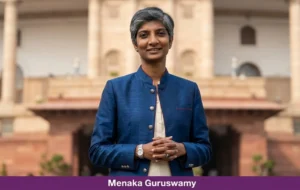
Who is Menaka Guruswamy?
- Intro: Menaka Guruswamy is a prominent Indian constitutional lawyer, Senior Advocate at the Supreme Court of India (2019).
- In April 2026, she became India’s first openly queer Member of Parliament in the Rajya Sabha representing West Bengal.
- Early Life: Menaka Guruswamy was born on 27 November 1974 in Hyderabad into a well-educated and politically aware family.
- Her father, Mohan Guruswamy, was a policy expert and former advisor to the Union Finance Ministry, which exposed her early to public policy and governance issues.
- Meera Guruswamy is Guruswamy’s mother and an advertising professional.
- She completed her schooling at Hyderabad Public School and later at Sardar Patel Vidyalaya, New Delhi, institutions known for academic rigor.
- Her upbringing instilled in her a strong sense of justice, equality, and intellectual curiosity.
- Education: Menaka Guruswamy possesses an exceptionally strong academic background in law. She graduated from the National Law School of India University (NLSIU), Bengaluru, one of India’s top law schools.
- She then pursued higher studies at the University of Oxford, where she earned a Bachelor of Civil Law (BCL), followed by an LL.M. from Harvard Law School.
- For a thesis on “Constitutionalism in India, Pakistan and Nepal,” Guruswamy was awarded a DPhil from Oxford in 2015.
- Career: Menaka Guruswamy began her legal career in 1997, working under former Attorney General Ashok Desai, which gave her early exposure to high-level constitutional and corporate litigation.
- She later worked internationally with the law firm Davis Polk & Wardwell in New York, before returning to India to establish her practice in the Supreme Court of India.
- Over time, she became a Senior Advocate, handling cases related to constitutional law, corporate disputes, arbitration, and governance issues.
- Academically, she served as a B.R. Ambedkar Research Scholar and Lecturer at Columbia Law School (2017–2019) and has been a visiting faculty at Yale, NYU, and the University of Toronto, teaching subjects like comparative constitutional law and democratic design.
- Contributions: One of the most significant contributions of Menaka Guruswamy is her role in the landmark Navtej Singh Johar v. Union of India (2018) case, where the Supreme Court decriminalised homosexuality by reading down Section 377 of the IPC.
- She was among the lead lawyers representing petitioners, arguing that the law violated fundamental rights such as equality, dignity, and privacy. This judgment is considered a turning point in India’s human rights jurisprudence.
- Beyond this, she has contributed to constitutional debates on governance, education, and institutional reforms, focusing on constitutional morality.
- In 2012, the Supreme Court of India appointed Guruswamy as an Amicus Curiae (friend of the court) in the case concerning 1,528 alleged extrajudicial killings by security forces in Manipur.
- In this role, she made suggestions to the court, including the establishment of a special team to investigate the killings.
- Recognitions: Menaka Guruswamy has received numerous national and international recognitions for her work in law and human rights.
- In 2019, she was included in the TIME 100 list of the world’s most influential people, highlighting her global impact.
- She was also named in Foreign Policy’s 100 Global Thinkers list, recognizing her contribution to legal and policy innovation.
- Additionally, she has been featured in Forbes India’s Women Power Trailblazers list.
- A unique honor includes her portrait being displayed at Rhodes House, University of Oxford, making her the first Indian and second woman to receive this distinction.
- Harvard Law School also recognized her as part of its “Women Inspiring Change” initiative.
|
Queer is a broad and inclusive term used to describe people whose sexual orientation or gender identity is not heterosexual (straight) or cisgender (same as birth gender).
|
Significance of Menaka Guruswamy’s Appointment
- LGBTQ+ Representation: Her appointment marks the first-ever LGBTQ+ representation in Parliament, nearly 8 years after the 2018 decriminalisation of homosexuality. It strengthens political inclusion for an estimated 8–10% LGBTQ population in India, symbolising a shift from legal recognition to political participation.
- Expertise-Based Political Inclusion: Unlike traditional politicians, she brings over 25+ years of constitutional law expertise, enhancing the quality of parliamentary debates. Her transition reflects a trend of domain experts entering legislatures, improving evidence-based policymaking in areas like civil liberties and governance reforms.
- Strengthening Right to Equality: Her presence reinforces constitutional morality and the spirit of Articles 14, 15, and 21, especially after the Navtej Singh Johar (2018) judgment. It institutionalises the idea that equality extends beyond courts into law-making bodies, ensuring sustained protection of minority rights.
- Scope for Progressive Legislation: Her role can influence future reforms like a more inclusive, addressing gaps in the Transgender Persons Amendment Bill, 2026, and areas such as reservation, healthcare access, and anti-discrimination enforcement through parliamentary advocacy.
- Enhancing India’s Global Image: Globally, countries like New Zealand, UK, and Canada already have openly LGBTQ MPs. India’s move improves its ranking in democratic inclusivity indices, projecting a progressive, rights-based image and aligning with UN human rights commitments on equality and non-discrimination.
|
LGBTQ+ Rights in India
|
|
Also Read: Transgender Persons Amendment Bill 2026 |