



Padma Awards
| General Studies Paper II: Awards & Recognition, Government Policies and Interventions |
Why in News?
Recently, the Ministry of Home Affairs started the online nomination and recommendation process for the Padma Awards 2027 from March 15, 2026. Citizens can submit entries, including self-nominations, for these prestigious civilian honours via the Rashtriya Puraskar Portal until the deadline of July 31, 2026.
What are Padma Awards?
- About: The Padma Awards are among the highest civilian honours of India, instituted in 1954 by the Government. They recognize exceptional achievements and distinguished service in various fields that contribute to the nation’s development and society.
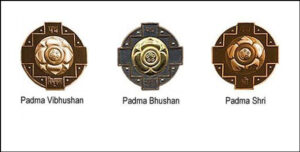
- Categories: The awards are classified into three levels of hierarchy. Padma Vibhushan is for “exceptional and distinguished service,” Padma Bhushan for “distinguished service of high order,” and Padma Shri for “distinguished service” in any field.
-
- Initially the government introduced two civilian awards—Bharat Ratna and Padma Vibhushan (Pahela Varg, Dusra Varg, and Tisra Varg), later renamed via a Presidential Notification in 1955.
- In the hierarchy of Indian civilian awards, the Padma Awards come after the Bharat Ratna.
- Padma Vibhushan is the second-highest civilian award in India, followed in precedence by the Padma Bhushan (third-highest) and the Padma Shri (fourth-highest).
- Fields of Activity: Awards are given in diverse fields including Art, Social Work, Public Affairs, Science & Engineering, Trade & Industry, Medicine, Literature & Education, Civil Service, and Sports.
- Eligibility Criteria: All persons without distinction of race, occupation, position, or sex are eligible. However, Government servants, including those working with PSUs (except doctors and scientists), are not eligible for these awards while in service.
- Nomination Process: The process is open to the public, meaning “self-nomination” is allowed.
- Nominations are submitted online through the Rashtriya Puraskar Portal.
- The Ministry of Home Affairs (MHA) usually opens the window between May and September each year for awards to be announced the following January.
- Padma Awards Committee: Every year, the Prime Minister constitutes a Padma Awards Committee headed by the Cabinet Secretary. It includes the Home Secretary, Secretary to the President, and four to six eminent personalities. The committee’s recommendations are submitted to the Prime Minister and the President of India for approval.
- Selection Process: The selection process is highly rigorous and merit-based. The committee looks for a “life’s work” rather than a single achievement.
- In recent years, there has been a significant shift toward identifying “Unsung Heroes”—individuals doing extraordinary work at the grassroots level without media attention.
- The awards are generally not conferred posthumously. However, the Government may consider giving an award posthumously in highly deserving cases (within the one year preceding the Republic Day announcement).
- Number of Awards: The total number of awards conferred in a year (excluding posthumous awards and those given to NRIs/Foreigners) should not exceed 120. While there is no minimum limit.
- Award Decoration: Recipients receive a Sanad (certificate) signed by the President and a medallion.
- The decoration features a lotus flower (Padma) embossed in the centre. The names of the awardees are published in the Gazette of India on the day of the investiture ceremony.
- Awardees are given a miniature replica of the medallion, which they can wear during state functions or ceremonial occasions.
- Ceremony: The awards are announced annually on the eve of Republic Day and presented by the President of India at an official ceremony held at Rashtrapati Bhavan, typically around March or April.
- Rules: The Padma Awards are not titles and cannot be used as a prefix or suffix to the awardee’s name (under Article 18(1) of the Constitution). If an awardee uses it as a title, they can be stripped of the honour.
- The award does not carry any monetary allowance, stipends, or perquisites like free rail or air travel. It is purely an honorary recognition.
- An individual who has already received a lower Padma award can be considered for a higher category only after a gap of at least five years, unless the Awards Committee makes an exception.
- A person may choose to decline the award after the announcement but before the ceremony.
- The President has the power to annul or rescind an award in cases of misconduct or if the recipient acts against the dignity of the honour.
- The awards can be given to Foreigners, NRIs, or OCIs (Overseas Citizens of India) if their work has significantly benefited India or contributed to global excellence in a way that reflects well on Indian values.
Notable Personalities Honoured with the Padma Awards
- Satyajit Ray (Arts): The legendary filmmaker received the Padma Bhushan (1958) and Padma Vibhushan (1976). He is credited with bringing Indian cinema to the global stage with his “Apu Trilogy.”
- Mother Teresa (Social Work): Awarded the Padma Shri in 1962, she dedicated her life to the “poorest of the poor.” Her work with the Missionaries of Charity later earned her the Bharat Ratna.
- Dr. A.P.J. Abdul Kalam (Science): The “Missile Man” received the Padma Bhushan (1981) and Padma Vibhushan (1990) for his pivotal role in developing India’s ballistic missile and space programs.
- Lata Mangeshkar (Arts): Known as the “Nightingale of India,” she was honored with the Padma Bhushan (1969) and Padma Vibhushan (1999) for her unmatched legacy in playback singing.
- Sachin Tendulkar (Sports): The “God of Cricket” received the Padma Shri (1999) and Padma Vibhushan (2008). He remains one of the youngest recipients of these high-level honors.
- Ratan Tata (Trade & Industry): The visionary industrialist was awarded the Padma Bhushan (2000) and Padma Vibhushan (2008) for his immense contribution to nation-building and philanthropy.
- Amitabh Bachchan (Arts): The “Shahenshah” of Bollywood received the Padma Shri (1984), Padma Bhushan (2001), and Padma Vibhushan (2015) for his five-decade cinematic career.
- Dr. Verghese Kurien (Science): The “Father of the White Revolution” received the Padma Vibhushan (1999) for transforming India into the world’s largest milk producer through Amul.
- M.S. Swaminathan (Science): A key architect of the Green Revolution, he was honored with the Padma Vibhushan (1989) for ensuring India’s food security through high-yielding crop varieties.
- Amartya Sen (Literature & Education): The Nobel laureate received the Padma Vibhushan in 1999. His work in welfare economics has influenced global policies on poverty and famine.
- Bismillah Khan (Arts): The Shehnai maestro was awarded the Padma Vibhushan in 1980. He is credited with elevating the Shehnai to the status of a concert instrument.
- Vikram Sarabhai (Science): Considered the father of the Indian Space Program, he was posthumously awarded the Padma Vibhushan in 1972 for his vision in establishing ISRO.
- Vishwanathan Anand (Sports): The first Indian Chess Grandmaster received the Padma Vibhushan in 2007. He was the first sportsperson to receive this second-highest civilian award.
- E. Sreedharan (Science): Known as the “Metro Man,” he received the Padma Vibhushan (2008) for his leadership in the Delhi Metro and Konkan Railway projects.
- Mary Kom (Sports): The legendary boxer received the Padma Vibhushan in 2020. She is the first female athlete to win six world titles in boxing.
- Pandit Ravi Shankar (Arts): The Sitar virtuoso received the Padma Vibhushan in 1981. He popularized Indian classical music globally through collaborations with Western artists.
- Dr. Manmohan Singh (Public Affairs): Before becoming Prime Minister, the economist received the Padma Vibhushan in 1987 for his exceptional service as a civil servant.
- N.R. Narayana Murthy (Trade & Industry): The co-founder of Infosys received the Padma Vibhushan (2008) for putting India on the IT map and promoting corporate governance.
- Zubin Mehta (Arts): The world-renowned orchestral conductor received the Padma Vibhushan in 2001, highlighting India’s cultural influence in Western classical music.
- Birju Maharaj (Arts): The Kathak legend received the Padma Vibhushan in 1986. He was instrumental in taking traditional dance forms to international audiences.
- Azim Premji (Trade & Industry): The Wipro chairman received the Padma Vibhushan (2011) for his contributions to the software industry and his massive scale of philanthropy.
- Sundar Pichai (Trade & Industry): The Google CEO was honored with the Padma Bhushan (2022) for his leadership in global technology and his roots in Indian excellence.
- Satya Nadella (Trade & Industry): The Microsoft CEO received the Padma Bhushan (2022), recognizing the impact of the Indian diaspora on the world’s most powerful tech companies.
- Milkha Singh (Sports): The “Flying Sikh” was awarded the Padma Shri in 1959 after his gold medal win at the Asian Games, inspiring generations of Indian runners.
- Neeraj Chopra (Sports): The Olympic Gold medalist received the Padma Shri in 2022 for his historic achievement in Javelin Throw, marking a new era for Indian athletics.
- Sudha Murty (Social Work): The author and philanthropist received the Padma Bhushan (2023) for her extensive work in rural development and education through the Infosys Foundation.
- M.S. Subbulakshmi (Arts): The legendary Carnatic vocalist received the Padma Vibhushan in 1975. She was the first musician to ever be awarded the Bharat Ratna.
| Also Read: Bharat Ratna |