



Paradip Port Historic Coal Loading Feat, Charting India’s Maritime Efficiency
| General Studies Paper III: Growth and Development, Infrastructure |
Why in News?
Recently, Paradip Port achieved a record single-day coal loading of 1,40,022 metric tonnes on October 10, 2026, demonstrating India’s maritime competitiveness and advanced handling capacity.
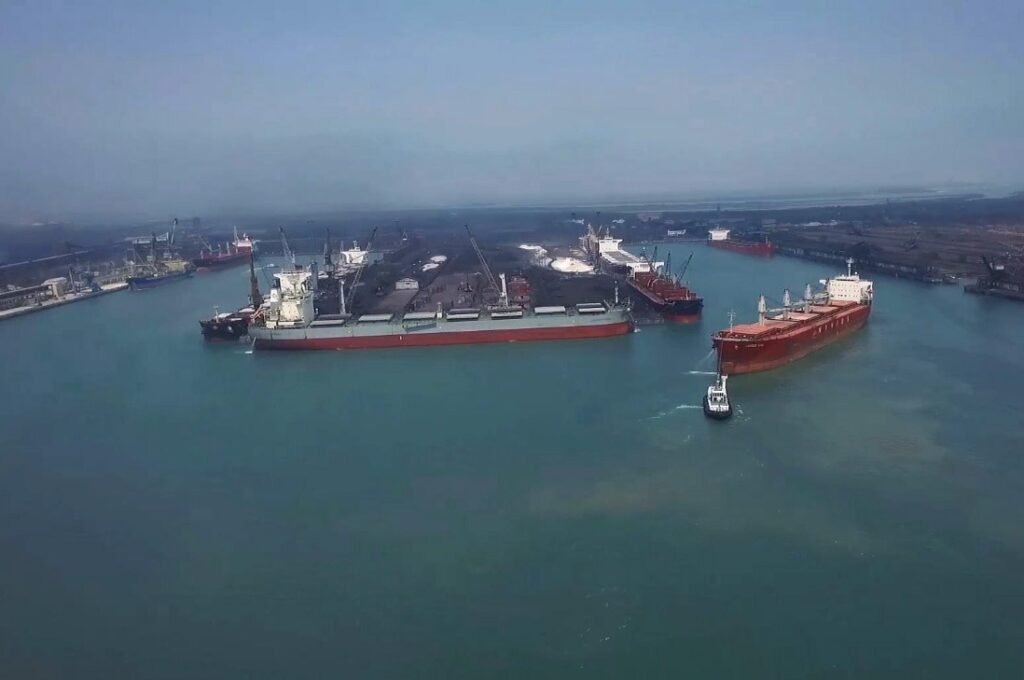
Highlights of Paradip Port Historic Coal Loading Achievement
- Quantity: The Paradip Port Authority (PPA) achieved a historic milestone on October 10, 2026, by recording its highest-ever single-day coal loading of 1,40,022 metric tonnes (MT).
- This operational feat was executed at its state-of-the-art Mechanised Coal Handling Plant (MCHP).
- Vessels Involved: The historic loading operations were distributed across two large specialized bulk cargo carriers: the M.V. APJ Indrani and the M.V. Ripley Pinnacle.
- Record: The port successfully loaded this amount of thermal coal within a single 24-hour cycle.
- This extraordinary bulk volume represents an increase of 2,522 MT over the previous record.
- The newly established figure eclipsed a long-standing record of 1,37,500 MT set on May 29, 2022.
- That previous benchmark had been completed during the dual loading of the M.V. Arethousa and the M.V. ISL Star.
- Significance: This landmark reinforces Paradip’s elite status, having been declared a “Mega Port” under the Indian Ports Act, 2025.
- This makes it the sole eastern-coast gateway with this designation, driving continuous structural infrastructure investments.
- By accelerating dry bulk cargo handling like coal, the port streamlines India’s domestic energy supply chain.
- Rapid turnaround times facilitate faster cargo movement of thermal coal to fuel national grids.
About Paradip Port
- Location: it is a premier deep-water, artificial lagoon-type maritime facility located at the confluence of the Mahanadi River and the Bay of Bengal in the Jagatsinghpur district of Odisha.
- It sits 210 nautical miles south of Kolkata and 260 nautical miles north of Visakhapatnam.
- Administration: The port is managed by the Paradip Port Authority (PPA), an autonomous statutory body under the Ministry of Ports, Shipping & Waterways.
- It operates under the legislative framework of the Major Port Authorities Act.
- A central government-appointed Board of Trustees, led by a Chairman, oversees its executive management.
- Foundation: The foundation stone was laid by Prime Minister Jawaharlal Nehru on January 3, 1962.
- Biju Patnaik, former Chief Minister of Odisha, is revered as the founding father of the port.
- The Government of India took over its management from the Odisha government on June 1, 1965, leading to the port being declared the eighth major port of India on April 18, 1966—the first major port commissioned on the east coast after independence.
- Features: The port features a 55,000 square meter paved concrete storage yard that accommodates over 1,000 TEUs of containerized cargo.
- The harbor infrastructure features a 2.2 km approach channel, 21 berths, a specialized Mechanized Coal Handling Plant, and three Single Point Mooring (SPM) terminals dedicated to processing crude oil imports for the Indian Oil Corporation Limited (IOCL).
- It holds the distinction of being the first major port commissioned on India’s East Coast post-Independence.
- It boasts a maximum draft depth of 16.5 meters, allowing it to seamlessly handle massive Cape-size vessels.
- Milestones: Driven by a diverse cargo mix of thermal coal, iron ore, and liquid petroleum (POL), the port commands the highest berth productivity in the country.
- This followed the historic berthing of the MV Mineral Kwangyang, the port’s first-ever Capesize vessel with a 16.5-metre draft at the newly constructed Western Dock-1.
- Future Projections: Financially robust with a net surplus crossing ₹2,000 crore and a stellar operating ratio of 31%, the port is actively advancing its “Paradip Port 2.0” vision.
- Moving from an 80% baseline, the port targets 100% berth mechanisation by 2030 via private concessionaires.
- Backed by the 25 MMTPA Western Dock Project, it expects to increase its rated capacity from 289 MTPA to over 350 MTPA by 2029, alongside setting up a Green Hydrogen/Ammonia export hub.
Significance of Paradip Port
- India’s Maritime Trade: Paradip Port anchors India’s eastern maritime trade, climbing to the No. 1 position among all Major Ports.
- Processing an unprecedented 156.45 million metric tonnes (MMT) of cargo annually, it handles crucial global and coastal traffic.
- The port facilitates key EXIM trade for minerals and crude oil, positioning India as a prominent global maritime powerhouse.
- Operational Efficiency: The port breaks global benchmarks by achieving a record output per ship berth-day of 34,303 MT.
- Strategic planning has minimized vessel turnaround times, permitting the handling of over 7,43,267 metric tonnes of cargo in a single day.
- Enhanced administrative coordination successfully manages a daily average of over 70 railway rakes.
- Supply Chains & Energy Security: As India’s premier domestic energy conduit, Paradip evacuates bulk fuel from Mahanadi Coalfields Limited.
- It ships over 43.97 MMT of coastal thermal coal annually to southern and western power utilities.
- By logging single-day unloading milestones of 70 railway rakes, it prevents critical stockouts and ensures uninterrupted national grid power.
- Economic Impact on Industries: Paradip anchors heavy industries by feeding the Paradip Petroleum, Chemicals and Petrochemical Investment Region (PCPIR), the IOCL refinery, and AM/NS steel complexes.
- Leasing 769 acres of land has attracted ₹8,700 crore in private industrial capital. Its deep harbor slashes freight expenses, enhancing the competitiveness of manufacturing sectors.
- Role in Sagarmala & PM Gati Shakti: Fully integrated into the PM Gati Shakti National Master Plan, Paradip coordinates multimodal logistics.
- Under the Sagarmala program, it is spearheading a massive ₹21,500 crore greenfield satellite port at Bahuda.
- It supports the upcoming National Waterway-5 to link industrial hubs directly with ocean networks.
Ports in India
- India’s coastline spans 11,098.81 km and supports 14 major ports (12 fully operational and 2 under advanced development/notified), handling approximately 95% of the nation’s trade volume.
- These 14 major ports are managed by the Central Government and around 200 non-major ports are overseen by State Maritime Boards.
- The Ministry of Ports, Shipping and Waterways directly administers the major ports.
- The non-major facilities rely heavily on private sector involvement.
- Major Ports on the West Coast:
- Deendayal Port (Kandla), Gujarat: India’s largest major port by cargo volume and a designated tidal/free trade zone.
- Mumbai Port, Maharashtra: India’s largest natural and spacious sheltered harbour.
- Jawaharlal Nehru Port Authority (JNPA / Nhava Sheva), Maharashtra: India’s largest container-handling port.
- Mormugao Port, Goa: Situated on the estuary of the Zuari River; major iron ore exporter.
- New Mangalore Port, Karnataka: All-weather, deep-water port dealing extensively in iron ore and general cargo.
- Cochin Port, Kerala: Located in the Vembanad Lake system; functions as a key natural harbour and transshipment terminal.
- Major Ports on the East Coast:
- Syama Prasad Mookerjee Port (Kolkata), West Bengal: The nation’s oldest operating major port and sole riverine facility.
- Paradip Port, Odisha: Deep-water, all-weather facility situated at the Mahanadi River confluence.
- Visakhapatnam Port, Andhra Pradesh: Deep, landlocked harbor acting as a primary oil and iron ore hub.
- Ennore Port (Kamarajar Port), Tamil Nadu: First corporatised major port, focusing on thermal coal.
- Chennai Port, Tamil Nadu: Major artificial harbor and the country’s second-largest container port.
- V.O. Chidambaranar Port (Tuticorin), Tamil Nadu: Artificial deep-sea facility supporting regional and international trade.
- Upcoming Notified Ports:
- Vadhavan Port, Maharashtra: Notified as the 13th major port, currently under development.
- Galathea Bay Port, Andaman & Nicobar Islands: Proposed transshipment project.
- The comprehensive Indian Ports Act, 2025 completely replaced the outdated 1908 colonial framework to streamline maritime business.
- This law provides a strong legal status to the Maritime State Development Council for synchronized center-state coastal planning.
- The government officially notified the Indian Ports Rules, 2026 to enforce strict operational compliance and seafarer welfare guidelines.
- These rules require vessels to submit digitized advance waste notices 24 hours prior to arrival to reduce local marine pollution.
- The operational framework transitioned under the Major Port Authorities Act, 2021 to grant individual port boards structural autonomy.
- Moving to a landlord model allows public authorities to regulate ports while private entities manage active commercial terminal berths.
- Under the Harit Sagar Guidelines, India mandates green development by integrating shore-to-ship power and carbon reduction strategies.
- The active Green Tug Transition Programme targets converting half of all port tugboats to green hydrogen or electricity.
- The government is building massive deep-draft ports at Vadhavan in Maharashtra and Galathea Bay in Great Nicobar.
- The regulatory framework permits 100% Foreign Direct Investment via the automatic route for constructing harbors.
- To invite private developers, the state offers an attractive 10-year tax holiday for corporate entities upgrading maritime systems.
- The Maritime India Vision 2030 and Amrit Kaal Vision 2047 provide blueprints to boost total cargo capacity.
- These roadmaps prioritize tech solutions like the Maritime Single Window to keep vessel turnaround times under 48 hours.
Frequently Asked Questions (FAQs):
1. What is the historic coal loading achievement recorded by Paradip Port?
Paradip Port’s reported coal-loading milestone highlights improved cargo handling; 1,40,022 metric tonnes.
2. How has Paradip Port improved its coal handling efficiency?
Mechanised conveyors, ship-loaders, storage facilities and coordinated railway evacuation help improve cargo handling speed and reduce vessel turnaround time.
3. Why is Paradip Port important for India’s maritime trade?
Located in Odisha along the Bay of Bengal, Paradip connects eastern and central India’s industries with domestic and international markets.
4. What role does Paradip Port play in India’s coal supply chain?
Paradip handles thermal and coking coal, supporting electricity generation, steel production and industrial supply chains through domestic and international cargo movement.
Disclaimer: Information in this article is based on official announcements and public records. Details may evolve over time.
| Also Read: Major Ports Cargo Hits 915 MT Growth |