




Gujarat Ambaji Mohanthal Prasad Gets GI Tag, Preserving Cultural Heritage
| General Studies Paper I: Indian Culture, Intellectual Property Rights |
Why in News?
Recently, Gujarat’s iconic Ambaji Mohanthal prasad received a Geographical Indication (GI) tag, recognising its regional identity.
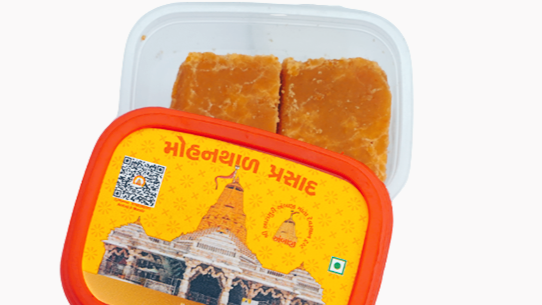
Highlights of Ambaji Mohanthal Prasad Receives GI Tag
- Recognition: The Ambaji Mohanthal Prasad, a traditional sweet offered as prasad at the Ambaji Temple in Gujarat, received Geographical Indication (GI) Tag under Class 30 for confectionery and food items.
- The application was submitted on 1 October 2026 by the Shree Arasuri Ambaji Mata Devsthan Trust.
- The central registry granted the legal certificate on 8 October 2026, valid initially for 10 years.
- The formal certificate handover occurred on 11 October 2026, marking the first day of Sharadiya Navratri.
- The process was supported by the Entrepreneurship Development Institute of India (EDII) and the Ministry of MSME.
- Texture: It’s an iconic temple prasad, featuring a striking, rich mustard-yellow colour.
- It possesses a distinctively dense, coarse, and granulated texture.
- The sweet is known for its heavy, melt-in-the-mouth consistency and an alluringly rich, aromatic flavour.
- Ingredients Used: The traditional recipe relies on three primary ingredients: premium quality gram flour (besan), pure ghee (clarified butter), and sugar.
- Preparation: The traditional preparation involves roasting gram flour meticulously in pure ghee until it turns golden brown and aromatic.
- It is then thoroughly blended with a precisely boiled sugar syrup to form a thick, cohesive mixture.
- The mixture is set in trays and cooled before being cut into blocks.
- Significance: The GI protection explicitly applies to the exact name “Ambaji Mohanthal”.
- It is offered as Rajbhog and distributed to devotees as prasad.
- It symbolizes the unwavering faith of millions of devotees towards Goddess Jagadamba.
- Mohanthal Prasad now joins the prestigious list of unique GI-tagged religious offerings of the country like Palani Panchamritam of Tamil Nadu and Tirupati Laddu of Andhra Pradesh.
- It enhances the global marketability of the sweet, preventing unauthorized piracy.
- It directly protects local artisans and ensures robust economic benefits for regional producers.
- This recognition elevates Gujarat’s cultural tourism, putting the culinary heritage of Banaskantha prominently on the international map.
About Ambaji Mata Temple
- Location: The Ambaji Mata Temple is situated in the Ambaji town of Banaskantha district in Gujarat.
- It is located at an altitude of 480 metres on the Arasur ridge at the southwestern terminus of the ancient Aravalli Range.
- The holy site sits close to the origin of the seasonal Saraswati River and lies near the border of Gujarat and Rajasthan.
- Mythology: Revered as one of the 51 sacred Shakti Peethas in Shaktism, ancient scriptures state that Goddess Sati’s heart fell here when her body was dismembered.
- The temple dates back to the pre-Vedic period, with historical chronicles indicating a structure was built in the 4th century by the Suryavanshi Emperor Arun Sen.
- The Nagar Brahmins were originally responsible for constructing the principal temple layout.
- Features: The most unique feature of this shrine is that it contains no physical idol or anthropomorphic statue of the deity.
- Worship is strictly centered around the Shree Visa Yantra, a sacred copper plate inscribed with Vedic geometric figures and the central syllable ‘Shree’.
- The Yantra is heavily protected inside a gold-plated wall niche (Gokh), and viewing it directly with naked eyes or photographing it is strictly forbidden.
- Built primarily in the opulent Māru-Gurjara style, the temple is crafted using pristine white Arasur marble.
- The structure features a grand 103-feet-high gold-plated Kalash spire weighing over 3 tonnes, adorned with a holy red flag.
- The inner doors are beautifully silver-plated, and comprises only a single front entrance and a tiny side-door, in accordance with ancient divine prohibitions.
- Rituals: The inner shrine is surrounded by a sprawling open courtyard known as the Chachar Chowk.
- Priests decorate the attire and ornaments of the Yantra to represent distinct forms of the Goddess throughout the day, shifting from Balyaroop (infant) in the morning to Yauvanroop (youth) in the afternoon and Praudhroop (mature) in the evening.
- Festivals: The temple attracts millions of devotees annually, particularly during the massive Bhadarvi Poonam Fair and the grand Sharadiya Navratri festival.
What is a GI Tag?
- About: A Geographical Indication (GI) tag is an intellectual property right (IPR) given to products originating from a specific geographical location.
- It certifies that a product possesses unique qualities, a distinct reputation, or characteristics that are entirely attributable to its place of origin, natural environment, or human skills.
- Issuing Authority: GI tags are issued by the Geographical Indications Registry located in Chennai, Tamil Nadu.
- This body operates under the Department for Promotion of Industry and Internal Trade (DPIIT), which functions beneath the Ministry of Commerce and Industry.
- Legal Basis: The legal framework is governed by the Geographical Indications of Goods (Registration and Protection) Act, 1999, which came into full effect on September 15, 2003.
- These guidelines comply with the World Trade Organization’s (WTO) TRIPS Agreement.
- Products: GI certifications cover five main categories of goods: Agricultural (e.g., Basmati Rice), Handicrafts (textiles, pottery), Foodstuff (traditional sweets), Manufactured Goods (industrial region-specific items), and Natural Goods (minerals).
- Eligibility Criteria: Any legal association of producers, organization, or state authority representing the interest of traditional creators can apply.
- The applicant must submit historical proof of the product’s origin, detailed production processes, unique characteristics, and defined geographical boundaries.
- Legal Protection: Registration grants exclusive rights to authorized regional users and prevents unauthorized commercial misuse or third-party imitation.
- A GI tag is valid for a period of 10 years, after which it can be renewed indefinitely.
- Total Count: As of 2026, the official registry maintained by the Government of India contains over 820 registered GI tags across the country.
- This makes India one of the largest holders of origin-linked intellectual property rights in Asia.
- Darjeeling Tea became India’s first registered Geographical Indication (GI) tag in 2004, followed by unique traditional crafts like Aranmula Kannadi (a polished metal mirror from Kerala) and Pochampally Ikat (a distinctive weaving style from Telangana).
- Gujarat currently holds over 31 registered GI tags.
- The state ranks prominently in the handicraft sector, its latest agricultural additions in 2026 being the famous Unjha Cumin and Unjha Fennel.
- Other gi tag registrations of Gujarat includes the premium double-ikat Patan Patola silk sarees, the traditional Sankheda Furniture, Gir Kesar Mango, Kutch Embroidery, and the unique Ambaji White Marble.
Frequently Asked Questions (FAQs):
1. Why has Gujarat’s Ambaji Mohanthal Prasad received a GI tag?
It recognises Mohanthal’s geographical identity and protects its traditional reputation, religious significance and regional culinary heritage.
2. What is Mohanthal Prasad, and which temple is it associated with?
Mohanthal is a traditional sweet prepared mainly from gram flour, ghee and sugar, offered as prasad at Gujarat’s Ambaji Temple.
3. What makes Ambaji Mohanthal unique compared to other traditional Indian sweets?
Its distinctive identity comes from its association with Goddess Amba’s shrine, traditional preparation practices and longstanding religious offering traditions.
4. How will GI recognition help preserve Gujarat’s cultural and religious heritage?
It strengthens regional identity, discourages unauthorised use, promotes traditional knowledge and may create livelihood opportunities through improved market recognition.
5. Which other religious offerings in India have received a Geographical Indication tag?
Tirupati Laddu from Andhra Pradesh and Palani Panchamirtham from Tamil Nadu are notable GI-tagged temple offerings.
Disclaimer: Information in this article is based on official announcements and public records. Details may evolve over time.