Parliament Monsoon Session 2026 – Agendas, Provisions and Significance
| General Studies Paper II: Parliament, Indian Constitution |
Why in News?
The Parliament Monsoon Session 2026 commenced on July 20 and is scheduled to run until August 13, featuring 19 sittings.
The session is expected to witness discussions on key important bills, agendas, and current national issues.
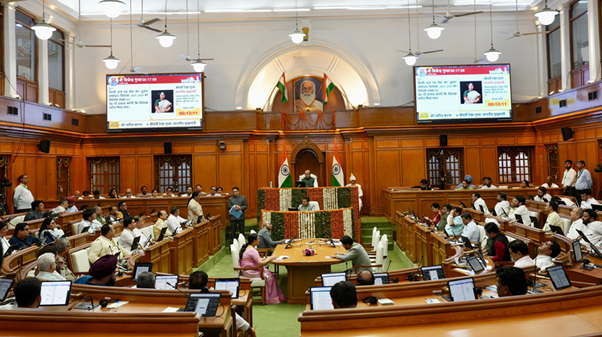
Parliament Monsoon Session 2026 Priority Agendas
The Government has listed eight Bills for consideration during the Parliament Session 2026. Passing these Bills remains the Centre’s principal objective. Key priority bills are:
- Supreme Court (Number of Judges) Amendment Bill, 2026: Introduced to replace an ordinance, this legislation seeks to increase the sanctioned strength of Supreme Court judges from 33 to 37 (excluding the Chief Justice of India).
- The primary aim is to reduce case pendency and accelerate the delivery of justice across India’s highest judiciary.
- Prevention of Insults to National Honour (Amendment) Bill, 2026: This proposed law amends the 1971 Act to make intentional insults or disruptions during the singing of the national song, Vande Mataram, a punishable offense.
- It grants the song statutory protection, similar to the legal provisions currently enjoyed by the national anthem.
- Income-tax (Amendment) Bill, 2026: A critical financial measure aiming to replace an earlier ordinance. It exempts specific foreign investments and the Bank for International Settlements from tax on specified earnings from government securities.
- It is designed to deepen the foreign debt market and attract foreign institutional investment.
- Micro, Small and Medium Enterprises Development (Amendment) Bill, 2026: This bill aligns the 2006 Act with the evolving MSME landscape. It addresses delayed payments, enforces arbitral awards, and authorizes State governments to regulate Micro and Small Enterprises Facilitation Councils, drastically improving ease of doing business.
- Foreign Contribution (Regulation) Amendment Bill, 2026: A legacy reform aimed at enhancing transparency in foreign funding. It provides a clearer framework for supervising and disposing of assets of organizations whose FCRA registration has ceased, while reducing the maximum jail penalty for violations from 5 years to 1 year.
- Viksit Bharat Shiksha Adhishthan Bill, 2025: A pending bill currently under a Joint Parliamentary Committee review. It aims to overhaul the higher education sector by replacing the UGC, AICTE, and NCTE with a single, unified regulator to streamline educational governance.
- Registration of Births and Deaths (Amendment) Bill, 2026: This legislation aims to overhaul India’s civil registration infrastructure by introducing stricter compliance timelines.
- It centralises real-time demographic indicators, mandating link-ups with digital databases and updating the National Population Register (NPR) seamlessly.
What is a Parliamentary Session?
- Meaning: A Parliamentary Session is the period during which Lok Sabha and Rajya Sabha meet to conduct official business.
- It begins with the President’s summons and ends with prorogation.
- Parliament performs law-making, financial control, and executive oversight during this period.
- Types: By constitutional convention, Parliament generally meets in three sessions every year:
- Budget Session (January–May), Monsoon Session (July–August), and
- Winter Session (November–December).
- The Constitution does not prescribe these names.
- History: Although the Indian Constitution came into effect in 1950, the practice of holding multiple sessions began with the first Lok Sabha in 1952.
- Constitutional Basis: Article 85 governs Parliamentary Sessions.
- It empowers the President to summon each House.
- Not more than six months can elapse between two sessions, ensuring regular parliamentary accountability.
- The Cabinet Committee on Parliamentary Affairs (CCPA) recommends the dates and duration of a session.
- The President formally summons Parliament based on the aid and advice of the Council of Ministers.
- Objectives: The session enables Parliament to pass Bills, approve the Union Budget, discuss national issues, examine government policies, and represent public concerns through debates and motions.
- Parliamentary Business: The business of the Indian Parliament is structured through daily operational devices, financial procedures, and legislative scrutiny mechanisms. Important business includes:
- Question Hour: The first hour of a parliamentary sitting. During this time MPs ask questions to ministers to hold them accountable for their ministry’s functioning. Types of Questions:
- Starred: Require oral answers; supplementary questions can follow,
- Unstarred: Require written answers; supplementary questions cannot follow,
- Short Notice: Asked with less than 10 days’ notice on matters of urgent public importance
- Zero Hour: An Indian parliamentary innovation, not mentioned in the Rules of Procedure.
- It commences immediately after Question Hour (usually at 12 noon).
- During this time MPs raise matters of urgent public importance without prior notice.
- Members need to notify the Speaker/Chairman before the start of the day’s session.
- Legislative Debates: Deliberations on bills across three readings to pass laws.
- Budget Discussions: Annual financial scrutiny, voting on demands for grants, and passing the Finance Bill.
- Committee Reports: Department-related panels that scrutinize bills and budgets in-depth.
- Private Members’ Business: Bills and resolutions introduced by MPs who are not ministers, typically discussed on Fridays.
- Government Resolutions: Formal statements moved by ministers to seek House approval on specific policies or matters of public interest.
- Question Hour: The first hour of a parliamentary sitting. During this time MPs ask questions to ministers to hold them accountable for their ministry’s functioning. Types of Questions:
- Parliamentary Terms:
- Summoning: The process of calling all members of Parliament to meet. It is governed by Article 85 of the Constitution.
- Adjournment: Temporarily suspends the sitting of the House to a specified time (e.g., hours, days, or weeks) or sine die (indefinitely).
- The power to adjourn lies with the presiding officer of the House.
- Prorogation: Concludes an entire parliamentary session. Formalized by the President, it occurs after the House is adjourned sine die, meaning it ends both the sitting and the session itself.
- Dissolution: Ends the life of the Lok Sabha, either by completing its five-year term or via a presidential decree.
- It requires new general elections to constitute a new House and applies solely to the Lok Sabha; the Rajya Sabha is a permanent body and is not subject to dissolution.
- Special Sessions: Apart from regular sessions, Special Sessions may be convened to address urgent national matters, constitutional milestones, or exceptional legislative requirements under the framework of Article 85.
- A notable example was the Special Session on June 30, 2017, held at midnight in the Central Hall of Parliament to launch the Goods and Services Tax (GST).
- Significance: Parliamentary Sessions ensure executive accountability, legislative transparency, financial oversight, and public participation through elected representatives.
Constitutional Provisions Related to Parliamentary Sessions
- Article 79 establishes the Parliament of India, consisting of the President, Lok Sabha, and Rajya Sabha.
- Article 85 empowers the President to summon each House of Parliament in appropriate time.
- Article 85(2)(a) authorises the President to prorogue either House or both Houses after completion of a session.
- Article 85(2)(b) empowers the President to dissolve the Lok Sabha before expiry of its normal tenure.
- Article 86 authorises the President to address either House separately or both Houses together whenever considered necessary.
- The President may also send messages to either House.
- Article 87 mandates the President’s Special Address at two important occasions:
- At the first session after every General Election to the Lok Sabha.
- At the first session of each calendar year.
- Article 88 grants every Union Minister and the Attorney General of India the right to participate, speak, and take part in the proceedings of either House of Parliament and its Parliamentary Committees.
- Article 100 provides that questions before either House are decided by a majority of members present and voting.
- The Presiding Officer (Speaker of Lok Sabha or Chairman of Rajya Sabha) ordinarily does not vote but exercises a casting vote in the event of a tie.
- Article 107 lays down the constitutional procedure for the introduction, consideration, and passage of Ordinary Bills in Parliament.
- Article 108 empowers the President to convene a Joint Sitting of the Lok Sabha and Rajya Sabha when a deadlock arises over an Ordinary Bill.
- A Joint Sitting is not applicable to Money Bills or Constitution Amendment Bills.
- Under Article 111, a Bill passed by both Houses of Parliament becomes law only after the President’s assent.
- The President may return an Ordinary Bill once for reconsideration.
- Article 118 empowers each House of Parliament to frame its own Rules of Procedure and Conduct of Business, subject to the Constitution.
- Article 123 empowers the President to promulgate an Ordinance when Parliament is not in session and immediate legislative action is necessary.
FAQs:
1. What is the Parliament Monsoon Session 2026?
It is the second regular Parliamentary session of 2026 for legislative business, debates, and government oversight.
2. When did the Monsoon Session 2026 begin?
It began on 20 July 2026 with proceedings in both the Lok Sabha and Rajya Sabha.
3. Which key bills are expected during the session?
The Government has listed eight Bills, mainly covering governance reforms and other legislative priorities.
4. How long will the Monsoon Session continue?
The session is scheduled to continue from 20 July to 13 August 2026.
5. Why is the Monsoon Session important?
It enables law-making, executive accountability, financial oversight, and discussion on major national issues.
Disclaimer: Information in this article is based on official announcements and public records. Regulations and implementation details may evolve over time.
| Also Read: Sessions of Parliament |