


SCO Meeting 2026 in Tajikistan, Defence Minister Rajnath Singh Represents India
| General Studies Paper I: Regional Groupings, Important International Institutions |
Why in News?
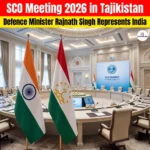
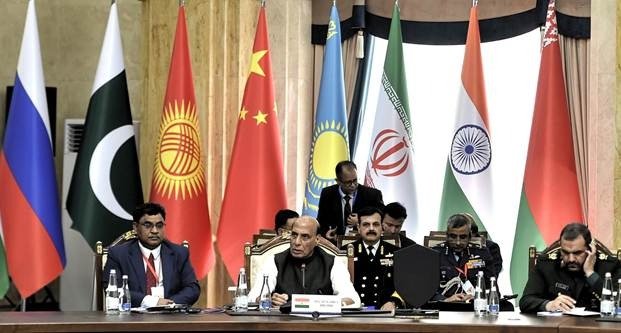
The 25th SCO Council of Heads of Government Meeting commenced in Dushanbe, Tajikistan, on October 19, 2026. Defence Minister Rajnath Singh is representing India.
SCO Meeting 2026 in Tajikistan Highlights
- Venue: The 25th SCO Council of Heads of Government (CHG) meeting is being held in Dushanbe, Tajikistan, on 19–20 October 2026, under Tajikistan’s Shanghai Cooperation Organisation (SCO) chairmanship.
- Participation: The meeting brings together member-state heads of government and designated senior representatives.
- Rajnath Singh, India’s Defence Minister, represents India; Pakistan is represented by Deputy Prime Minister and Foreign Minister Ishaq Dar.
- Other delegations include senior leaders from China, Russia, Central Asian states, Iran and Belarus.
- Agendas: The agenda centres on trade, economic cooperation, investment, transport connectivity, industrial collaboration, innovation, digital and creative economies, financial interaction, and cultural-humanitarian exchanges.
- Preparatory activities include the Council of National Coordinators’ meeting, which began in Dushanbe on 15 October, and sectoral discussions.
- The city also hosted an SCO Youth Forum on water, glaciers and climate on 12–13 October, alongside investment-facilitation consultations.
- Preparatory activities include the Council of National Coordinators’ meeting, which began in Dushanbe on 15 October, and sectoral discussions.
- Outcomes: Heads of delegation formally adopted the Joint Communiqué of the 25th Meeting of the SCO CHG.
- They approved the organization’s budget for 2027, along with financial and administrative decisions and the Multilateral Trade and Economic Cooperation (PMTEC) Action Plan for 2026–2030.
- They reviewed progress in trade, finance, transport, logistics, and social development.
- India’s Engagement: India’s focus includes practical, mutually beneficial cooperation through start-ups, innovation, digital public infrastructure and people-to-people exchanges.
- India urged member states to build on 25 years of foundational work through consensus-driven action.
- India pressed for unified measures to dismantle terror ecosystems and invited members to India’s upcoming SCO Civilisational Dialogue Forum.
- India also seeks to advance regional stability and preserve strategic space in a forum containing competing geopolitical interests.
What is Shanghai Cooperation Organisation (SCO)?
- About: The Shanghai Cooperation Organisation (SCO) is a permanent Eurasian intergovernmental organisation promoting regional security, political trust and socioeconomic cooperation.
- It functions as a prominent multilateral platform. Its founding principles include sovereignty, territorial integrity, non-interference, equality and peaceful settlement of disputes.
- Objectives: The primary goal is combating terrorism, separatism, and extremism (the “three evils”).
- It also works to promote trade, energy partnerships, cultural exchange, and a fair international political order.
- Members: The SCO now comprises 10 members: China, Russia, Kazakhstan, Kyrgyzstan, Tajikistan, Uzbekistan, India, Pakistan, Iran and Belarus.
- Origin and Evolution: The organisation evolved from the Shanghai Five, formed in 1996 by China, Russia, Kazakhstan, Kyrgyzstan and Tajikistan to build confidence along borders.
- Uzbekistan joined; the SCO was formally established on 15 June 2001, through the Shanghai Declaration. Its Charter was signed in 2002 and entered into force in 2003.
- In 2017, India and Pakistan became full members.
- In 2023, Iran became the ninth member and in 2024, Belarus became the tenth member.
- Structure: The organization operates via the supreme Heads of State Council (HSC) and the Heads of Government Council (HGC).
- Permanent organs include the Secretariat and the executive committee of the Regional Anti-Terrorist Structure (RATS).
- Heads of State determine broad strategic direction; Heads of Government address economic and budgetary cooperation. Ministerial meetings, national coordinators and working groups advance decisions.
- Official sessions are conducted annually in a rotating presidency format.
- Summits convene leaders for high-level political directives using Chinese and Russian as official working languages.
- Headquarters: The SCO Secretariat is headquartered in Beijing, China; the Regional Anti-Terrorist Structure (RATS) Executive Committee is based in Tashkent, Uzbekistan.
- Initiatives: Key frameworks include joint anti-drug centers and RATS counter-terror drills.
- The 2025 Tianjin Declaration prioritized local currency trading, while the group consolidated observers into a singular “SCO Partners” tier.
- India’s Participation: India gained observer status in the SCO in 2005 and became a full member in June 2017.
- India held the rotating presidency of the SCO Council of Heads of State (CHS) for 2022–2023 and virtually hosted the 23rd SCO Summit on July 4, 2023, adopting the New Delhi Declaration.
- India’s chairship focused on the theme “SECURE SCO” — representing Security, Economic cooperation, Connectivity, Unity, Respect for sovereignty, and Environment.
- India is the only SCO member state that refuses to endorse China’s BRI, consistently citing sovereignty and territorial integrity concerns regarding the China-Pakistan Economic Corridor (CPEC) passing through Pakistan-Occupied Kashmir (PoK).
- Significance: The SCO acts as the “Alliance of Asia,” representing an alternative global axis.
- It yields an institutional forum where adversarial neighbors can de-escalate tensions under a neutral multilateral framework.
- The bloc spans over 40% of the world’s population and roughly 25% of global GDP.
- It wields deep geopolitical weight as a Eurasian counterweight to traditional Western economic institutions.
- For India, it offers access to Central Asian engagement and discussions on Afghanistan, terrorism, energy and connectivity.
- Challenges: India–Pakistan tensions, China–India rivalry, divergent threat perceptions, sanctions, weak intra-regional trade and connectivity barriers constrain effectiveness.
- Structural differences, economic asymmetry, and lack of enforcement mechanisms limit integration.
- Way Forward: Members must institutionalize the SCO Development Bank to unlock real regional connectivity.
- Maximizing cross-border infrastructure like the International North-South Transport Corridor (INSTC) while managing internal friction remains vital.
Frequently Asked Questions (FAQs):
1. What is the Shanghai Cooperation Organisation (SCO)?
The SCO is a Eurasian intergovernmental organisation established in 2001 to promote regional security, stability and economic cooperation.
2. When and where is the SCO meeting scheduled in 2026?
The 25th Council of Heads of Government meeting is scheduled for 19–20 October 2026 in Dushanbe, Tajikistan.
3. Which countries are members of the SCO?
Its ten members are China, Russia, India, Pakistan, Iran, Belarus, Kazakhstan, Kyrgyzstan, Tajikistan and Uzbekistan.
4. What are the main objectives of the SCO meeting?
The meeting aims to strengthen multilateral cooperation in trade, investment, economic development, connectivity, innovation and cultural exchanges.
5. What issues are expected to be discussed at the SCO meeting?
Discussions cover trade, transport, logistics, digital economy, industrial cooperation, financial matters, innovation and cultural-humanitarian cooperation.
6. What role does India play in the Shanghai Cooperation Organisation?
India, a full member since 2017, promotes counterterrorism, regional stability, digital public infrastructure, innovation and mutually beneficial economic cooperation.
Disclaimer: Information in this article is based on official announcements and public records. Details may evolve over time.
| Also Read: 25th SCO Summit 2025 in China |