Shoko Ishikawa Presents Credentials As UN Women Representative
|
General Studies Paper II: Appointment, Important International Institutions, Issues Related to Women |
Why in News?
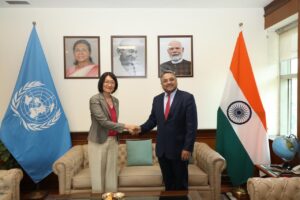
Recently, Ms. Shoko Ishikawa presented her credentials to the Ministry of External Affairs, assuming her role as UN Women’s Country Representative in India to strengthen local gender equality initiatives and partnerships.
Shoko Ishikawa’s Appointment as UN Women India Representative: Background and Role
-
- Credential Presentation: Shoko Ishikawa formally presented her credentials as UN Women Country Representative in India.
- The credentials were received by Ambassador Sibi George, Secretary (West), Ministry of External Affairs, marking the official commencement of her tenure.
- Ishikawa assumed office in April 2026, succeeding the previous leadership at a crucial stage when India is accelerating efforts toward SDG 5 (Gender Equality).
- Experience: She brings over 20 years of experience in advancing women’s rights, gender-responsive governance, economic empowerment, humanitarian response, and institutional reforms across the United Nations system.
- Before India, Ishikawa served as Deputy Director of UN Women’s Policy, Programme and Intergovernmental Division in New York, helping shape global gender policies and co-leading preparation of the UN Women Strategic Plan 2026–2029.
- She previously headed UN Women programmes in Bangladesh and Vietnam and served as Acting Regional Director for East and Southeast Asia, giving her extensive experience in diverse development contexts.
- Her UN career began with the United Nations Development Fund for Women (UNIFEM), where she supported implementation of the Convention on the Elimination of All Forms of Discrimination against Women (CEDAW) and promoted women’s access to justice across Southeast Asia.
- Academic Credentials: Ishikawa holds a Master’s in International Development from George Washington University and a Bachelor’s degree in International Relations and Political Science from Keio University (Japan).
- Significance: India hosts nearly 681 million women and remains central to global gender-development efforts.
- The appointment reflects India’s growing engagement with UN institutions, strengthens international cooperation on women’s empowerment.
- Credential Presentation: Shoko Ishikawa formally presented her credentials as UN Women Country Representative in India.
- Role & Responsibilities: As Country Representative, Shoko Ishikawa is the highest-ranking UN Women official in India and will lead the entire UN Women India Country Office.
-
- She will be responsible for translating UN Women’s Strategic Plan 2026–2029 into country-level actions aligned with India’s development priorities and the UN Sustainable Development Cooperation Framework (UNSDCF) 2023–2027.
- She will be responsible for strengthening partnerships with the Government of India, state governments, civil society organizations, academia, and the private sector.
- She will oversee the implementation of UN Women’s India Country Programme and ensure alignment with national development priorities and Sustainable Development Goal 5 (Gender Equality).
- She will provide policy advice and technical support to promote women’s empowerment, gender-responsive governance, and inclusive development.
- She will promote the use of gender-responsive budgeting and gender-sensitive public policies across sectors.
- She will represent UN Women in national and international forums and will serve as a key voice on gender equality issues in India.
- She will facilitate India’s implementation of international commitments such as CEDAW, and the Beijing Platform for Action, while advancing the vision of women-led development.
What is UN Women?
-
- About: UN Women is the United Nations Entity for Gender Equality and the Empowerment of Women, created by the UN General Assembly on 2 July 2010.
- It became operational in January 2011 to strengthen the UN’s work on women’s rights worldwide.
- Need: The organization was established because gender-related responsibilities were previously scattered across multiple UN bodies, reducing efficiency and impact.
- About: UN Women is the United Nations Entity for Gender Equality and the Empowerment of Women, created by the UN General Assembly on 2 July 2010.
- Merger: The creation of UN Women combined the mandates and resources of four distinct pre-existing bodies:
- DAW: Division for the Advancement of Women
- INSTRAW: International Research and Training Institute for the Advancement of Women
- OSAGI: Office of the Special Adviser on Gender Issues and Advancement of Women
- UNIFEM: United Nations Development Fund for Women
- Core Mission: It’s aim to dismantle systemic inequality worldwide:
- Governance & Leadership: Focuses on closing the gender gap in political representation so women can participate equally in decision-making at all levels.
- Economic Empowerment: Aims to eliminate wage gaps, promote decent work conditions, and ensure women achieve lasting financial independence and economic security.
- Ending Violence Against Women: Concentrates on eliminating all forms of gender-based violence (GBVF) and supporting survivors through essential services and legislation.
- Peace & Humanitarian Action: Increases women’s representation in conflict resolution, peacebuilding efforts, and disaster response operations.
- International Standards: Supports intergovernmental processes such as the Commission on the Status of Women (CSW) and helps shape international standards on women’s rights.
|
UN Women India:
|
|
FAQs: Q1. Who is Shoko Ishikawa? Shoko Ishikawa is the Country Representative of UN Women India, leading gender equality and women empowerment programmes in India. Q2. What is the role of UN Women Country Representative in India? Leads UN Women’s India operations, coordinates with government, designs gender equality programmes, oversees policy advocacy, and implements women empowerment initiatives. Q3. Why did Shoko Ishikawa present her credentials in India? She presented credentials to formally assume office as UN Women India Country Representative and begin official diplomatic and programme responsibilities in India. Q4. What does UN Women do in India? UN Women promotes gender equality, women’s safety, economic empowerment, political participation, and supports government policies for inclusive development in India. Q5. What are Shoko Ishikawa’s priorities for UN Women India? Her priorities include ending gender-based violence, increasing women’s economic empowerment, leadership participation, digital inclusion, and strengthening policy partnerships. |
|
Also Read: Beti Bachao Beti Padhao Scheme (BBBP) Eliminating Gender-Biased Practices |