Two New MQ-9B Sea Guardian Drone Lease Deal Signed by India
| General Studies Paper III: Defence Agreement, Defence Technology |
Why in News?
Recently, India’s Ministry of Defence signed a contract with General Atomics Aeronautical Systems on August 17, 2026, to lease two MQ-9B Sea Guardian HALE drones for the Indian Navy.
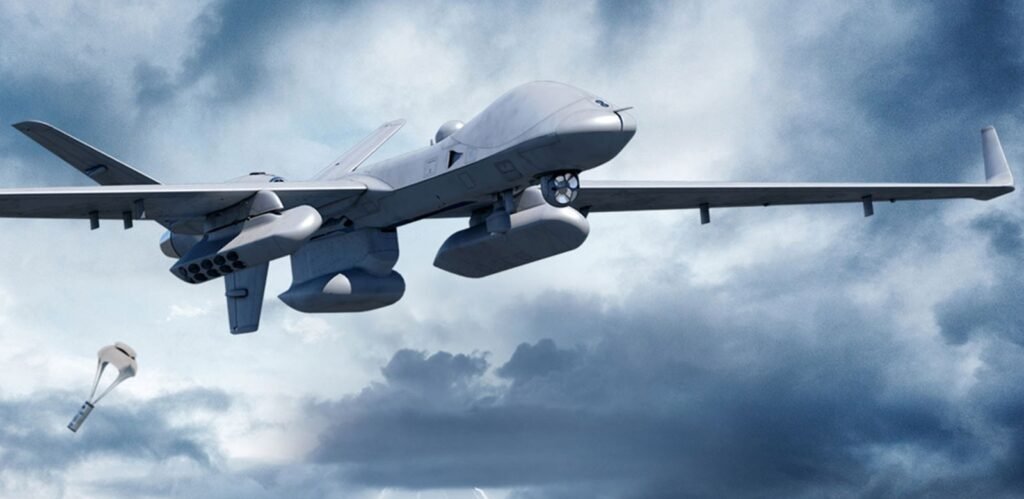
What is MQ-9B SeaGuardian?
- About: The MQ-9B SeaGuardian is a High-Altitude Long-Endurance (HALE) remotely piloted aircraft system (RPAS) designed primarily for persistent maritime Intelligence, Surveillance and Reconnaissance (ISR).
- It can monitor vast oceanic areas for prolonged periods and support maritime-security missions.
- Developer: It is developed and manufactured by General Atomics Aeronautical Systems Inc. (GA-ASI), USA.
- Origin: SeaGuardian evolved from the MQ-9B family, with a maritime-focused configuration.
- The MQ-9B series was originally developed based on the successful combat experiences of the Predator and Reaper drones.
- The US Navy and Marine Corps extensively tested its initial prototype during the Rim of the Pacific (RIMPAC) exercises held in the Pacific Ocean in 2020.
- Features:
- SeaGuardian is a long-endurance unmanned aircraft, classified within the HALE RPAS category. It is designed for operations above and over the maritime domain.
- Its endurance can exceed 30 hours, while particular MQ-9B configurations have demonstrated 40+ hours.
- Its operational range is over 5,500 nautical miles (approximately 10,000+ kilometers) , allowing it to cover vast oceanic areas in a single flight.
- It is capable of flying at a maximum altitude of over 40,000 feet , allowing it to safely gather intelligence.
- The aircraft can carry approximately 2,177 kg of internal and external sensor payload, including a 360-degree maritime surface search radar.
- Its principal strength is Maritime Domain Awareness (MDA) through a multi-mode maritime surface-search radar, Automatic Identification System (AIS) and electro-optical/infrared sensors.
- SeaGuardian can incorporate a dedicated Anti-Submarine Warfare (ASW) mission kit, including sonobuoy deployment and monitoring.
- The aircraft incorporates Detect-and-Avoid technology, satellite-enabled beyond-line-of-sight operations and civil-airspace-oriented design features.
- It is also designed around NATO STANAG 4671 airworthiness requirements, improving interoperability and operational integration.
- Global Users: The MQ-9B family is associated with operators including the United Kingdom, Belgium, Japan and India.
- Japan’s Coast Guard commenced SeaGuardian operations in October 2022, demonstrating its maritime surveillance utility.
- India’s Navy began operating two leased MQ-9B SeaGuardians in 2020, under a Contractor-Owned, Contractor-Operated (COCO) arrangement.
- Under the India-US Foreign Military Sales (FMS) framework, India signed mega $3.5 billion the 31-MQ-9B procurement contract on 15 October 2024: 15 SeaGuardians for the Navy and 16 SkyGuardians—eight each for Army and IAF; separate logistics/MRO support was included.
- On 17 August 2026, MoD additionally signed a ₹1,943-crore, 30-month lease for two SeaGuardians for the Navy, sustaining surveillance capability until the procured fleet arrives.
Significance of MQ-9B SeaGuardian
- Maritime Awareness: SeaGuardian significantly strengthens Maritime Domain Awareness (MDA) by providing persistent, wide-area surveillance over the Indian Ocean.
- Its 30+ hour endurance allows prolonged monitoring beyond the practical endurance of many manned platforms.
- Improves Surveillance: These advanced unmanned aerial vehicles (UAVs) are critical for monitoring ongoing standoffs with China in Ladakh and managing persistent tensions with Pakistan.
- It provides essential aerial support for India’s counter-terrorism and counter-insurgency operations in Kashmir and other high-conflict zones.
- Indian Ocean Region Surveillance: For India, the system is particularly valuable across the Indian Ocean Region (IOR), where vast distances make continuous surveillance challenging.
- It can support monitoring of shipping, naval movements and suspicious maritime activity, strengthening India’s ocean-security architecture.
- It counters China’s expanding naval and submarine presence in the Indian Ocean Region, securing vital trade lanes.
- India-US Defence Partnership: The programme deepens India-US defence cooperation in high-end unmanned systems.
- The procurement represents diversification of India’s defence-technology partnerships.
- This high-tech military cooperation cements India’s role as a net security provider in the Indo-Pacific.
- It bolsters its operational synergy within the Quad framework alongside the US, Japan, and Australia.
- Operational Experience and Readiness: India’s earlier leased SeaGuardians/MQ-9 systems provided valuable operational experience.
- It reported over 12,000 operational hours within two years for India’s leased MQ-9 fleet.
- Continued leasing therefore supports crew training, operational familiarity and mission readiness.
- Atmanirbhar Bharat: The acquisition of MQ-9B drones features domestic assembly, local component manufacturing partnerships (such as with Bharat Forge).
- It also features a comprehensive Maintenance, Repair, and Overhaul (MRO) facility in India to support the Make in India initiative.
India–US Defence Cooperation:
- 1962: India-US defence cooperation began during the 1962 Sino-Indian War.
- During the war the US supplied transport aircraft, weapons, and training.
- 1995: The modern phase began with the Agreed Minutes on Defence Relationship (1995), establishing structured military dialogue.
- It created the foundation for institutionalised defence exchanges, exercises and cooperation.
- 2005: The New Framework for the US-India Defense Relationship (2005) marked the decisive turning point.
- It expanded military exercises, defence trade, technology cooperation, intelligence-sharing and interoperability, moving relations beyond limited military contacts.
- 2013: The Defence Technology and Trade Initiative (DTTI) was launched to overcome barriers to defence-technology cooperation.
- The 2013 Joint Declaration on Defence Cooperation further committed both countries to technology transfer, co-development and co-production.
- 2015: The 2015 Framework for the US-India Defense Relationship renewed the 2005 framework for another decade.
- It emphasises maritime security, joint exercises, counter-terrorism, intelligence cooperation, defence technology and disaster response.
- 2016: The Logistics Exchange Memorandum of Agreement (LEMOA) enabled reciprocal logistical support during authorised port visits, exercises, training and HADR.
- The US simultaneously recognised India as a Major Defense Partner, facilitating advanced defence-technology access.
- 2018: The first India-US 2+2 Ministerial Dialogue institutionalised high-level strategic coordination.
- Communications, Compatibility and Security Agreement (COMCASA) enabled India to access secure communications equipment and enhanced interoperability with US-origin platforms.
- 2019: The Industrial Security Agreement (ISA) created a framework for protecting and exchanging classified information between defence industries, enabling deeper private-sector and industrial cooperation.
- 2020: The Basic Exchange and Cooperation Agreement (BECA) enabled sharing of geospatial information and advanced satellite-derived data.
- It improves navigation, targeting and situational awareness.
- 2023: iCET expanded cooperation into critical technologies, while the Defence Industrial Cooperation Roadmap (2023) prioritised co-development and co-production.
- INDUS-X, launched in 2023, connected defence startups, investors, academia and industry.
- 2024: The Security of Supplies Arrangement (SOSA), signed in August 2024, strengthened defence supply-chain resilience and encouraged industrial cooperation.
- India also concluded the 31-MQ-9B procurement in October 2024.
- 2025: In October 2025, India and the US signed a new 10-year defence framework, succeeding the 2015 framework.
- It covers military cooperation, information sharing, technology, defence industry and Indo-Pacific security.
- Annual apex diplomatic and defense dialogue co-chaired by foreign and defense chiefs.
- The U.S. recognizes India as a Major Defense Partner and grants Strategic Trade Authorization-1 (STA-1) status for expedited technological access.
- Military Hardware: India operates prominent U.S.-origin systems including P-8I Poseidon maritime aircraft, AH-64E Apache and CH-47F Chinook helicopters, C-17 Globemaster III and C-130J transport aircraft, and M777 howitzers.
- Ongoing discussions and emergency approvals cover items like MQ-9B Sky Guardian drones, Javelin anti-tank systems, and Excalibur guided munitions.
- Joint Exercises: Regular large-scale training encompasses Yudh Abhyas (Army), Vajra Prahar (Special Forces), Cope India (Air Force), and Tiger Triumph (Tri-Service).
Frequently Asked Questions (FAQs):
1. What is the MQ-9B Sea Guardian drone lease deal?
India signed a ₹1,943-crore contract to lease two MQ-9B Sea Guardians for Indian Navy maritime surveillance.
2. Why is India leasing MQ-9B Sea Guardian drones?
The lease provides immediate long-range ISR and maritime-domain awareness, bridging capability until India’s larger MQ-9B fleet arrives.
3. How many MQ-9B Sea Guardian drones will India receive?
India will receive two MQ-9B Sea Guardian drones under this latest 30-month lease agreement.
4. How much is India’s MQ-9B Sea Guardian lease deal worth?
The lease agreement is worth approximately ₹1,943 crore, equivalent to about $203 million.
5. Which company is providing the MQ-9B Sea Guardian drones to India?
The drones are being provided by General Atomics Aeronautical Systems, Inc. (GA-ASI), a US defence company.
6.How long is the MQ-9B Sea Guardian lease agreement?
The lease agreement covers 30 months, providing an interim maritime-surveillance capability for the Indian Navy.
Disclaimer: Information in this article is based on official announcements and public records. Regulations and implementation details may evolve over time.