Jharkhand Cancels JSSC CGL Exam 2026 And TDPL Tests
| General Studies Paper II: Transparency & Accountability, Education |
Why in News?
Recently, the Jharkhand Government cancelled the Jharkhand Staff Selection Commission Combined Graduate Level (JSSC-CGL) examination and all TDPL-conducted recruitment tests since 2014 amid alleged irregularities.
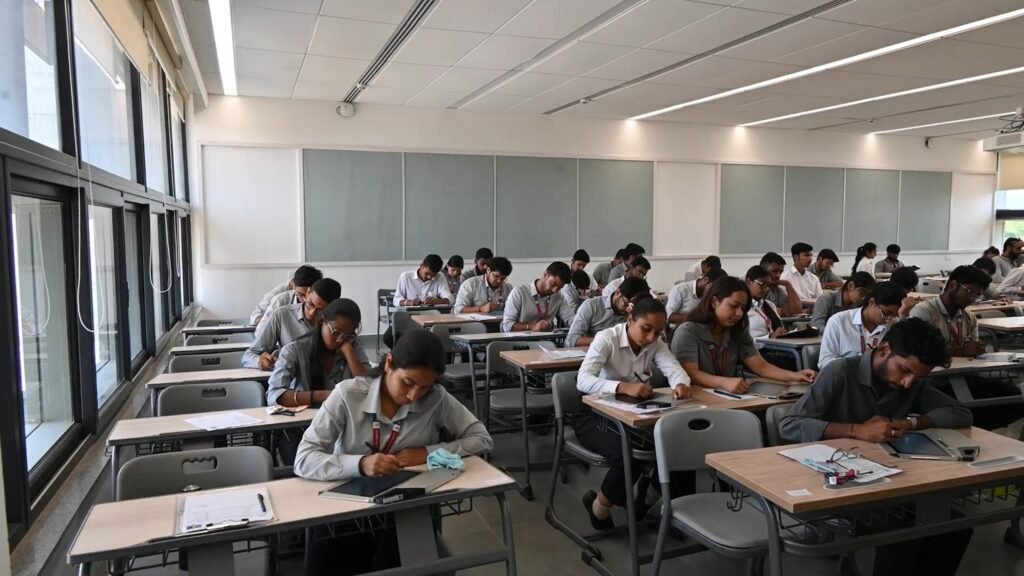
Jharkhand’s JSSC-CGL Exam Cancellation Highlights
- Cabinet Decision: On 17 August 2026, the Jharkhand Cabinet, chaired by Chief Minister Hemant Soren, cancelled the JSSC-CGL examination.
- The government also cancelled all recruitment examinations conducted by TSR Data Processing Pvt. Ltd. (TDPL), along with associated results and selections, dating back to 2014.
- Chief Minister Hemant Soren directly announced the absolute nullification of all related selection pipelines.
- This covers all exam activities, published results, and past recruitments managed by the blacklisted outsourcing firm.
- Reason: The decision followed allegations of irregularities and malpractice in the recruitment process, raising concerns over fairness, transparency and examination integrity.
- The JSSC-CGL controversy was connected with earlier paper-leak allegations, intensifying demands for cancellation and an independent investigation.
- The cancellation came after approximately 24 days of student protests at Jaipal Singh Munda Ground in Ranchi.
- Driven by the JPSC-JSSC Reforms Manch, the agitation included a grueling 16-day hunger strike by student leader Devendra Nath Mahto.
- Students demanded cancellation of the examination over alleged irregularities and compromised transparency.
- Although major demands were accepted. Their principal demand of an independent Central Bureau of Investigation (CBI) probe into alleged irregularities is unresolved.
- Investigation: Initial probes by the state Special Investigation Team (SIT) exposed shocking exam rigging and organized syndicates.
- Investigators uncovered compromised answer keys shared with third-party networks prior to official publication dates.
- SIT investigations were already underway, while reports indicated scrutiny of the JSSC office, officials and selected candidates’ documents.
- The Cabinet ordered the Crime Investigation Department (CID) to thoroughly investigate all recruitment anomalies.
- This wide-ranging structural audit scrutinizes major and minor operational errors spanning back from 2014 to the present.
- Reform Committee: The government announced an exam-reforms committee, headed by senior IAS officer Amitabh Kaushal, to strengthen recruitment procedures and institutional safeguards.
- The committee will draft secure and modernized Standard Operating Procedures (SOPs).
- Strict Legislation: The administration committed to applying the strict Public Examinations Amendment Bill 2026 framework.
- This penalizes organized cheating cartels with severe punishments up to 10 years imprisonment and ₹10 crore fines.
- Also, the state launched an interactive online feedback portal for parents, students, and educators. This portal collects grassroots suggestions to safely rebuild the recruitment process transparently.
- Impact: The widespread cancellation directly disrupts 1,975 successfully qualified candidates from the initial recruitment attempt.
- Displaced employees who previously resigned from stable jobs are preparing to challenge the job losses in the High Court.
- Cancellation potentially requires a fresh recruitment process, creating additional preparation time, and administrative expenditure.
- Delayed re-recruitment could disproportionately affect aspirants approaching upper-age limits.
| Note: The Jharkhand Staff Selection Commission (JSSC) is the state agency that handles recruitment for various government jobs in Jharkhand, running the Combined Graduate Level (CGL) test to fill graduate-level vacancies. |
India’s Examination Crisis: Systemic Gaps and Reforms
- Systemic Gaps:
- India’s recruitment and entrance ecosystem concentrates employment and social mobility into a few high-stakes examinations. Any leak, or disputed evaluation creates disproportionate consequences for millions of aspirants.
- State Public Service Commissions face deeply rooted local challenges. Agencies like the Jharkhand Staff Selection Commission (JSSC) suffer from prolonged operational backlogs and regional oversight gaps.
- Investigations by the Central Bureau of Investigation (CBI) into the NEET 2026 leak revealed that a panel expert exploited lax security during the paper translation phase. This highlights compromised content creation chains.
- Gatekeeping processes at local centers lack real-time digital cross-checks, lack of real-time data sharing between State Police and Central agencies like the CBI, allowing organized proxy candidates to bypass security.
- Although OMR tests are highly cost-effective for large-scale evaluation, the physical transportation of answer sheets to scanning centers creates a vulnerable second window for security breaches and tampering.
- Education sits on the Concurrent List, but despite the Central Public Examinations Act of 2024, interstate paper-leak syndicates seamlessly exploit state borders across hubs like Bihar, Jharkhand, and Rajasthan.
- Reforms:
- The Public Examinations Act, 2024 specifically criminalises question-paper leakage, unauthorised access, answer-sheet tampering and organised unfair practices.
- It imposes strict penalties, including 3 to 10 years of imprisonment and heavy fines up to ₹1 crore, treating offenses as cognizable and non-bailable.
- To rescue the fracturing system, the Ministry of Education fast-tracked the Dr. K. Radhakrishnan Committee recommendations.
- The panel analyzed over 37,000 stakeholder responses to compile 101 systemic reform points.
- The core focus centers on restructuring the National Testing Agency (NTA) by replacing contractual personnel with a permanent, fully accountable cadre.
- The committee’s primary security recommendation introduces Computer-assisted Secure Pen-and-Paper Testing (CPPT). This model aims to eliminate physical transport leaks.
- The plan outlines the phase-by-phase establishment of 1,000 Secure Testing Centres at reputable government facilities.
- To eliminate impersonation, governance reforms are shifting toward an integrated “DIGI-EXAM” framework.
- This initiative mandates Aadhaar-based biometric verification, AI-driven data analytics, and multi-layered frisking.
- In July 2026, Prime Minister Narendra Modi announced the constitution of a high-powered task force led by Infosys co-founder and Aadhaar architect Nandan Nilekani to spearhead comprehensive examination reforms across India.
- The panel—which features top experts like former ISRO chief S. Somanath and IIT Madras Director V. Kamakoti—focuses heavily on leveraging advanced digital public infrastructure, AI surveillance, end-to-end encryption, and secure biometric authentication to build a transparent examination system.
- India updated its legal framework via the Public Examinations (Prevention of Unfair Means) Amendment Bill, 2026.
- Individual prison sentences increase from 3–5 years up to 5–10 years.
- Complicit management or officials face up to 5 years.
- Maximum individual fines jump from ₹10 lakh to ₹50 lakh.
- Organized crime penalties spike to a minimum fine of ₹10 crore alongside 7 years in jail.
- Agencies involved face fines up to ₹5 crore and a debarment period extended from 4 years to 8 years.
- It sets up Fast-Track Courts designated special courts for day-to-day hearings.
- Police or central agencies/Special Task Forces must finish probes within 60 days (2 months).
- Trials must conclude within 3 months of filing the charge sheet.
- Appeals are assigned to a two-judge division bench of the High Court with a targeted 3-month disposal window.
- The Public Examinations Act, 2024 specifically criminalises question-paper leakage, unauthorised access, answer-sheet tampering and organised unfair practices.
Frequently Asked Questions (FAQs):
1. Why was the JSSC CGL exam cancelled in Jharkhand?
It was cancelled amid allegations of recruitment irregularities, following a 24-day student protest demanding greater transparency.
2. When did the Jharkhand government cancel the JSSC CGL exam?
The Jharkhand government announced its cancellation on 17 August 2026, following a Cabinet decision chaired by Chief Minister Hemant Soren.
3. What is the JSSC CGL exam cancellation controversy?
The controversy concerns alleged irregularities and examination-process failures, prompting protests, investigations and demands for independent scrutiny.
4. Which TDPL exams have been cancelled by the Jharkhand government?
The government cancelled all recruitment examinations conducted by TDPL since 2014, including associated results and selections.
5. Will the JSSC CGL exam be conducted again?
A fresh examination appears likely, but no official new examination date has yet been announced by the Jharkhand government.
Disclaimer: Information in this article is based on official announcements and public records. Regulations and implementation details may evolve over time.