




Nearly 100 Years Later Tiger Spotted in Beed District
| General Studies Paper I: Biodiversity, Wildlife |
Why in News?
Recently, a tiger named Ramling was photographed in Beed district of Maharashtra after nearly a century, highlighting wildlife corridor connectivity.
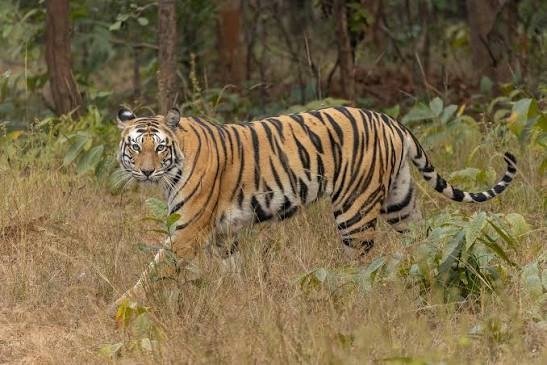
Tiger Sighting in Beed District Highlights
- Location: A four-year-old male Bengal tiger weighing over 200 kg was captured on camera traps on August 20, 2026.
- The sighting occurred in the Brahmgaon forest range of Ashti tehsil within Maharashtra’s Beed district.
- Local forest officials confirmed that the apex predator roamed the Ashti and Patoda tehsils throughout September.
- This recording marks the first confirmed presence of a tiger in Beed in nearly a century.
- The last historical record of tiger populations in this region dates back to the 1910s and 1920s. The official Beed District Gazetteer of 1920 holds the last formal documentation of tigers here.
- Name: The dispersing big cat is a male cub born to tigress T-22. It is known by the local names “Ramling” or “Avenger”.
- Migration Pattern: The tiger originally dispersed from the Tipeshwar Wildlife Sanctuary in Yavatmal district in 2023.
- The big cat embarked on an extraordinary journey covering over 400 kilometers.
- It initially traveled south to the Kawal Tiger Reserve in Telangana before heading into Nanded.
- It followed the Painganga River to Latur, traversing Chandrapur, Dharashiv, and Ahilyanagar before entering Beed.
- It recently moved toward Solapur district’s Kari area.
- Forest department staff utilized 16-centimeter pugmark tracking and camera traps to monitor its safe movement across public landscapes.
- The big cat embarked on an extraordinary journey covering over 400 kilometers.
- Factors: This massive transit highlights the critical health of active wildlife corridors and habitat connectivity outside reserves.
- Experts attribute the successful migration to adequate prey base availability and functional natural water streams.
- Tigers are territorial carnivores that require expansive areas for prey.
- As an unprotected agricultural landscape, Beed features sugarcane farms and rocky terrains where the tiger sought temporary shelter.
- The tiger has maintained zero human conflict, preying solely on local cattle.
Facts About Tigers
- Classification: The tiger, Pantheratigris, belongs to the family Felidae and order Carnivora.
- It is the largest living cat species and native to Asia.
- Characteristics: Tigers have reddish-orange coats with black stripes and pale undersides.
- Each tiger has a unique stripe pattern, helping researchers identify individuals through camera-trap photographs.
- Tigers are generally solitary and territorial, with males often occupying larger territories overlapping those of several females.
- Their muscular bodies, powerful forelimbs, retractable claws, sharp canine teeth and excellent low-light vision make them effective ambush predators.
- Tigers are capable swimmers and often use water for cooling and movement.
- Tigers inhabit tropical and subtropical forests, moist and dry deciduous forests, mangroves, grasslands and temperate forests.
- Tigers are apex predators that mainly hunt ungulates, including deer and wild pigs.
- The tiger functions as an umbrella species, meaning its preservation automatically secures vast forest biodiversity.
- Tigers can breed throughout the year, depending on local conditions. Gestation lasts approximately 100–110 days, usually producing two to four cubs.
- Conservation Status: The tiger is categorized as Endangered on the IUCN Red List and is declared Critically Depleted under the IUCN Green Status of Species.
- It is protected under Appendix I of CITES, which completely bans international commercial trade of its body parts.
- Existential Threats: Tigers face severe habitat fragmentation from infrastructure development, linear intrusions (roads/railways), and declining prey bases.
- Organized poaching for illegal wildlife trade and rising human-wildlife conflict remain critical challenges to long-term population stability.
India’s Tiger Protection Framework
- Project Tiger: India initiated Project Tiger on April 1, 1973, to revive the dwindling population of the Royal Bengal Tiger.
- In India, the tiger is listed under Schedule I of the Wildlife (Protection) Act, 1972.
- Originally introduced across nine initial reserves under the Wildlife Act, 1972, this flagship initiative focuses on protecting critical ecosystems.
- Legal Framework: The Wildlife Protection (Amendment) Act, 2006, significantly fortified the nationwide conservation architecture.
- This legislative change established the National Tiger Conservation Authority (NTCA) as a statutory body to oversee guidelines.
- It coordinates with the Wildlife Institute of India (WII) to mandate Tiger Conservation Plans.
- It also instituted the Wildlife Crime Control Bureau (WCCB) to tackle the illegal wildlife trade and poaching syndicates.
- The Ministry of Environment, Forest and Climate Change provides financial and technical support.
- Every designated tiger reserve is split systematically into a Core Area and a Buffer Area.
- The Core Zone acts as a strictly protected, inviolate critical habitat where commercial resource extraction and human settlements are strictly prohibited.
- The surrounding Buffer Zone permits regulated human activity, fostering community participation and sustainable coexistence.
- Every designated tiger reserve is split systematically into a Core Area and a Buffer Area.
- This legislative change established the National Tiger Conservation Authority (NTCA) as a statutory body to oversee guidelines.
- Monitoring: The Quadrennial Tiger Census tracks the density of felines every four years using the advanced M-STrIPES software application.
- Field teams combine digital patrol logs with expansive camera trapping and DNA fingerprinting through scat analysis.
- This methodology revealed that India’s tiger count reached approximately 3,682 individuals, representing roughly 75% of global wild tigers.
- Field teams combine digital patrol logs with expansive camera trapping and DNA fingerprinting through scat analysis.
- Protection Areas: India manages a vast grid of 58 tiger reserves stretching across 18 states.
- Northern and Central India: Corbett Tiger Reserve in Uttarakhand, Ranthambore Tiger Reserve in Rajasthan, Kanha Tiger Reserve and Bandhavgarh Tiger Reserve in Madhya Pradesh are important conservation landscapes.
- Madhya Pradesh leads the country with nine reserves, including the recently added Madhav Tiger Reserve.
- The Jim Corbett National Park in Uttarakhand holds the single highest individual density of tigers.
- Western and Southern India: Maharashtra’s Tadoba-Andhari Tiger Reserve and Melghat Tiger Reserve, Karnataka’s Bandipur Tiger Reserve and Kerala’s Periyar Tiger Reserve support significant tiger habitats.
- Eastern and Northeastern India: Sundarbans Tiger Reserve, Kaziranga Tiger Reserve and Manas Tiger Reserve protect diverse ecosystems, including mangroves, floodplains and forests.
- The Nagarjunsagar Srisailam reserve remains the largest by area.
- Northern and Central India: Corbett Tiger Reserve in Uttarakhand, Ranthambore Tiger Reserve in Rajasthan, Kanha Tiger Reserve and Bandhavgarh Tiger Reserve in Madhya Pradesh are important conservation landscapes.
Frequently Asked Questions (FAQs):
1. Where was the tiger spotted in Maharashtra’s Beed district?
It was captured by a camera trap in the Brahmgaon forest range, Ashti tehsil, on August 20, 2026.
2. Why is the tiger sighting in Beed considered significant after nearly 100 years?
It is the first confirmed presence in the Ashti–Patoda forest areas since the 1910s–1920s, according to historical records.
3. When was the tiger last reportedly spotted in the Beed region?
The previous historical record reportedly dates to the 1920 Beed District Gazetteer.
4. Which forest department officials are investigating the sighting?
Amol Munde, Range Forest Officer, Ashti, has publicly discussed the sighting; forest staff are monitoring the tiger’s movements.
5. Has the tiger’s presence in Beed district been officially confirmed?
Yes. Camera-trap photographs and matching pugmarks provided evidence confirming the tiger’s presence.
6. How could a tiger have reached Maharashtra’s Marathwada region?
It reportedly dispersed from Tipeshwar Wildlife Sanctuary in Yavatmal, travelling across multiple districts through connected forest patches and landscapes.
Disclaimer: Information in this article is based on official announcements and public records. Details may evolve over time.
| Also Read: New Cat Species Leopardus Tilcayo Discovery |