



Trump Lake Ontario Renaming Order – Lake Ontario Renamed to Lake America
| General Studies Paper I: Important Geographical Locations |
Why in News?
Recently, President Trump signed an executive order renaming Lake Ontario to Lake America. The change applies to U.S. federal usage, not international naming.
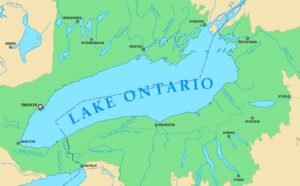
Image Credit: Ontheworldmap.com
About Lake Ontario: Geography, Location and Strategic Importance
- Lake Ontario is the easternmost and smallest of North America’s five Great Lakes, forming the final major lake in the Great Lakes chain before water enters the St. Lawrence River and ultimately reaches the Atlantic Ocean.
- It lies between Ontario province in Canada to the north and New York State in the United States to the south and east.
- Its surface area is approximately 18,960 sq km, while the international boundary passes through the lake between Ontario and New York.
- Its name derives from the Huron-Wendat word Ontari’io, meaning “lake of shining waters“.
- It measures about 193 miles (311 km) long and 53 miles (85 km) wide.
- It has an average depth of 283 feet (86 m) and a maximum depth of 802 feet (244 m).
- It spans 712 miles (1,146 km) of total shoreline.
- Its geographical position gives it exceptional economic and strategic importance.
- Lake Ontario is connected westward through the Niagara River to Lake Erie and eastward through the St. Lawrence River toward the Atlantic.
- The Great Lakes–St. Lawrence system therefore provides an inland waterway linking the industrial heartlands of Canada and the United States with international maritime routes.
- The St. Lawrence system provides nearly 1,200 km of navigable waters connecting the Great Lakes region with the Atlantic.
- It connects to Lake Erie via the Welland Canal to bypass Niagara Falls.
- Lake Ontario is relatively deep despite being the smallest Great Lake by surface area.
- NOAA records its maximum depth at about 802 feet, making it the third-deepest Great Lake, after Lakes Superior and Michigan.
- Its physical characteristics also make it important for freshwater storage, ecosystems, fisheries, recreation and shoreline communities.
- The lake has major urban and industrial significance.
- Important Canadian cities around its basin include Toronto, Hamilton, Kingston and Oshawa, while the American side includes Rochester, Syracuse-area communities and other New York settlements.
- The surrounding Great Lakes–St. Lawrence region constitutes one of the most economically productive areas of North America.
- Canada describes the broader region as an industrial and agricultural heartland of both countries.
- The lake is also significant for navigation, energy and water security.
- Its waters support commercial transportation, municipal water supplies and industrial activity.
- Wolfe Island serves as the largest island in the Lake Ontario, while other prominent local and regional landmasses include Amherst Island, Garden Island, Howe Island, Simcoe Island, and the Toronto Islands.
Trump’s Executive Order: What Exactly Has Been Changed?
- On 27 August 2026, U.S. President Donald Trump signed an executive order titled “Honoring the American History of the Great Lakes and Renaming Lake Ontario as Lake America.”
- The order directs the U.S. federal government to use “Lake America” instead of “Lake Ontario” in federal usage.
- The order instructs the U.S. Secretary of the Interior, working with the U.S. Board on Geographic Names, to take appropriate steps within 30 days to rename the feature in the Geographic Names Information System (GNIS).
- Federal agencies are also directed to reflect the new name on relevant maps, contracts, documents and communications.
- The administration justified the decision through American historical, economic and strategic interests.
- The order claims that the United States has played a major role in protecting the Great Lakes, including through Coast Guard icebreaking and federal investment.
- It states that the United States Coast Guard operates 9 of the 11 icebreaking vessels on the Great Lakes and claims nearly $4 billion of U.S. investment in Great Lakes freshwater protection during the previous decade.
- Trump’s order additionally emphasizes the lake’s importance to American exploration, settlement, commerce and defence, referring to historical military and commercial activity around places such as Oswego and Sackets Harbor.
- It also highlights contemporary shipping, industrial supply chains, energy infrastructure and municipal water use.
- The critical distinction is that the order changes U.S. federal nomenclature, not the physical geography of the lake and not Canada’s official terminology.
Legal Authority and Limits of Unilateral Geographical Renaming
- The most important legal issue is the scope of executive authority. The executive order relies on U.S. presidential authority and directs the Department of the Interior and Board on Geographic Names to alter federal geographic records under the relevant U.S. statutory framework.
- The Board on Geographic Names plays an important role in standardizing geographical names for U.S. federal purposes.
- Consequently, the order can have practical consequences for federal maps, databases, official documents and government communications.
- But an executive order cannot unilaterally impose a geographical name upon Canada.
- Lake Ontario is a shared transboundary water body, and Canada’s geographical authorities continue to recognize Lake Ontario as its official name.
- Canada’s Geographical Names Database records Lake Ontario as an official geographical name.
- This distinction is crucial under international law and state sovereignty.
- The United States exercises jurisdiction over its territory and federal institutions; Canada exercises jurisdiction over its territory and institutions.
- A unilateral administrative decision by one state cannot automatically bind the other state or compel third countries.
- The lake also exists within a much broader framework of Canada–U.S. transboundary water governance.
- The Boundary Waters Treaty of 1909 established mechanisms for preventing and resolving disputes involving shared waters and created the International Joint Commission (IJC).
- The treaty remains a foundational instrument for managing Canada–U.S. transboundary water issues.
- The Great Lakes Water Quality Agreement further demonstrates that the two countries treat the Great Lakes as a shared ecological system requiring cooperation to maintain their chemical, physical and biological integrity.
Canada’s Response: Historical, Indigenous and Diplomatic Dimensions
- Canada’s response has been unequivocal. Prime Minister Mark Carney stated that Canadians would continue to call the water body Lake Ontario.
- The controversy is particularly significant because “Ontario” has Indigenous linguistic origins.
- Reporting on the Canadian and Indigenous response identifies the name as deriving from the Wendat language, with historical interpretations relating to the lake’s beauty or size.
- The Seneca Nation, part of the Haudenosaunee Confederacy, has also condemned the renaming.
- Its response invokes the historical significance of Indigenous relationships with the region and references the 1794 Treaty of Canandaigua.
- Diplomatically, the episode is important because it occurred during an already serious deterioration in Canada–U.S. relations.
US–Canada Relations: Trade War, Geopolitics
- The Lake Ontario controversy cannot be separated from the broader U.S.–Canada trade conflict.
- In August 2026, trade negotiations broke down, followed by new U.S. tariffs and Canadian retaliation.
- The United States imposed 50% tariffs on approximately $20 billion of Canadian goods, while Canada announced retaliatory measures of roughly comparable value.
- The dispute has implications for automobiles, steel, agriculture, energy, manufacturing and supply chains, particularly because the two economies are deeply integrated.
- Canada has also sought greater diversification of its energy exports, with the trade dispute strengthening arguments for expanding access to Pacific markets and reducing excessive dependence on the U.S. market.
- Canada and the United States share the world’s longest international border and cooperate extensively through NATO, NORAD, Arctic security arrangements, energy networks, freshwater management and continental defence.
- Therefore, prolonged economic confrontation can generate consequences for security cooperation and regional geopolitics.
Frequently Asked Questions (FAQs):
1. Did Donald Trump sign an order to rename Lake Ontario?
Yes. Trump signed an executive order on August 27, 2026, directing U.S. federal agencies to use the new name.
2. What new name has been proposed for Lake Ontario?
Trump ordered U.S. federal agencies to refer to Lake Ontario as “Lake America.”
3. Why does Trump want to rename Lake Ontario?
Trump cited American historical, economic and strategic interests, amid escalating trade tensions with Canada.
3. Is Lake Ontario shared by the United States and Canada?
Yes. Lake Ontario is a transboundary Great Lake, bordering Ontario, Canada, and New York, United States.
4. Can the US legally change the name of Lake Ontario?
The U.S. can change its federal geographic usage, but cannot legally compel Canada or other countries to recognize the new name.
5. Has Canada accepted the proposed name change?
No. Canada has rejected the renaming, with Prime Minister Mark Carney affirming that Canadians will continue calling it Lake Ontario.
Disclaimer: Information in this article is based on official announcements and public records. Regulations and implementation details may evolve over time.