



52nd G7 Summit 2026
|
General Studies Paper II: Groupings & Agreements Involving India and/or Affecting India’s Interests |
Why in News?
Prime Minister Narendra Modi will attend the 52nd G7 Summit in Évian‑les‑Bains, France, from June 15–17, 2026, after being invited by French President Emmanuel Macron as India engages on global economy, security and strategic issues.
What Are the Expected Agendas of 52nd G7 Summit 2026?
- Macroeconomic Stability: The G7 Summit is expected to prioritize global macroeconomic stability, addressing rising financial imbalances between the US (high consumption), Europe (low investment), and China (export-led growth).
- Concerns over currency volatility (USD decline, weak Yuan) and risks of a global financial crisis are central.
- Energy Security: A key geopolitical agenda is energy security, especially amid tensions linked to the US–Israel–Iran conflict.
- The Strait of Hormuz, handling nearly 20% of global oil trade, is under focus due to disruption risks. This directly impacts oil prices, inflation, and supply chains, making it a major discussion area.
- Geopolitical Conflicts: The summit will deliberate on ongoing conflicts including Russia–Ukraine war and escalating Middle East tensions.
- Continued financial and military support to Ukraine and managing global instability are priorities.
- Broader concerns include maintaining rules-based international order and preventing escalation into wider conflicts.
- Global Trade: A major agenda is restructuring global trade systems, particularly reducing dependence on China in critical sectors like rare earths and manufacturing.
- G7 nations aim to address trade distortions, market access, and push for China to boost domestic demand while ensuring resilient supply chains.
- Digital Governance: The summit is expected to focus on regulation of emerging technologies such as Artificial Intelligence, quantum computing, and digital infrastructure.
- Discussions may include data governance, cybersecurity, and ethical AI frameworks, reflecting increasing concerns about technological competition.
- Climate Change: Another major agenda is climate action, including clean energy transition, reducing carbon emissions, and addressing climate finance gaps.
- G7 countries will focus on sustainable development, green technology cooperation, and tackling energy shocks linked to geopolitical crises.
- Governance Reform: France’s presidency emphasizes reducing global inequality and reforming global governance institutions. Focus areas include support for developing nations, Africa engagement (e.g., Kenya invitation), tackling illegal financial flows, and building a new multilateral cooperation framework.
What is G7 Summit?
- About: The G7 Summit is an annual meeting of leaders of the world’s most advanced economies to discuss global economic, political, and security issues.
- It is an informal forum, meaning it has no legal authority but high global influence.
- G7 stands for “Group of Seven”, representing seven industrialized democracies.
- It functions as a policy coordination platform, not a formal international organization like the UN, relying on consensus-based decisions.
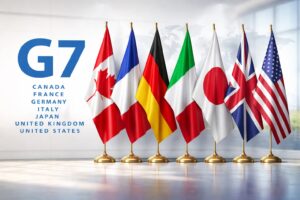
- Member Countries: The G7 includes the United States, United Kingdom, France, Germany, Italy, Japan, and Canada.
- The European Union (EU) also participates as a non-national member, represented by its top leadership.
- Non-Members: The summit often invites guest countries such as India, Brazil, and South Africa, along with organizations like the UN and World Bank, to broaden discussions and include Global South perspectives.
- Formation: The G7 originated after the 1973 Oil Crisis, when leaders of six countries met in 1975 (France) to address economic instability. Canada joined in 1976, forming the G7 structure.
- Russia joined in 1997, creating the G8, but was suspended in 2014 after the Crimea annexation, returning the group to the G7 format.
- Discussion: The summit covers broad global issues, including: Global economy and financial crises, Climate change and energy, Geopolitics and conflicts and Terrorism and human rights.
- Nature: G7 decisions are non-binding and based on mutual agreement (consensus). Outcomes are published as a “Leaders’ Communiqué”, which guides global policy but is not legally enforceable.
- Summit Mechanism: The G7 Summit is held every year, usually in June, hosted by a rotating presidency among member states. The host country sets the agenda, organizes meetings, and leads negotiations.
- Structure: The G7 operates through a multi-layered process, including: Leaders’ Summit, Ministerial meetings (Finance, Foreign Affairs, etc.) and Sherpa Negotiations (policy preparation).
G7 Countries: Economic Significance and Key Achievements
- Economic Significance:
-
-
- Share in Global GDP: The G7 economies contribute 45% of global GDP (2025 estimates) despite having only 10% of the global population, reflecting high productivity and economic dominance in global markets.
- Control over Global Financial Systems: G7 nations dominate key institutions like the IMF, World Bank, and global capital markets, influencing monetary policies, lending norms, and financial stability frameworks worldwide.
- Energy Demand and Supply Leadership: They account for nearly 30% of global energy demand and around 35% of power generation capacity, making them central to energy transition and global energy security debates.
- Carbon Emissions and Climate Responsibility: G7 countries contribute about 25% of global energy-related CO₂ emissions, placing them at the forefront of climate negotiations and decarbonization commitments.
- Technological and Industrial Dominance: The G7 leads in advanced manufacturing, AI, digital economy, and innovation ecosystems, controlling major global supply chains and high-tech industries.
-
- Achievements:
-
- 2002: The G7 supported the creation of the Global Fund (2002), mobilizing billions of dollars to combat HIV/AIDS, TB, and malaria, significantly improving global health outcomes.
- 2009: L’Aquila Food Security Initiative (AFSI) was launched during the 2009 Italy Summit, AFSI pledged $20+ billion to address global hunger, agricultural development, and food security.
- 2021: Initiated at the 2021 UK Summit, Build Back Better World (B3W) aimed to mobilize hundreds of billions in infrastructure investment as a transparent alternative to China’s Belt and Road Initiative (BRI).
- 2022: At the 2022 Germany Summit, Partnership for Global Infrastructure and Investment (PGII) replaced B3W, committing $600 billion by 2027 for sustainable infrastructure, digital connectivity, and climate-resilient projects.
|
India’s Participation in G7
|
|
Also Read: G7 Summit 2025 |