



India Preparedness Amid West Asia Crisis
|
General Studies Paper II: Government Policies & Interventions |
Why in News?
Recently, the Indian government dismissed rumours of a nationwide lockdown amid the West Asia crisis, calling such claims baseless and assured citizens, reaffirming India’s preparedness.
West Asia Crisis 2026
-
- Origin: The crisis began on 28 February 2026 when US and Israel launched “Operation Epic Fury”, conducting nearly 900 airstrikes within 12 hours targeting Iran’s air defence, missile systems, and leadership.
- The strikes reportedly killed Supreme Leader Ali Khamenei and multiple officials, marking a major escalation. Strikes also caused civilian casualties, including attacks on urban areas and a school, leading to over 1,400 civilian deaths.
- The West Asia crisis is rooted in decades of hostility between Iran, US, and Israel, driven by issues like Iran’s nuclear program and ballistic missiles. The collapse of the JCPOA nuclear deal (2015) and rising proxy conflicts intensified tensions.
- Origin: The crisis began on 28 February 2026 when US and Israel launched “Operation Epic Fury”, conducting nearly 900 airstrikes within 12 hours targeting Iran’s air defence, missile systems, and leadership.
- Retaliation: Iran responded with massive missile and drone attacks targeting Israel, US bases, and Gulf countries such as Saudi Arabia, UAE, Bahrain, and Iraq.
- The retaliation included ballistic missiles (like Ghadr/Emad) and large-scale drone warfare, signaling Iran’s capacity for asymmetric warfare across the region.
-
-
- Iran expanded attacks beyond direct enemies, hitting oil infrastructure, military bases, and urban areas across West Asia.
- A major strike on Saudi Arabia’s Prince Sultan Airbase injured US personnel, while attacks reached Oman and Bahrain, indicating a broader regional escalation strategy.
- Iran has threatened or disrupted the Strait of Hormuz, through which nearly 20% of global oil trade passes, causing oil price volatility and global economic uncertainty.
- Expansion: The crisis has evolved into a multi-front war, involving Iran-backed groups like Hezbollah (Lebanon), Houthis (Yemen), and militias in Iraq. These actors are attacking Israel and Western interests, transforming the conflict into a regional conflagration.
- In Lebanon, war between Israel and Hezbollah has caused over 1,000 deaths and displacement of around 1 million people, deepening sectarian tensions and risking state collapse.
- The Red Sea region is again at risk as Houthi rebels threaten attacks on shipping routes like Bab-el-Mandeb. This could disrupt global trade flows between Asia and Europe.
-
- Implication: The war has severely impacted the global economy, causing sharp increases in crude oil prices and instability in financial markets.
- Crude oil prices surged above $110 per barrel, causing inflation globally.
- Flights have been halted, trade disrupted, and supply chains strained.
-
- The conflict has led to mass displacement, civilian deaths, and infrastructure destruction.
- The crisis has triggered global concerns, including risks of nuclear escalation and involvement of major powers.
Impact of West Asia Crisis on India
- Extreme Volatility in Crude Oil Prices: The most immediate impact has been the surge in the Indian Basket of Crude, which hit a three-year high of $118 per barrel on March 15, 2026.
- Since India imports nearly 85% of its oil, every $10 rise in prices widens the Current Account Deficit (CAD) by approximately 0.5% of GDP.
- State-run oil marketing companies have been forced to pause daily price revisions to shield consumers, leading to massive under-recoveries.
- Disruption of Strait of Hormuz: The Strait of Hormuz, through which 60% of India’s crude and 80% of its LNG imports pass, faced a partial blockade on March 10, 2026. This has forced Indian tankers to take longer routes or wait for naval escorts.
- The delay in LNG shipments has already caused a 15% spike in domestic piped natural gas (PNG) prices and impacted the fertilizer industry’s feedstock supply.
- Sharp Decline in Remittance Inflows: West Asia contributes approximately 40% of India’s total remittances, which reached $125 billion in 2025. Due to the war, many Indian blue-collar workers face wage delays or layoffs.
- A projected 12% drop in remittances for the Q1 2026 period is expected to hit consumption-driven economies in states like Kerala, Tamil Nadu, and Uttar Pradesh.
- Pressure on Essential Commodities: The crisis has triggered “imported inflation.” Beyond fuel, the cost of fertilizers and chemicals imported from the region has risen by 22% this month.
- This has pushed the Consumer Price Index (CPI) above the RBI’s upper tolerance band of 6%, reaching 6.8% as of late March 2026. The rising cost of logistics is also trickling down to the prices of FMCG goods and electronics.
- Setback to the IMEC Corridor: The ambitious India-Middle East-Europe Economic Corridor (IMEC), meant to be a rival to China’s BRI, has been effectively put on hold.
- Construction on the rail links in the UAE and Saudi Arabia halted in February 2026 due to security risks. This delay hampers India’s long-term strategy to reduce shipping times to Europe by 40%.
- Trade Deficit and Export: India’s exports to West Asia—primarily Basmati rice, tea, and textiles—have seen a 18% decline in the last 30 days. On March 18, 2026, major insurance providers declared the Persian Gulf a “High-Risk Area,” leading to a 300% hike in war-risk insurance premiums.
- Small and medium enterprises (SMEs) are finding it unviable to ship goods, leading to inventory pile-ups at Mundra and Nhava Sheva ports.
- Gold Reserves and Currency: As a traditional “safe haven,” gold prices in India breached the ₹85,000 per 10 grams mark on March 22, 2026, as investors fled the volatile equity markets.
- Simultaneously, the Indian Rupee (INR) has faced downward pressure, touching a record low of 84.50 against the USD this week. The RBI has had to intervene by selling dollars from its $620 billion reserves to prevent a freefall.
India Preparedness and Actions for West Asia Crisis
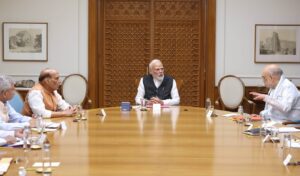
- High-Level Review: Prime Minister Narendra Modi chaired a Cabinet Committee on Security (CCS) meeting on March 23, 2026, to review mitigation plans for energy and trade disruptions. The government has officially urged “restraint, dialogue, and diplomacy” while maintaining a neutral “India First” approach.
- Invocation of Essential Commodities Act: On March 20, 2026, the government invoked the Essential Commodities Act to mandate real-time data sharing by oil and gas firms. This allows the Petroleum Planning and Analysis Cell (PPAC) to monitor granular stock levels and prevent hoarding or black marketing of fuel and fertilizers.
- Seven Empowered Inter-Ministerial Groups: To manage the economic fallout, the Centre established seven new empowered groups focusing on supply chains, fuel, inflation, and energy. This structure mirrors the pandemic response mechanism, ensuring rapid coordination between ministries like Finance, External Affairs, and Petroleum.
- Indian Navy’s Operation Sankalp: The Indian Navy re-initiated and expanded Operation Sankalp to secure merchant vessels. Since December 2023, the Navy has responded to over 90 hostile maritime incidents, including drone and missile attacks, utilizing destroyers and P-8I Neptune surveillance aircraft.
- Under the broader aegis of Sankalp, the Navy launched Operation Urja Suraksha (Energy Security) specifically to escort energy carriers through the Strait of Hormuz. Over five frontline warships are currently deployed to provide a “layered security arrangement” for India-bound tankers.
- Passage of Specific Indian Oil Tankers: Between March 14 and March 25, 2026, several critical vessels safely transited the conflict zone under Navy escort:
- SCI Shivalik and SCI Nanda Devi: Carried 92,700 metric tonnes of LPG from Qatar to Mundra and Kandla ports.
- Jag Vasant and Pine Gas: Escaped the conflict zone carrying 92,612 tonnes of LPG combined.
- Jag Laadki: A crude tanker that departed Fujairah with 80,800 tonnes of oil after a “close call” during port attacks.
- Desh Vaibhav: A Very Large Crude Carrier (VLCC) that transited with transponders identifying it as a “Govt. of India Ship”.
- Strategic Petroleum Reserves (SPR) Status: India maintains 5.33 million metric tonnes (MMT) of strategic crude reserves at Visakhapatnam, Mangalore, and Padur. Currently, these reserves are at 64% capacity (approx. 3.37 MMT), providing a buffer for roughly 9.5 days of national requirement.
- Diversification of Oil Imports: To reduce vulnerability, India has increased its crude oil import partners from 27 countries to 41 countries. This shift aims to minimize dependence on the Strait of Hormuz, which handles nearly 40% of India’s crude imports.
- Excise Duty and Protection: The Ministry of Petroleum has assured stable fuel prices despite global volatility. The government slashed Excise Duty on petrol by ₹10 and diesel by ₹13 in late March, the government has absorbed the impact of $118/barrel Brent crude. This prevents “cost-push inflation,” keeping the Consumer Price Index (CPI) within the RBI’s 4-6% comfort zone despite global turmoil.
- Evacuation and Diaspora Safety: The government has already facilitated the return of 3.75 lakh Indian citizens from the region. Indian missions in the Gulf are in 24/7 contact with the remaining 1 crore diaspora members, issuing safety advisories as the conflict spreads.