



RELIEF Scheme
| General Studies Paper II: Government Policies and Interventions, Development and Growth |
Why in News?
Recently, the Government of India launched a ₹497 crore RELIEF (Resilience & Logistics Intervention for Export Facilitation) Scheme to support exporters affected by the West Asia conflict, protecting India’s export sector stability.
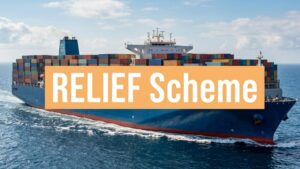
What is RELIEF Scheme?
- About: The RELIEF (Resilience & Logistics Intervention for Export Facilitation) Scheme is a ₹497 crore government initiative, launched on 19 March 2026, to support Indian exporters facing disruptions due to the West Asia conflict.
- Objective: The primary aim is to stabilize exports, prevent order cancellations, and protect India’s global market share, especially in Gulf and West Asia trade corridors.
- Framework: It is implemented under the Export Promotion Mission (EPM) using provisions of the Foreign Trade (Development and Regulation) Act, 1992 and aligned with Foreign Trade Policy 2023.
- Implementing Agency: The scheme is executed through the Export Credit Guarantee Corporation (ECGC), which handles insurance coverage, claim settlement, verification, and monitoring of exporter support.
-
- Coverage: The scheme covers exports to countries like UAE, Saudi Arabia, Qatar, Oman, Kuwait, Iraq, Iran, Israel, and Yemen, focusing on small exporters and vulnerable sectors.
- Operational Support: The government has waived storage and dwell time charges at ports for stranded cargo. An Inter-Ministerial Group (IMG) meets daily to coordinate these logistics relaxations and monitor supply chain resilience.
- Components:
- Existing Exports: The first component (₹56 crore) provides 100% risk insurance coverage and deadline extensions for shipments between 14 Feb–15 March 2026, including export obligation extensions till 31 August 2026.
- Future Shipments: The second component (₹159 crore) supports upcoming exports from 16 March–15 June 2026, offering up to 95% risk coverage with pre-conflict insurance premiums, encouraging continued trade.
- MSME Support: The largest component (₹282 crore) targets MSME exporters, providing up to 50% reimbursement of increased freight and insurance costs, with a cap of ₹50 lakh per exporter.
Impact of West Asia Conflict on India Exports
- Trade Exposure Risk: India has strong trade dependence on West Asia, exporting nearly $50 billion (Apr–Dec 2025)—about 15% of total exports. Ongoing conflict threatens up to $4 billion monthly shipments, creating significant uncertainty for exporters.
- Freight Cost Surge: Shipping costs have increased sharply, with freight rates rising 3–5 times and containers costing around $1,500+ per unit. Rerouting via the Cape of Good Hope has increased transit time by 3–7 weeks, reducing export competitiveness.
- Insurance Premium Burden: War-risk insurance premiums have surged significantly, increasing export costs. Exporters face higher financial risks and reduced profit margins, forcing many small firms to delay or cancel shipments due to unaffordable coverage.
- Logistics Disruptions: Key trade routes like the Strait of Hormuz face disruptions, affecting shipping and air cargo. Export cargo from one Indian airport dropped 37%, with losses of ₹2–5 lakh per exporter in weeks, highlighting severe logistics breakdown.
- Sector Specific Losses: Sectors like coffee, agriculture, and perishables are worst affected. Coffee freight costs rose from $578 to $3,800 per container, increasing nearly 6 times, leading to reduced exports and price volatility in global markets.
- Supply Chain Disruptions: Export-oriented industries face input shortages due to energy disruptions. Over 55% of India’s crude imports come from West Asia, and supply shocks are affecting production and export capacity, especially in MSME sectors.
- Macroeconomic Impact: Rising oil prices ($83–$100 per barrel) increase logistics costs and inflation, reducing export demand. Experts estimate a 15–40 basis points impact on GDP growth, indirectly weakening India’s export performance and global competitiveness.
Economic Importance of RELIEF Scheme
-
- Boost to Export Targets: The scheme directly supports India’s ambition of achieving $2 trillion exports by 2030 under Foreign Trade Policy 2023. By preventing shipment disruptions, it sustains export growth momentum required for 14% annual growth, crucial for meeting long-term trade targets.
- GDP Growth Support: Exports contribute around 21.9% of India’s GDP (2023), making them a critical growth driver. By reducing export shocks during crises, the scheme helps maintain GDP stability and foreign exchange inflows.
- Trade Deficit Control: India faces a persistent trade deficit (over $80 billion in FY2025 estimates). The scheme ensures continuity of exports despite disruptions, helping reduce current account pressure and supporting currency stability during global uncertainties.
- Global Value Chain Integration: By ensuring uninterrupted supply during geopolitical crises, the scheme helps Indian exporters remain competitive against countries like Vietnam and China, supporting long-term goals of becoming a global manufacturing and export hub.
- Sectoral Export Expansion: High-growth sectors like electronics ($22+ billion exports in FY2026) and pharmaceuticals ($25+ billion exports) depend on stable trade conditions. The scheme safeguards these sectors, helping India move toward a manufacturing-led export economy.
- Employment and Industrial Output: Export sectors such as textiles, engineering goods, and agriculture employ millions. The scheme prevents production slowdown caused by rising costs, protecting jobs and industrial output, especially in export-driven clusters like Gujarat, Maharashtra, and Tamil Nadu.
About West Asia
|
| Also Read: Bharat Audyogik Vikas Yojna (BHAVYA) |