




Horse-Trading in Politics
| General Studies Paper II: Transparency & Accountability, Ethics in Private & Public Relationships |
Why in News?
Recently, Opposition MPs alleged widespread horse-trading and power misuse by the ruling party following Rajya Sabha Election 2026 results, citing unfair practices.
What is Horse-Trading in Politics?
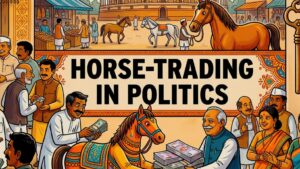
- About: Horse-trading in politics refers to the unethical practice of inducing elected representatives (MLAs/MPs) to switch loyalties through money, power, or positions to influence government formation or survival. It typically involves “buying and selling legislators” to secure a majority in legislatures.
- Origin: The term originates from 19th-century horse markets, symbolizing shrewd bargaining and manipulation. It carries a negative connotation of unethical negotiations aimed at gaining advantage.
-
-
- The phenomenon became prominent after the 1967 elections, especially with the famous “Aya Ram, Gaya Ram” episode in Haryana, where frequent defections symbolized political opportunism and instability.
- Causes: It is most common in situations of hung assemblies or coalition politics, where no party has a clear majority. Political instability creates incentives for parties to poach legislators to form governments.
- Horse-trading is closely linked to defection, where legislators switch parties for personal gain. Between 1967–1969, over 1500 defections were recorded in India, highlighting the scale of the issue.
- In some instances, citizens prioritize immediate economic benefits offered by politicians over political stability.
-
- Legal Framework: To curb this, India introduced the Anti-Defection Law (1985) under the Tenth Schedule, disqualifying members who defect or violate party whip. However, loopholes like mass defections and resignations limit its effectiveness.
-
- It was strengthened by the 91st Amendment Act in 2003 to combat political instability, especially after hung assemblies. The power to decide on disqualification petitions is vested solely in the Speaker or Chairman of the House.
- The Supreme Court clarifies that “voluntarily giving up membership” under the Tenth Schedule extends beyond formal resignation.
- The Governor can call for a floor test (trust vote) if they feel the government has lost its majority. If no party has a clear majority, the Governor has discretion to invite a leader to form a government.
Supreme Court Landmark Rulings:
|
Challenges Posed by Horse Trading
- Government Collapse: Horse-trading creates unstable governments. Data shows that between 1967–1971, 32 state governments collapsed due to defections linked with such practices. This leads to repeated elections, administrative delays, and weak policy continuity.
- Mass Defections: India witnessed 1,969 MLA defections and 142 parliamentary defections in a short period after 1967. This large-scale switching created political chaos, where loyalty shifted frequently, making governance unpredictable and unstable.
- Rise of Money Power: Horse-trading increases the use of black money and illegal inducements. Reports have highlighted offers as high as ₹10 crore to individual MLAs to switch sides. This shows how financial power dominates democratic processes, weakening fairness.
- Weakening of Political Parties: Frequent defections weaken party structures. Data shows 120 MLAs changed parties since 2018, with many moving to ruling parties. According to ADR, nearly 45% of defectors between 2016 and 2020. This reduces party discipline and ideological commitment, turning parties into power-driven groups.
- Distortion of Representation: Horse-trading turns elected representatives into “tradable assets”, where seats are treated like commodities. This distorts representation, as leaders act for personal gain instead of public interest, undermining democracy.
- Public Distrust: Continuous defections create loss of public trust. Studies show it leads to political apathy, where citizens feel their votes do not matter. This reduces participation and weakens the foundation of a healthy democracy.
Reforms Implemented to Stop Horse-Trading
-
- Removal of the Split Rule: The 91st Constitutional Amendment (2003) removed a major loophole that allowed “one-third” of a party to split without penalty. Now, at least two-thirds of the members must agree to a merger with another party to avoid disqualification. This change stopped small groups of MLAs from selling their support easily.
- Ceiling on Cabinet Size: The 91st Amendment also fixed the number of ministers at both the Union and State levels. The Council of Ministers cannot exceed 15% of the total strength of the House. This rule prevents parties from bribing defectors with “ministerial berths”.
- Bar on Political Office: A member disqualified for defection is now barred from holding any remunerative political post. This ban lasts for the remainder of their term or until they are re-elected. It ensures that a defector cannot immediately become a Minister or head a state board after betraying their party.
- Time-Bound Floor Tests: To prevent long periods of horse-trading, the Supreme Court now frequently orders immediate “Floor Tests”. Courts often mandate that these tests be video recorded and completed within 24 to 48 hours. This leaves no time for parties to “poach” rival MLAs in luxury resorts.
- Electoral Funding Reforms: The government introduced electoral funding reforms like Electoral Bonds (2018) to reduce cash-based political corruption. The aim was to shift donations to banking channels, improving transparency and traceability of funds used in political deals.
Proposed Reforms: Recommendations from the Law Commission and various committees suggest that disqualification cases should be decided by the President or Governor based on the Election Commission of India’s (ECI) advice.
|
| Also Read: ADR Report on Registered Unrecognised Political Parties in India |